






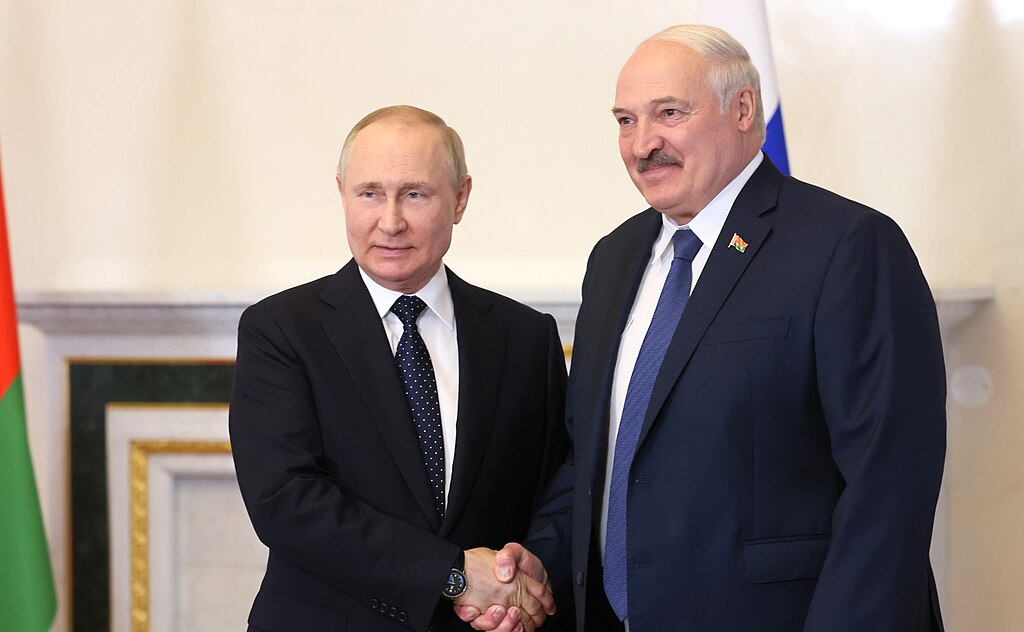
Even the most isolated authoritarian regimes cannot survive completely on their own. North Korea may be the model pariah state, but it still relies on allies – like China and Russia – to provide basic goods like raw materials and food. Still, as every good dictator knows, there’s no such thing as a free lunch. In one recent example, Russia secretly transferred over a million barrels of oil to North Korea, from March-November 2024. And North Korea reportedly sent around 10,000 troops to fight on the Russian side in Ukraine.
Mutually beneficial exchanges between autocrats are commonplace. This phenomenon, which I call “authoritarian backscratching,” can help boost regime stability. But these moves also pose a serious threat to democracies across the globe – as much as the more commonly studied phenomenon of democratic backsliding. And dictators’ interests aren’t always aligned. When these interests clash, there are still places authoritarian backscratching can’t – or won’t – reach.
What is authoritarian backscratching, exactly?
Authoritarian backscratching refers to the symbiotic ways in which dictators advance their interests by pursuing policies that benefit the other. Sometimes this quid pro quo is explicit. For example, in 2000 Venezuela and Cuba signed a bilateral agreement stipulating that Caracas would sell its oil at a reduced price. In return, Havana agreed to send doctors to Venezuela. At other times, dictators engage in implicit backscratching. Here’s an example: In 2022, Chinese state media parroted Kremlin talking points about NATO responsibility for the war in Ukraine. Yet there was no evidence of formal coordination between Chinese and Russian media on this issue.
Pursuing policies that advance a common interest is only part of the backscratching phenomenon, however. Dictators also get involved in matters about which they might otherwise be ambivalent – or even oppose – with the expectation that their autocratic counterpart will “scratch their back” in the future. In 1968, for instance, Fidel Castro reluctantly condemned the Soviet invasion of Czechoslovakia, describing the Soviet actions as a “bitter necessity.” And when Russia invaded and annexed Crimea in 2014, China maintained a “neutral” position, refusing to explicitly condemn Putin’s actions. Beijing, however, stopped short of officially recognizing the annexation.
Backscratching differs from other concepts, such as authoritarian linkage and diffusion. Autocratic linkage, as theorized by Tansey et al. (2016), is a broader idea that captures not just mutually beneficial policies, but also trade volume, migration, and geographic distance. And not all of these are the direct result of quid pro quo policymaking. Authoritarian diffusion, in the words of Ambrosio and Tolstrup (2019), is “the process by which the institutions, organizations, policies, strategies, rhetorical frames, norms, etc., which establish, protect, or strengthen authoritarian rule, are reproduced from one authoritarian system to another.” Diffusion involves conscious learning and mimicry across dictatorships, but also the inadvertent spread of strategies from one regime to another. The term “authoritarian backscratching,” in contrast, emphasizes reciprocal, back-and-forth, deliberate interactions between two (or more) regimes.
Authoritarian backscratching can take many forms. Some are material: preferential trade policies, shipments of natural resources or weapons, assistance evading sanctions – even sending mercenaries to fight in foreign conflicts. Autocrats also support each other symbolically, e.g., through U.N. voting patterns and by repeating each other’s propaganda points.
Russia-Belarus relations offer a good case study
Why do dictators scratch each other’s backs, even when they don’t have an obvious interest in doing so? It’s not because they are altruistic – quite the opposite. After all, an autocrat’s ultimate goal is to maintain power. Accumulating favors with fellow dictators is one way to prepare for future needs, like stashing coins in a piggy bank for a rainy day. The Russia-Belarus relationship is one concrete example.
The relationship between Russia and Belarus is a classic case of authoritarian backscratching. Indeed, a 2023 Washington Post article used this very metaphor, noting that Belarusian dictator Alexander Lukashenko (also transliterated as Alyaksandr Lukashenka) and Russian dictator Vladimir Putin “have a habit of scratching each other’s backs.”
Lukashenko, who has been in power in Belarus since 1994, is often called “Europe’s last dictator.“ In fact, Lukashenko has ruled for six years longer than Putin, who was elected president of Russia in 2000. Belarus’s Freedom House score, a way to measure access to political rights and civil liberties, was 7/100 last year – even lower than Russia’s 12/100 score. A Trump administration envoy recently negotiated the release of former opposition leader Siarhei Tsikhanouski, but an estimated 1,000 or more political prisoners remain behind bars in Belarus.
After Russia invaded and annexed Crimea in 2014, Lukashenko was cautious about taking sides. But the two dictators have engaged in considerable backscratching in recent years. Moscow provided crucial rhetorical and logistical support to the Lukashenko regime in 2020, when election fraud triggered mass protests that threatened to unseat the Belarusian dictator. In 2022, Belarus served as the staging ground for Russia’s full-scale invasion of Ukraine. Russian troops then crossed the border, heading towards Kyiv, while Russian missiles launched from Belarusian territory.
The relationship between Putin and Lukashenko is uneven. Lukashenko’s survival depends on Putin’s backing – at least since 2020 – but the converse is not true. Yet Putin still relies on Lukashenko to control Belarus, whose territory has become an essential part of Russia’s campaign against Ukraine.
The limits of backscratching
We should observe authoritarian backscratching most often in areas where the interests of the dictators in question converge. Backscratching is also likely to occur when one dictator stands to benefit and the other can help at little cost. But when their interests explicitly conflict, backscratching should be much more limited. At the end of the day, it’s every autocrat for himself; no rational dictator would deliberately put another’s interests before his own.
This likely explains why Lukashenko has not committed troops to Putin’s war effort: The domestic costs are too great. The North Korean regime, on the other hand, rules a population with less information about Ukraine and fewer personal ties to Ukrainians. North Korea is also in a more precarious economic and geopolitical position, so currying favor with Russia promises greater benefits.
Why backscratching is a threat
The concept of democratic backsliding has received much research attention in political science – along with considerable debates over the extent of the problem. To be sure, the erosion of democracy across the globe, including in the United States and Europe, is concerning. But this challenge also has a flip side: the strengthening of autocratic regimes, in part through the kind of quid pro quo politics I described above. The favors Russia has accumulated over the past three years of war in Ukraine – from Belarus, North Korea, and others – have allowed the Kremlin to continue its war despite fierce Ukrainian resistance. Meanwhile, Russia’s imports of weapons and troops from Pyongyang strengthens the Kim regime in the face of crippling international sanctions – and simultaneously exposes North Korean soldiers to modern warfare tactics.
One encouraging note is that diverging interests and limited capabilities impose constraints on authoritarian backscratching. We can only hope that the world’s dictators don’t learn how to put aside their differences any time soon.
Isabelle DeSisto is a 2025-2026 Good Authority fellow. This article was inspired by a grad school course paper, regrettably never published, which she wrote with Yingjie Fan on Russian and Chinese propaganda in the context of Russia’s war against Ukraine. She would like to thank Yingjie for the inspiration she provided for this piece.

_03.jpg)