







In 1926, 10-year-old Felícita Gómez Martínez and her family left their home in Puerto Rico to move to the United States. Recruited to work in the cotton fields of Arizona, the family was part of a large group of Puerto Ricans hired to address labor shortages in the Southwest. These shortages were partly due to the growing number of urban factories competing for workers, and undermining agricultural employers. But the 1924 Johnson-Reed Act, which severely restricted immigration from European and Asian nations, also caused acute U.S. labor shortages. When the impact of this legislation made it harder to find workers, farmers across the Southwest shifted their focus first to Puerto Rico and then to Mexico to fill labor shortages.
Felícita would later play a key role in one of the most significant stories of the 20th century. Her life story represents the myriad unforeseen consequences of using immigration policy to shape the racial and ethnic demographics of the United States. But understanding these developments requires a deeper understanding of the historical currents that brought her family to the U.S. in the first place. These currents continue today – contributing to unpredictable political futures.
Immigration and American racialization projects
Americans today are witness to one of the largest immigration enforcement escalations of the past few decades. How do the overt racial tones and motivations behind current immigration policy tie into the policies of the past? The politics over Mexican and Latin American immigration today are not just a reflection of the same apprehensions over previous immigrant groups – in fact, current immigration politics are their direct result. Each generation of Americans pushes the federal government to restrict the “undesirable immigrants” of their time. And this then opens the door to new groups and new political cleavages for the parties to exploit for electoral advantage.
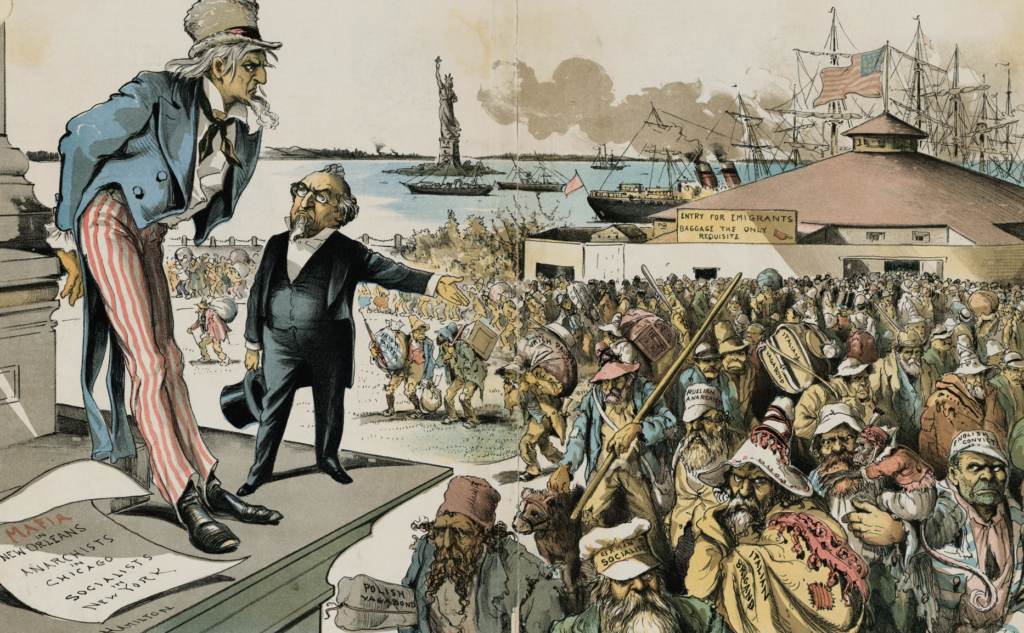
Just 100 years ago, America’s “immigration problem” centered around Italians, Russians, Polish, and others looking to escape political and economic turmoil across Europe. Political cartoons from the era – like the examples below – portrayed these groups as dehumanized vermin, and a threat. This was the same era that saw the emigration of President Donald Trump’s mother from Scotland and Governor Ron Desantis’ great-great-grandmother from Italy. In the 1920s, many Americans saw new immigrants as biologically unworthy of U.S. life and citizenship. Anti-immigrant politicians and groups accused these immigrants of bringing crime, disease, and anti-American cultures into the United States.
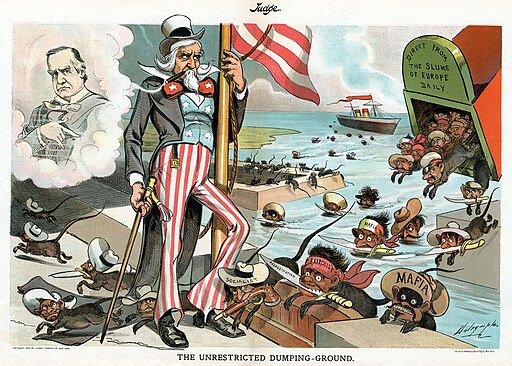

This process of “racializing” immigrants – portraying them as biologically different and inferior – to maintain political and social benefits for white Americans was not new. In the 19th century, German, Irish, Chinese, and Japanese immigrants had also been subjects of political racial projects. Federal and state politicians of the time used immigration policy to engage in explicit racial politics. Racist and eugenic language was rife throughout congressional and public speeches. In his 1906 address to Congress, President Theodore Roosevelt spoke directly about the dangers of the racism faced by Japanese and Japanese Americans, and the need to treat immigrants fairly.
The unanticipated long tail of immigration restrictions
In the 19th century, diplomacy and legislation curtailed the arrival of Chinese immigrants and other targeted groups. In the 20th century, the federal government’s political focus shifted to Jewish, southern European, Russian, and Polish immigrants. Congress empowered the Dillingham Commission in 1907 to undertake the first national investigation of immigration and immigrants in the United States. The leader of the commission, Jeremiah Jenks, publicly described its racial focus, “What is the problem of immigration? Most of us have something like a race feeling, to put it another way, we have a racial prejudice.” The individual commissioners may have disagreed on the nature of biological racism. But the commission was certainly attuned to the race-related feelings of the U.S. public and politicians.
The proposals in the Dillingham Commission’s extensive 1911 report made their way into federal legislation, culminating in the national quota system in 1921, tying yearly immigration numbers to each group’s existing population size. When these quotas didn’t restrict enough southern and eastern Europeans, the Johnson-Reed Act made sure to adjust the equation to guarantee more northern Europeans and British entry. Again, the authors of this legislation were perfectly clear in their racial motivations. Senator David Reed (R-Pa.) wrote in the New York Times in 1924:
Beginning about 1885, new types of people began to come. For the first time in our history men began to come [in] large numbers from Italy, Greece, Poland, Turkey in Europe, the Balkan States and from Russia…who want neither to learn our common speech nor to share our common life…. From all this has grown the conviction that it was best for America that our incoming immigrants should hereafter be of the same races as those of us who are already here, so that each year’s immigration should so far as possible be a miniature America….
The aftermath of the 1924 racial quotas: a Latino century
Some members of Congress wanted the 1924 Act to include restrictions on Mexican and Central American immigrants. But the new quota system excluded these immigrants, in part due to concerns about the economic effects in the Southwest and foreign relations with Mexico. Efforts to restrict Mexicans continued in Congress until at least 1930. The Great Depression and Democratic control of the House then largely ended debate on quotas for the Western hemisphere. The politics of Mexican and other Latino immigration would swing back and forth between World War II and the Cold War, culminating in the 1965 Hart-Cellar Act, a definitive refutation of the 1920s racial quota system. A new era of Latino-centered immigration politics, initiated in large part by European racial quotas, was well underway.
And this brings us back to Felícita Gómez Martínez. Felícita’s family quickly made their way to California after protesting their treatment in the Arizona cotton fields, where recruiters had made false promises to attract farm workers. In California, she met her husband Gonzalo Mendez, a naturalized Mexican American citizen, in 1936. In the 1940s the Mendez family rented a farm from a Japanese family that had been forced into an internment camp after the attack on Pearl Harbor – an attack that some speculate had small roots in the 1924 act itself. It was from this farm community that Felícita and Gonzalo successfully challenged and ended California’s public school segregation in Mendez vs. Westminster 1947, widely considered the state-level precursor to the Supreme Court’s Brown vs. Board of Education ruling in 1954. Just 21 years after leaving Puerto Rico, Felícita, Gonzalo, and their daughter Sylvia Mendez played a significant role in transforming the entire country. Their journey, a consequence of the 1924 law designed to maintain a racially static nation, led to an unanticipated explosion of demographic diversity, educational equality, and racial and ethnic inclusion few could have foreseen.
Stay tuned! In a second post, we will explore in detail how U.S. immigration policy transformed during the Cold War and the Civil Rights era, culminating in a period of bipartisan immigration acceptance America had never witnessed before.
Eric Gonzalez Juenke is a 2025-2026 Good Authority fellow.