





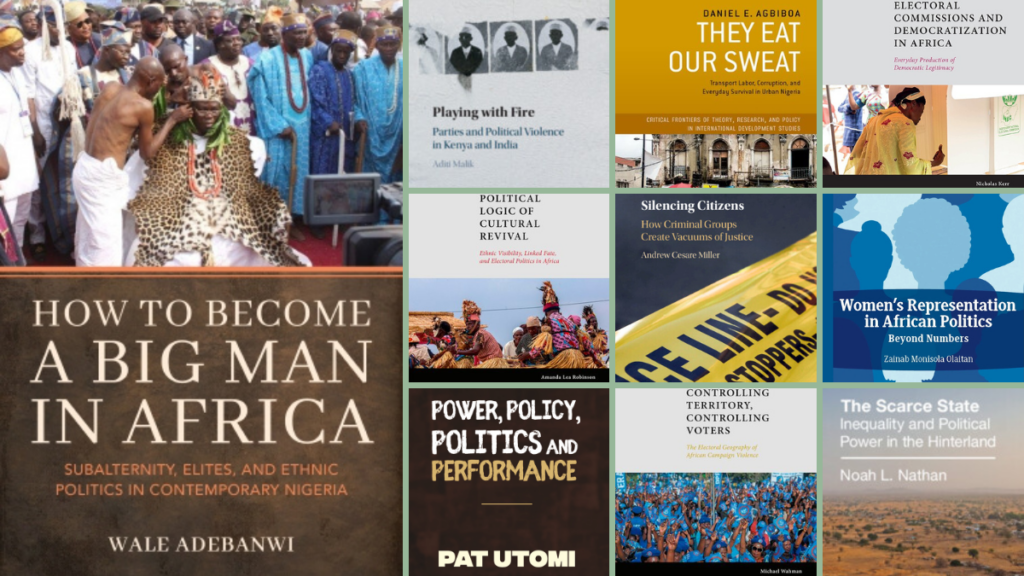
Africa’s political landscape is as dynamic as it is diverse. This post revives the spirit of the “African Politics Summer Reading Spectacular,” an annual reading list of recently published books in African politics that we recommend to our readers.
From the inner workings of electoral commissions to the street-level experiences of transport workers, from cultural revivalism to party-led violence, this year’s books offer sharp, grounded insights into the continent’s evolving democratic journeys.
Whether you’re a researcher, student, policymaker – or simply curious about the forces shaping power and policy in Africa – these recent books provide tools to think more critically about politics on the continent.
1. How to Become a Big Man in Africa: Subalternity, Elites, and Ethnic Politics in Contemporary Nigeria, by Wale Adebanwi (Indiana University Press, 2024)
Main argument: Adebanwi examines the rise of Gani Adams, a former vigilante leader who became a prominent political figure in Nigeria. The book analyzes how ethnic identity, grassroots mobilization, and informal networks contribute to the emergence of “Big Men” in African politics.
Why read it: Through an in-depth ethnographic study, the book sheds light on the dynamics of power, legitimacy, and social mobility in Nigeria, offering broader implications for understanding political leadership in Africa.
2. Playing with Fire: Parties and Political Violence in Kenya and India, by Aditi Malik (Cambridge University Press, 2024)
Main argument: Malik compares the role of ethnic political parties in instigating violence in Kenya and India. She argues that party structures and strategies significantly influence the likelihood of political violence, especially in ethnically diverse societies.
Why read it: Malik’s book enhances our understanding of how party politics can both mitigate and worsen conflict in multiethnic democracies.
3. They Eat Our Sweat: Transport Labor, Corruption, and Everyday Survival in Urban Nigeria, by Daniel E. Agbiboa (Oxford University Press, 2022)
Main argument: Agbiboa studies the daily experiences of transport workers in Lagos, revealing how systemic corruption and informal practices shape their livelihoods. He argues that corruption is not merely a top-down phenomenon but is embedded in the everyday survival strategies of urban dwellers.
Why read it: The book provides a compelling ethnographic account of how corruption operates at the grassroots level, offering insights into the challenges of governance and accountability in urban Africa.
4. Electoral Commissions and Democratization in Africa: Everyday Production of Democratic Legitimacy, by Nicholas Kerr (Oxford University Press, 2024)
Main argument: Kerr explores the role of electoral commissions in fostering democratic legitimacy in Africa. He argues that these institutions are not just administrative bodies but are central to building public trust and ensuring credible elections.
Why read it: The deep dive into the operations of electoral commissions offers valuable perspectives on the institutional foundations of democracy across Africa.
5. Women’s Representation in African Politics: Beyond Numbers, by Zainab Monisola Olaitan (Palgrave MacMillan, 2024)
Main argument: Olaitan examines the effectiveness of gender quotas in enhancing women’s political representation in Africa. She argues that while quotas have increased the number of women in political offices, that has not necessarily translated into substantive policy changes addressing women’s issues.
Why read it: The book provides a critical analysis of gender equality initiatives in African politics – particularly the experiences in South Africa and Botswana – highlighting the need for more comprehensive approaches to women’s empowerment.
6. Controlling Territory, Controlling Voters: The Electoral Geography of African Campaign Violence, by Michael Wahman (Oxford University Press, 2024)
Main argument: Wahman explores how some parties strategically deploy political violence during African election campaigns to control territories and influence voter behavior. He emphasizes that such violence is not random but is often concentrated in areas where political competition is intense and government institutions are weak.
Why read it: This book offers an understanding of the spatial dynamics of electoral violence, providing valuable insights not only for scholars and policymakers focused on electoral integrity and conflict prevention in Africa. Wahman’s book will also be relevant to activists, journalists, and citizens who care about fair elections and peaceful political processes.
7. The Political Logic of Cultural Revival: Ethnic Visibility, Linked Fate, and Electoral Politics in Africa, by Amanda Lea Robinson (Oxford University Press, 2024)
Main argument: Robinson studies how cultural revivals are used as political tools to enhance ethnic visibility and solidarity, influencing electoral outcomes. She focuses on the Lhomwe revival in Malawi to illustrate how political elites seek to mobilize cultural identity for political gain.
Why read it: The book offers a fresh perspective on the intersection of culture and politics in Malawi, demonstrating how identity politics can shape democratic processes.
8. Silencing Citizens: How Criminal Groups Create Vacuums of Justice, by Andrew Cesare Miller (Cambridge University Press, 2024)
Main argument: Miller explores how criminal organizations undermine government authority by creating “justice vacuums” in areas where formal legal systems are weak. These groups set up their own systems to enforce rules, which deeply affects how people view and trust the government.
Why read it: The book provides insights into the challenges of state-building and establishing the rule of law in contexts where individuals and groups operating outside of formal government channels – such as criminal organizations, militias, and insurgent networks – wield significant power.
9. The Scarce State: Inequality and Political Power in the Hinterland, by Noah L. Nathan (Cambridge University Press, 2024).
Main argument: Nathan challenges the conventional wisdom that African governments are uniformly weak, especially in the hinterland. He argues that in areas where the state’s presence is limited, political power and inequality are negotiated through local institutions and groups, leading to different experiences of authority and order.
Why read it: This book offers a nuanced analysis of state capacity and political inequality in Ghana’s hinterlands. It received the African Politics Conference Group’s Best Book Award in 2024.
10. Power, Policy, Politics, and Performance, by Patrick Utomi (Bookcraft, 2025)
Main argument: Utomi explores how political power, policymaking, and government performance interact in Nigeria. He argues that the success of policies depends on the strength of political leadership and how well government systems are organized.
Why read it: Using Nigeria as a case study, this book offers a sharp look at the real challenges governments face across Africa when trying to put policies into action. It is a valuable guide for anyone wanting to understand why good ideas sometimes struggle to deliver results.
Kelechi Amakoh is a 2025-2026 Good Authority fellow.