







The 2026 midterms give Democrats an obvious opening with President Trump’s unpopularity over high prices and a poorly conceived conflict in the Middle East. And they can expect the typical midterm pattern to work in their favor: The president’s party nearly always loses ground in midterm elections. So Democrats may reasonably hope to gain quite a few seats in 2027.
But victories for both parties have recently been short-lived. In 2016 Republicans won unified control of the federal government, but in 2018 Democrats took the House. Democrats did well in 2020, but Republicans won back the House in 2022 with a narrow 4-seat margin. And Trump returned to the White House in 2024 with majorities in both the House and Senate.
Our research suggests one reason for this pattern. The two parties have built distinct issue packages. We often refer to these packages collectively as “liberal” or “conservative” ideologies, but voters do not accept those ideological packages all at once. Each party now faces a different kind of mismatch between its coalition and the positions it routinely emphasizes.
Political scientists have long argued about whether ordinary Americans are ideological. If ideology means a fully developed philosophy of politics, then most Americans are not ideological. They do not build every policy opinion from first principles, and most do not think about politics like political theorists, activists, or elected officials do. But voters can recognize party signals. They know that support for a border wall usually points toward one party, while support for universal health care points toward the other, and they can make those associations across many issues. However, knowing this information does not mean that voters also adopt these issue baskets wholesale for themselves.
How we did our research
Using survey data from the Cooperative Election Study, we identify two kinds of issues. The first are longstanding governing issues that have structured national party conflict for decades: taxes, spending, health care, environmental regulation, guns, defense, and the size of the federal government. The second are identity and culture fights that have become more central to partisan debate in recent years: immigration, border walls, voter ID requirements, racial bias, school curriculum, transgender athletes, COVID mandates, free speech on social media, and related disputes. We do not mean that every issue in the second group is new. Immigration, for example, has a long history in American politics. Our point is that these issues now occupy a newer place in the parties’ public rhetoric.
Americans do not respond to these two sets of issues in the same way.
The issues that voters agree on – and the issues that test party loyalty
Republicans look stronger and more united on these newer issues. Across education groups, Republican voters tend to support conservative positions on immigration, voter ID, school curriculum, COVID restrictions, transgender athletes, and similar questions. These issues hold the Republican coalition together. But on longstanding economic and government issues the survey data show that the public, including many Republican voters, generally sides more often with Democrats.
Democrats face the reverse problem. Their voters are comparatively unified on longstanding economic issues and generally support more spending on health care, education, environmental protection, and aid to the poor, all positions that are popular with the public. But Democrats are divided on identity and culture issues, especially by race. Nonwhite Democrats are hardly conservatives. Yet they are more moderate and internally varied than many white progressive activists assume. That gives Republicans an opening to win votes.
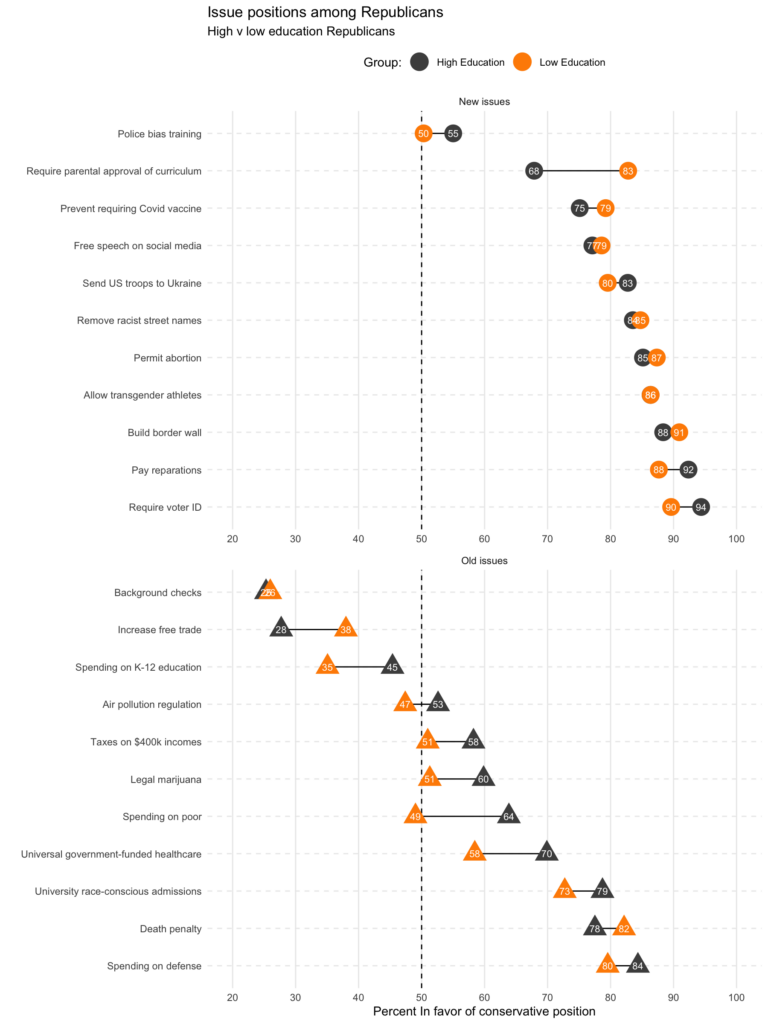
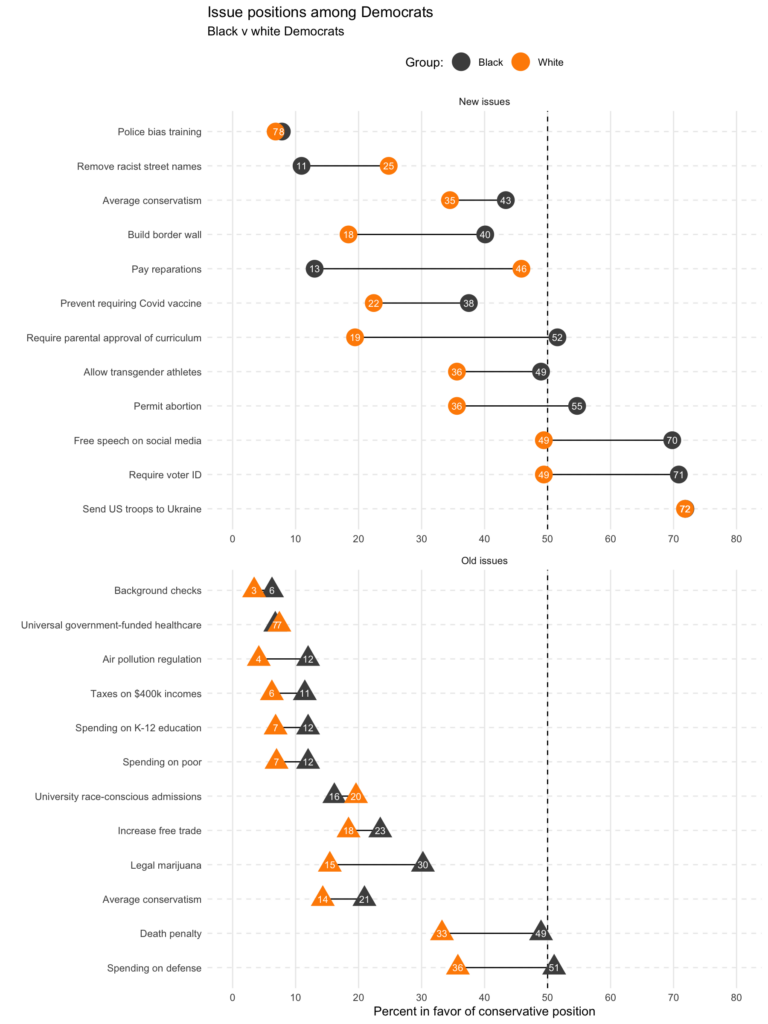
The figures below show this pattern directly. Each point reports the share of a party subgroup that takes the conservative position on a given issue. Points to the right of the 50% line show issues where a majority of that group supports the conservative position. The top panels show newer identity and culture issues, while the bottom panels show older issues.
We focus on education among Republicans and race among Democrats because the division around those specific issues reveal the main stress points inside each coalition. Among Republicans, identity and culture issues produce broad agreement across education groups. Republicans with and without college degrees are very conservative on most of these questions. Some gaps remain, especially on school curriculum, but the basic pattern holds. On longstanding governing issues, shown in the bottom panel, Republicans are less conservative and the coalition is more divided. The older small-government agenda does not bind the Republican coalition as tightly as cultural conflict does.
The Democratic figure shows the mirror image, but for race. On longstanding economic and government issues, both Black and white Democrats usually cluster on the liberal side. Identity and culture issues divide Democrats more sharply. Black Democrats are clearly more conservative than white Democrats on school curriculum, voter ID, free speech on social media, and other issues. Some race-specific issues cut differently. Black Democrats are much less conservative than white Democrats on reparations and removing racist street names. Still, the overall pattern shows far more variation on identity and culture issues than a simple left-right account would suggest.
Each party has a preferred battlefield
Taken together, the figures help explain why both parties can look both strong and weak at the same time. Republicans have a clear cultural advantage. Democrats have the advantage on longstanding economic issues, where their coalition is more unified and closer to the general public’s broad preferences. But neither party’s voters are uniformly behind its full issue package.
How does this play out in elections? Democrats want elections centered on economic policy, while Republicans want contests about identity and culture. Each party can win when U.S. politics moves onto its own terrain. But neither party can keep things there for long, because in our political environment parties do not control the agenda by themselves.
Governing forces Republicans to make choices about budgets, taxes, and spending, which can expose their older coalition divisions. Governing Democrats can face the same problem on different terrain because opponents, advocacy groups, and news events can push schools, immigration, race, and gender issues into national politics. The out-party has a strong incentive to make the in-party fight on ground where its own voters disagree.
That’s why the 2026 election will be easy to overread
In November, Democrats will very likely gain seats for all the usual midterm reasons, and because long-standing economic issues, especially rising prices, are salient right now. But those gains are unlikely to signal a new and durable coalition.
The broader lesson is that voters are neither blank slates nor perfect partisan loyalists. They recognize the signals parties send, but many voters do not buy the entire party package. Some Republicans like the cultural message but hesitate over the older small-government agenda. Some Democrats like the economic message but are less comfortable with newer cultural fights.
When the agenda shifts, these voters can move, stay home, or vote reluctantly. That dynamic produces a strange mix of volatility and stagnation in American politics. Power changes hands frequently, but margins stay narrow. American politics will keep producing close elections, frustrated voters, and victories that disappear almost immediately.
Jeremy C. Pope is a professor in the Department of Political Science at Brigham Young University and a Constitutional Government Fellow at the Wheatley Institution. He also serves as a co-director for the Cooperative Election Study.
Michael Barber is a professor in the Department of Political Science and the director of the Center for the Study of Elections and Democracy at Brigham Young University. He also serves as an associate researcher with the Cooperative Election Study.