





The 2026 U.S. election season has already begun. Democrats are hoping to take advantage of Donald Trump’s low approval ratings to make significant gains in Congress and in downballot races. There are some clear parallels with the 2006 midterm elections, when a different Republican president was also leading an unpopular war in the Middle East and watching his approval rating topple. But one big difference from two decades ago is that the clear advantage that Democrats once had in party identification has now almost entirely disappeared.
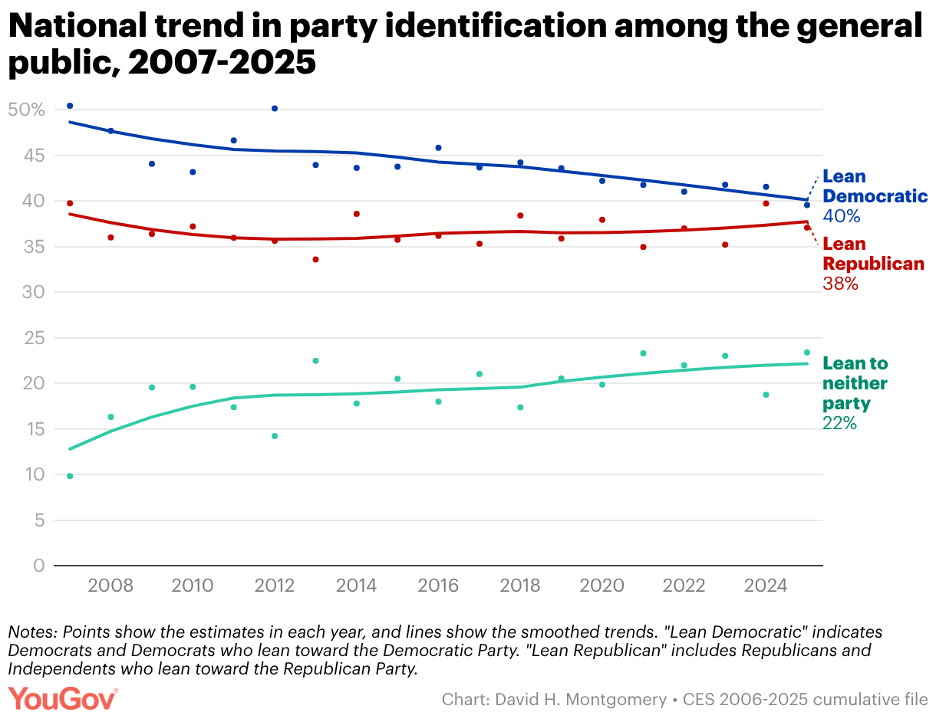
This is the topline finding of a report from YouGov based on Cooperative Election Study (CES) data exploring trends in how the American public identifies when it comes to the political parties. In 2007 and 2008, Americans were about 10 to 12 percentage points more likely to identify with or lean towards the Democratic Party as they were to identify with or lean towards the Republican Party. But by November 2025, that gap was just 2 to 3 percentage points. It’s worth noting that people who initially identify as independents but then admit that they lean towards one party or another are counted as partisans. Political scientists generally follow this practice, since “independent leaners” often behave similarly to partisans.
What’s behind this big shift? Most of this movement reflects a decline in people identifying with the Democratic Party, and an increase in those who say they do not lean towards either party. As recently as 2012, about half of Americans identified with the Democratic Party. That figure was down to around 40% in the most recent CES, however. Republican Party support has remained mostly consistent, with between 35% and 38% of Americans identifying with the GOP during this time period.
Most groups have shifted away from Democrats – some dramatically
Because the CES surveys such a large number of Americans each year, the report is able to detail shifts among many different demographic groups. It is striking to see how Democrats have lost ground to Republicans among such a broad swath of the American public. However, the CES data reveal some especially large shifts among notable groups.
Black Americans continue to be overwhelmingly Democratic, but less so than during the Obama presidency. As Barack Obama was about to leave office in 2016, 78% of Black Americans identified as Democrats, while just 6% identified as Republican. In 2025, 66% of Black people were Democratic and 10% were Republican. This shift has been especially pronounced among Black adults without college degrees.
Hispanic Americans have also shifted away from the Democratic Party, and much of this movement has been since 2020. In fact, the Democratic advantage among Hispanic adults has been cut in half just since 2019. In 2025, 43% of Hispanic adults were Democrats, compared to 27% who were Republican. The shifts are particularly large among Hispanic women, who have moved closer to Hispanic men in their partisanship over the past two decades.
The CES report also reveals another big shift among women voters. White women without college degrees were slightly more Democratic than Republican during the 2007-2009 period but have now come to favor Republicans by 20 percentage points. This shift, which reflects the broader polarization along educational lines in recent decades, is particularly important given that this demographic accounts for one-fifth of the adult population in the United States.
Three groups have countered the trend
While most groups have seen an erosion of Democratic identification during this period, there are a few noteworthy instances that run counter to this trend. First, white men with college degrees have shifted from identifying 7 percentage points more Republican than Democratic two decades ago to having a slight Democratic advantage today.
Atheists, who already gave a nearly 59-point partisan advantage to Democrats over Republicans in 2007-2009, are even more overwhelmingly Democratic now. And while Mormons are still the second most loyal Republican religious group in our data (after white Evangelicals), the Republican advantage among this group has dropped nearly 20 points over the past two decades.
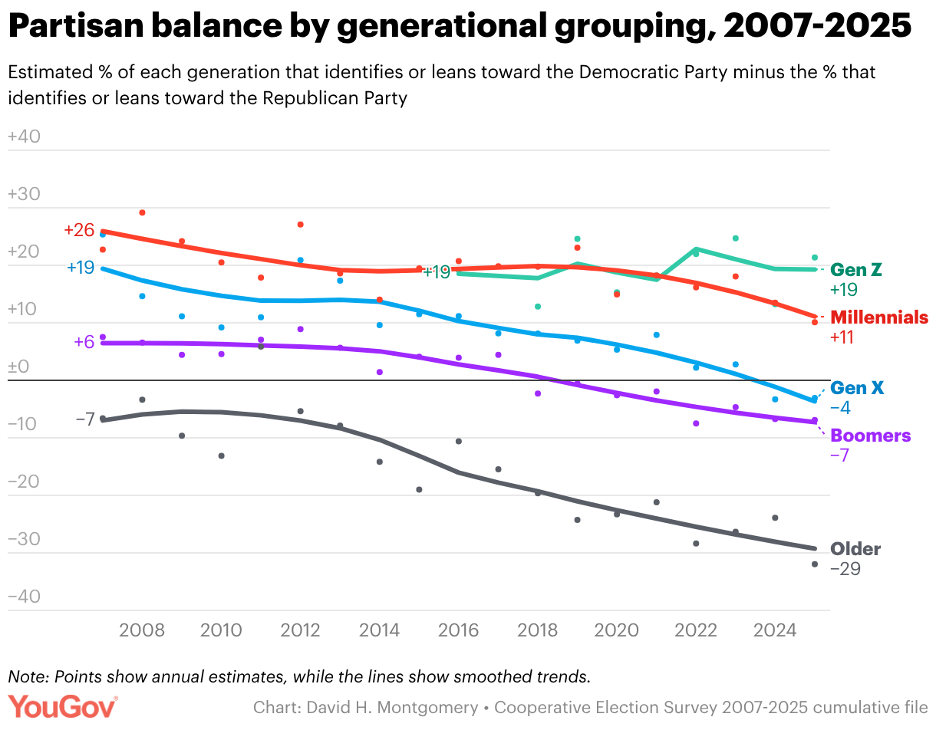
Perhaps most notable is that while every other generational cohort has become more Republican over the past decade, Gen Z Americans – those born between 1997 and 2012 – have not followed suit. Will this trend hold? It’s difficult to know for sure, since Gen Z is still a fairly young cohort and so a shift toward Republicans may come as this group grows older. Even Millennials – those born between 1981 and 1996 – have seen a dip in their support for the Democratic Party over the past few years.
Will these trends blunt a blue wave in 2026?
In 2006, Democrats picked up 31 seats in the House and 6 in the Senate to take full control of Congress for the first time in more than a decade. But that was a time when Democrats still had a definite party identification advantage over Republicans. The CES report makes clear that this advantage has mostly disappeared. And that could mean that we are less likely to see a big wave election like we did in 2006.
Given the relative parity of party identification and the fact that partisans vote almost uniformly for candidates from their own party, the midterm results will likely hinge on two factors: how true independents vote in 2026, and whether one party is more motivated to go to the polls. Voters who claim not to lean towards either party have constituted 10% to 12% of the electorate in recent election cycles. This group typically leans Republican in how they vote in House races. Democrats’ best recent performances among this group were in 2008 and 2018, both years in which the Democratic Party made big gains in Congress when they managed to break even among independent voters.
Of course, it’s still too early to predict how independent voters will break in the November 2026 midterms – but the most recent CES poll showed that Trump’s approval rating was just 27% among this group. If the vast majority of independent voters are looking for change in November, then a blue wave might materialize, despite the near parity in party identification.
