





There is something unusual happening in American public opinion. Social issues that were once thought to be “settled” are not so settled anymore. A liberal consensus that emerged over decades is breaking down – and it’s being led not only by Republicans but also by younger Republicans.
I know of three issues where we see this basic pattern: gender roles, gay marriage, and marijuana legalization.
The liberal consensus was real
The phrase I used before (“liberal consensus”) might seem like an overstatement. And I want to be clear: It doesn’t apply to every issue – abortion is one example. But on a wide array of social and moral issues, the trend in public opinion has been leftward. In a comprehensive review, sociologist Michael Hout wrote: “the social climate of the last 50 years…was decidedly liberal.”
That liberal trend followed a predictable pattern, as Delia Baldassarri and Barum Park have documented. Groups predisposed to less traditional attitudes – the young, the better educated – moved first. But other groups followed. In terms of partisanship, Democratic-leaning groups shifted to the left, and then Republican-leaning groups came along later. The trend shifted in the same direction for both groups, but Democrats moved first, and faster.
Recent trends have flipped that pattern on its head. Democrats and Republicans are now moving in opposite directions – and younger Republicans are on the vanguard of this resurgent conservatism.
Let’s unpack the three issues I mentioned.
Resurging gender traditionalism
By “gender traditionalism,” I mean endorsement of traditional gender roles, where men pursue a career outside of the home and women work in the home. Colette Marcellin, Michael Tesler, and I have previously documented that the long-term decline in gender traditionalism has reversed.
Here is a graph showing the trend in several different survey questions:
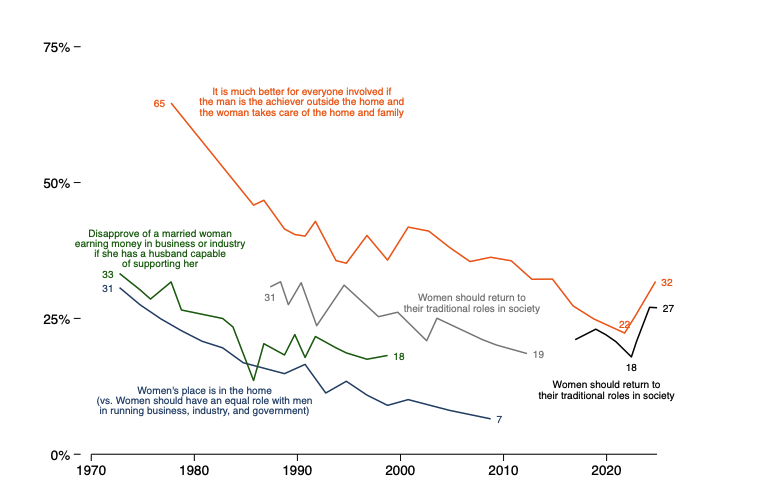
Overall, support for traditional gender roles declined from the 1970s to the 2000s. Indeed, the issue probably seemed so settled that some survey organizations stopped asking about it.
But on the questions that surveys have asked continually, there was a significant increase between roughly 2021-2022 and 2024.
In both surveys, the increases in endorsement of traditional gender roles were concentrated among Republicans, including both Republican men and women:
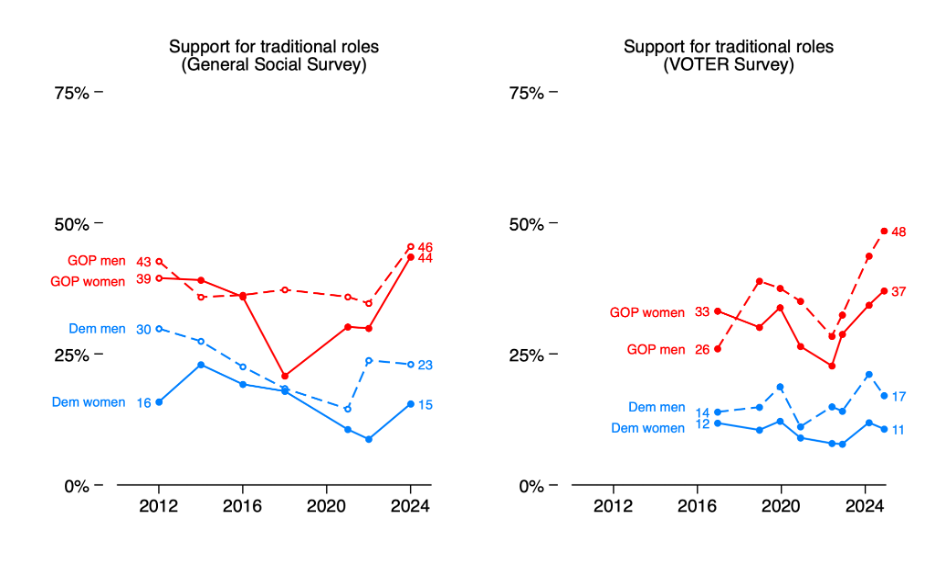
And the trends among Republicans may be a bit larger among young people. In the GSS, the percentage-point increase in traditionalist views between 2022 and 2024 was 17 points among 18- to 30-year-olds, 15 points among 31- to 44-year-olds, 5 points among 45- to 64-year-olds, and 11 points among those 65 and older. In the VOTER Survey, the increases in traditionalism among those four age groups were 25 points, 8 points, 7 points, and 13 points, respectively.
Of course, subdividing Republicans by age group means that the sample sizes aren’t huge. The differences among the age groups aren’t necessarily statistically meaningful. And there is nothing sacrosanct about those four specific age groups. You could obviously define the age groups differently.
But the general pattern suggests somewhat larger increases in traditionalism among the younger groups than the older groups, which is exactly the opposite pattern from the one that created the previous decline in traditionalism.
Resurgent opposition to same-sex marriage
The same pattern emerges with same-sex marriage. Again, there was a prolonged leftward shift in public opinion among both parties. The Supreme Court’s Obergefell v. Hodges decision in 2015 more or less took the issue off the political agenda, and now the two parties don’t fight about it much anymore.
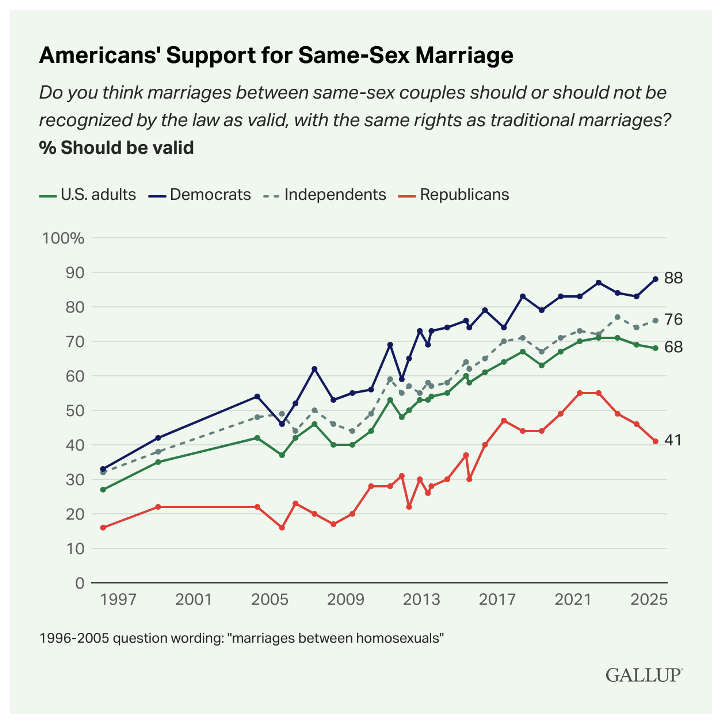
Yet several Republican governors shifted away from celebrating Pride Month this year, rebranding June as “Nuclear Family Month,” “Strong Families Month,” and “Fidelity Month.” In Gallup’s polling, the percentage of Republicans who say that same-sex marriages should be recognized as valid under the law has dropped from 55% in May 2022 to 41% in May 2025:
Gallup also recorded a 22-point drop in the percentage of Republicans who believe that “gay or lesbian relations” are “morally acceptable.”
The same trend among Republicans is visible in polling by Civiqs and by the American National Election Studies (ANES), although any recent increase in opposition to same-sex marriage is not quite as large, perhaps because the question wording and response options are different. (It’s also worth noting that the ANES did not show any change in Republican support for gay couples adopting children.)
But the changing view fits with a broader trend of increasing anti-gay sentiment. Indeed, when the ANES asked respondents how warmly they felt toward “gays and lesbians” on a 0 to 100 scale, Republican sentiment dropped from 54 in 2020 to 48 in 2024, which was the first drop in almost 30 years.
Here’s the trend among Republicans broken down by age, from Civiqs. Over the last five years, there has been about a 20-point increase in opposition to same-sex marriage among Republicans ages 18 to 34:
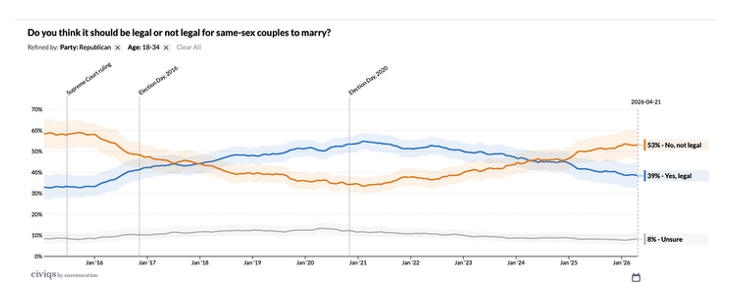
But among Republicans who are 65 and older? No change:
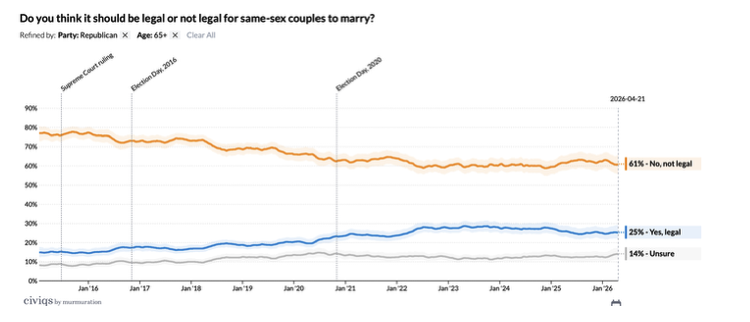
There was also an increase in opposition among Republicans ages 35 to 49, although smaller than the increase among Republicans 18 to 34. So, overall, younger Republicans appear to be shifting their views more than older Republicans.
Declining support for marijuana legalization
In an earlier post, Michael Tesler showed that marijuana legalization fits this story, too. Here is the trend in Gallup polling:
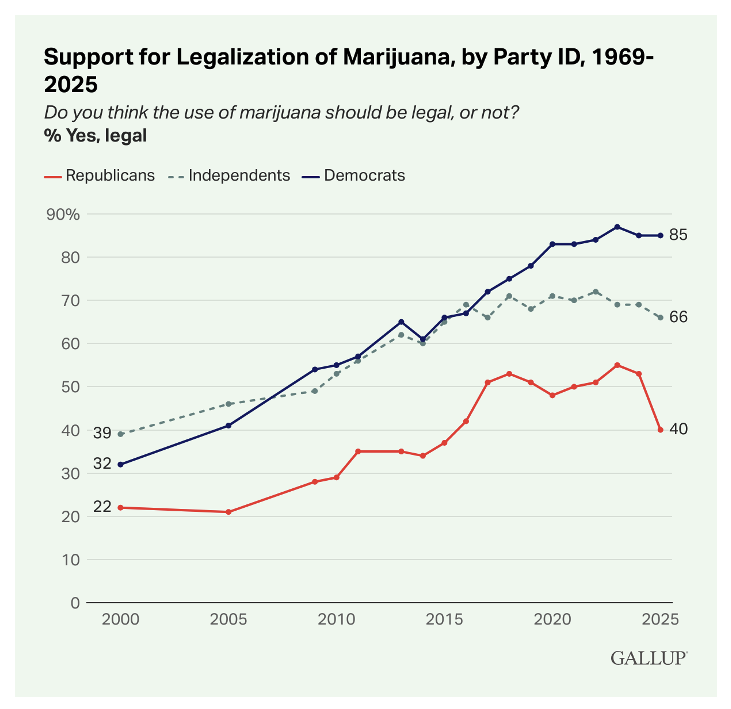
There was a 13-point drop in Republican support for legalization between 2024 and 2025. Michael shows further that the decline among Republicans age 18 to 34 is even steeper.
What is going on here?
Whenever there are changes in public opinion that are concentrated in one party, the most plausible cause is a change in communication: Republicans are hearing or seeing new messages from leaders within their party – whether elected leaders, media personalities, or others – that advocate for more conservative views.
For example, in my research with Colette and Michael on gender views, we show a sharp increase in discussions of traditional masculinity on Fox News between 2021 and 2024. (You may remember this example.)
Similarly, the increase in opposition to same-sex marriage and cooler feelings toward gay people coincides with a set of messages about how gay people “groom” children. This is an old stereotype, of course. But it resurfaced, at least according to a few different analyses of social media.
Neither Michael nor I have an explanation for why support for marijuana legalization would have decreased. It’s not as if federal policy is shifting. Trump’s recent move to reclassify marijuana as a less dangerous drug under the Controlled Substances Act isn’t legalization, obviously. But it’s consistent with the trend toward permissiveness toward marijuana use.
Moreover, the messages from Republican party leaders have been mixed. For example, when Florida debated a 2024 ballot initiative that would have legalized marijuana, state Republicans, including Gov. Ron DeSantis, opposed it. But Trump supported it. You can find a few examples of critical coverage of legalization in conservative media, but I don’t know of systematic evidence that the coverage has become more critical.
As to why messages on these issues would have a larger impact on Republicans in their 20s and 30s, one possible explanation is just that their political attitudes are less crystallized and more malleable. The stability of attitudes appears to increase with age.
What does all this mean?
These recent trends may not become a permanent reversal in the “liberal social climate.” Indeed, one classic 1992 study noted that even in a liberal climate, there can be “conservative weather.” The question, then, is whether a stronger social conservatism among younger Republicans persists – and thus whether a weather pattern becomes a true climatic shift.