





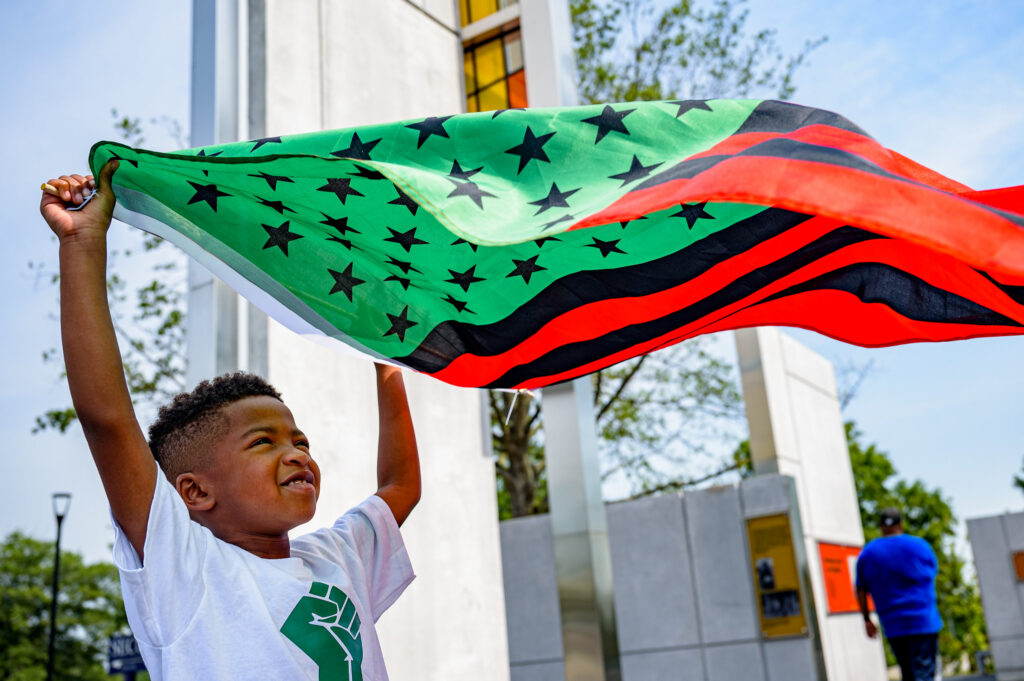
Juneteenth, the day many Black Americans celebrate to mark the end of enslavement in Confederate States, was codified as a national holiday by President Joe Biden in 2021. America’s newest national holiday commemorates the day that enslaved people in Galveston, Texas, learned that they were free, a whole two years after President Abraham Lincoln issued the Emancipate Proclamation in 1863.
This day illustrates an important lesson for American democracy: Winning rights is not the same as receiving them. Political scientists have long recognized that there is often an “implementation gap“ between the passage of a law and the realization of its promises. Rights can exist on paper long before they become meaningful in people’s everyday lives. Juneteenth reminds us that freedom requires more than legal declarations. It requires institutions that are capable of implementing them.
The implementation problem
Lincoln’s Emancipation Proclamation did not end slavery in the totality of the United States. Indeed, the Jan. 1, 1863, executive order only ended slavery in the rebel states that had seceded, and in slave states loyal to the Union. Missouri, Kentucky, Maryland, and Delaware, for instance, were not impacted by Lincoln’s decree. This means that many enslaved people remained in the same position that they were in prior to the Emancipation Proclamation’s issue. Furthermore, the effectiveness of the Emancipation Proclamation depended on military enforcement and the capacity of the federal government to impose its authority in formerly Confederate territories. In short, Lincoln’s edict had an implementation problem.
Lawmakers routinely pass laws and regulations. However, achieving the intended effects of the law and announced policies requires administrators, resources, enforcement mechanisms, and local compliance.
In Texas, the federal government did not have the immediate capacity to enforce emancipation. As a result, slaveholders ignored the Emancipation Proclamation and continued to benefit from enslaved labor because the enslaved were unaware that their legal status changed. The result was a two-year gap between the formal rights endowed by the Emancipation Proclamation in 1863 and the lived realities of enslaved people when Major General Gordon Granger led Union troops into Galveston in June 1865 and read General Order No. 3:
The people of Texas are informed that, in accordance with a Proclamation from the Executive of the United States, all slaves are free. This involves an absolute equality of personal rights and rights of property between former masters and slaves, and the connection heretofore existing between them, becomes that between employer and hired labor.
Why rights require institutions
Research on state capacity demonstrates that governments can only deliver rights when they possess the ability to implement them. Specifically, institutional capacity and political commitment at the state level shape the extent to which the U.S. government can implement national initiatives. Political factors such as partisanship, ideology, and active interest groups play a role in the decision making of implementing agencies and bureaucrats.
For example, Brown v. Board of Education declared school segregation unconstitutional in 1954. However, many school districts forcefully and actively resisted integration for several years. In response, the Supreme Court issued Brown v. Board of Education II as an enforcement degree in 1955, directing authorities to use “all deliberate speed” to desegregate schools. But rather than integrate, Virginia’s Prince Edward County school district decided to close its entire public school system from 1959 to 1964. And in practice, many schools across America remain de facto racially segregated today. Similar to the Emancipation Proclamation, Brown faced an implementation gap.
Here’s another example: the Voting Rights Act of 1965 (VRA), which dramatically expanded access to the ballot box for African Americans. But voting rights remain a point of contention in American politics. The April 2026 Supreme Court decision in Louisiana v. Callais weakened the VRA by ruling that states cannot justify race-conscious redistricting maps as required by Section 2, even when those maps were drawn to remedy racial discrimination. While the VRA had been tremendously successful in narrowing the gaps between minority and white voter turnout, particularly in the South, this landmark legislation and cornerstone of the Civil Rights Movement has been consistently under attack. Political challenges to registration procedures, polling place access, voter and identification requirements have all weakened the VRA. Thus, even when legal victories are secured, implementation often remains contested.
Juneteenth, Brown, and the VRA all remind us that rights in America become meaningful not simply because they are declared, but because institutions make them real. In short, policy only becomes meaningful when governments have the capacity and willingness to enforce them.
The politics of enforcement
Additionally, policy enforcement is rarely neutral. Individuals and organizations that operate at various levels of governments and within varying political environments must interpret, enforce, and administer policies. This requires local officials, courts, and bureaucrats as well as political leaders to influence whether rights are expanded, constrained, or ignored.
Enforcing social rights in democracies also requires a strong citizen-government relationship based on political trust, in which citizens expect the government to act competently. Although race and racism are central to U.S. politics, there are long-held discrepancies in how Americans believe that their government should remedy racial harms. Thus, how and if the federal and local governments enforce race-based policies matters because implementation ultimately determines whether formal rights translate into meaningful social and political change for minoritized groups.
Juneteenth illustrates this point very clearly. Freedom did not arrive in Texas simply because the Emancipation Proclamation existed. Rather, enslaved persons in Texas were free once federal authority became strong enough to enforce the proclamation. Through Reconstruction-era politics and policies that forced the former Confederate States to ratify the Civil War amendments, formerly enslaved people in these rebel territories were granted rights and federal protections endowed to all American citizens.
This distinction matters because Americans often assume that passing a law settles a political dispute. In reality, the struggle frequently continues during the implementation process. The politics of rights often shifts from legislatures to courts, bureaucracies, and administrative agencies.
Why Juneteenth still matters
As we celebrate Juneteenth, we are reminded of the question: What good are rights if people cannot access them? Legal change matters, but implementation determines whether that change has the power to transform people’s lives.
Whether Americans are seeking access to the ballot box, quality schools, affordable housing, or health care, Juneteenth reminds us that rights become meaningful not when they are declared, but when people see the benefits of these policies in everyday life.
In this way, Juneteenth is more than acknowledging the past, celebrating freedom for Black Americans, and the potential for the United States to live up to the words in its founding documents. Rather, Juneteenth reminds us of the enduring challenges of democracy. Ensuring that rights are guaranteed in law is one thing, but how will Americans experience these rights in practice?