







Political violence has again dominated conversations and headlines in the United States, after an armed man tried to break through security at the White House Correspondents’ Association dinner on Saturday night. In the wake of several attacks targeting President Trump – and the assassination of conservative political activist Charlie Kirk last fall – Americans seem to agree that political violence is on the rise. They don’t, however, agree on what counts as “political violence.”
In a 2025 Pew Research study, 85% of Americans agreed that politically motivated violence is increasing in this country. That may be the extent of our common ground. In that same study, 76% of Democrats identified right-wing extremism as a “major problem.” Among Republicans, 77% identified left-wing extremism as a “major problem.”
Part of the issue appears to be a divide between how Americans define political violence in the first place. As political scientists Scott Clifford, Lucia Lopez, and Lucas Lothamer point out, there is little consensus even within the academic community on what the words “political” and “violence” actually mean. Previous studies have found that questions like, “How much do you feel it is justified for [respondent’s own party] to use violence in advancing their political goals these days?” leave “violence” up for respondent interpretation. As a result, it’s difficult to tell what Americans actually classify as political violence, and if those classifications differ along partisan lines.
In a new survey, we have identified some common ground. But we also see at least as much disagreement between Democrats and Republicans on what types of actions count as political violence.
Explicit physical harm is a point of consensus
We fielded a YouGov survey of 2,000 American adults in early April 2026 and asked those respondents whether they would consider each of six actions to be political violence. Of those six, we classify three as “direct violence” – the kind of action that might make you think “ouch.” These included “physically assaulting a politician or government official,” “armed attacks on protesters or demonstrators,” and “using the military against civilians.”
We found nearly unanimous bipartisan consensus that assaulting a politician or government official is political violence. In fact, 93% of both Democrats and Republicans in our survey agree that this fits the definition (see figure). This is, perhaps, the clearest case of political violence, as seen through highly publicized events like the 2011 shooting of Representative Gabby Giffords (D-Ariz.) or the attempted assassination of Donald Trump in July 2024.
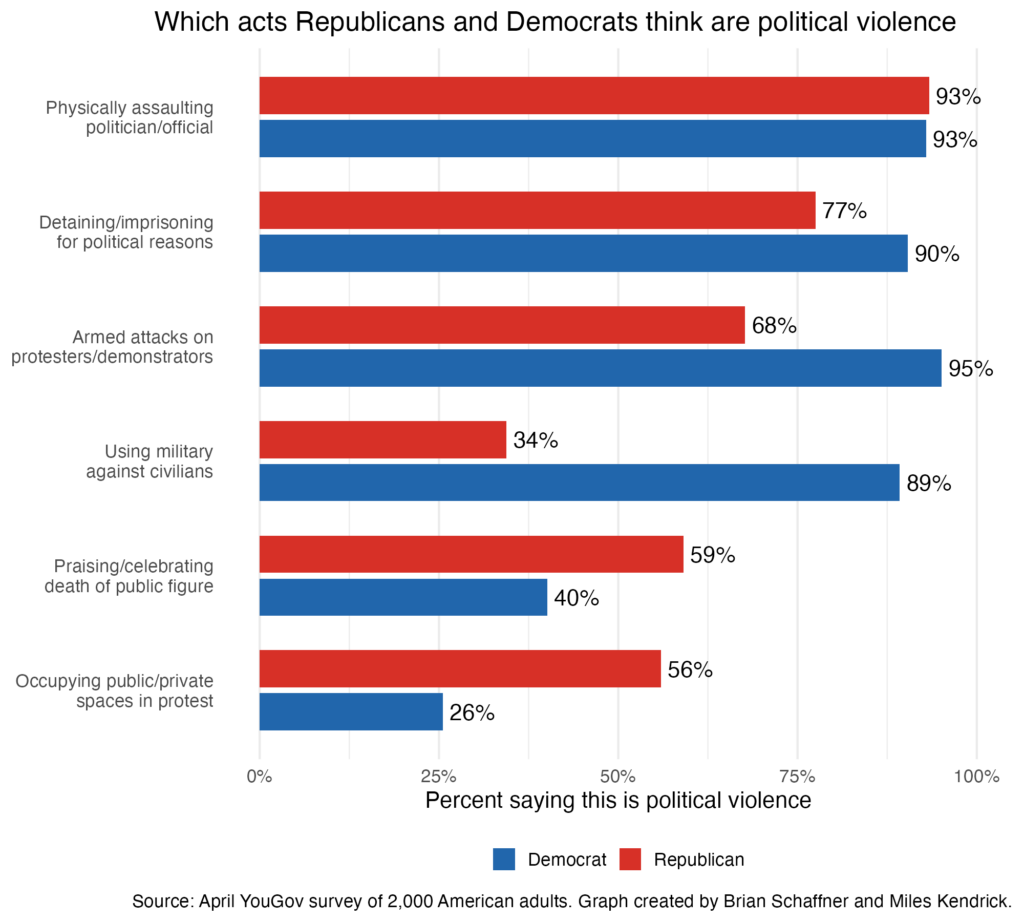
This consensus, however, begins to erode with the other “direct harm” questions. On whether or not “armed attacks on protesters or demonstrators” is political violence, a 27-point gap separates Democrats, who almost unanimously agree that it is, and Republicans, of whom 68% agree. Still, a clear majority of people from both parties see this as political violence.
The partisan differences grow even larger for the survey question on “using the military against civilians.” The partisan gap on this question is a staggering 55 points, with 89% of Democrats but just 34% of Republicans labeling it political violence.
Republicans rarely classify actions by the government as politically violent
The discrepancy between Democratic and Republican categorizations of direct harm as political violence is perhaps the product of another trend identified in the data: Republicans are less likely to view actions carried out by the government as political violence. In addition to the question on using the military against civilians, Republicans are 13 points less likely than Democrats to identify “detaining or imprisoning people for political reasons” as political violence. However, a clear supermajority of Republicans do see such detainments as political violence.
The parties also diverge when it comes to protesters, either as recipients or perpetrators of violence. In addition to their 27-point gap on “armed attacks on protesters or demonstrators,” Republicans are more than twice as likely than Democrats to classify “occupying public or private spaces as part of a political protest” as political violence. That’s a notable finding, given that many activists view occupation of public/private spaces as an exemplar of nonviolent protest tactics. Regardless, the pattern is clear: Democrats are more likely than Republicans to see actions taken against protesters as violent, while Republicans are more likely to see actions taken by protesters as violent.
Together, these findings seem to align with previous studies that suggest that Republicans are more likely than Democrats to have authoritarian personalities, a deference to authority, and distaste for perceived outsiders. Political scientists like Peter Jonason and Gordon Hodson and colleagues find associations between right-wing ideology and authoritarian personality traits, reinforcing the idea that perhaps ideology has a greater influence on personality than originally understood.
Another likely explanation is that Republicans are supportive of the current administration and antagonistic to protesters because their party is currently in power. Previous studies have found that belief in electoral legitimacy, political trust, personal happiness and wellbeing, and more are influenced by whether or not your party is in charge. Perhaps classification of government violence as political violence is determined by the party associated with the administration at the time of violence. In that light, perhaps Republicans are especially forgiving during a Trump presidency.
The Charlie Kirk effect
In the aftermath of Charlie Kirk’s shooting on September 10, 2025, Fox News headlines like “Sick Leftists Cheer the Murder of Charlie Kirk” reflected a general Republican outrage towards Democrats who reportedly celebrated the activist’s death. In a press gaggle one day after Kirk’s death, Trump told reporters, “We don’t celebrate if something happened on their side, and we don’t. These are sick people. These are really deranged people.”
Whether or not the actual percentage of Democratic celebrations was as high as some pundits predicted, our data suggest that the narrative that Democrats applauded the death has shaped how Republicans and Democrats view such celebrations of violence. About 6 in 10 Republicans in our survey said that celebrating or praising the death of a public figure was itself political violence. Just 1 in 4 Democrats said the same. This is particularly striking given that, in recent years, liberals are the group receiving the most criticism for attempts to curtail offensive speech.
Why this matters
We often see headlines noting that Americans view political violence as a major problem – and one that many Americans expect will increase. It’s difficult, though, to make sense of such statistics without understanding what people have in mind when they’re asked about the topic. Regardless of party, our data find that most people are likely thinking about things like politically motivated detainments or physical attacks on politicians or protesters.
But that’s not all they’re considering. Democrats may also be thinking about military operations that target civilians. Republicans may have in mind protesters occupying public buildings and people praising attacks on politicians. Thus, while polls celebrating American consensus on political violence may offer some relief, an understanding of how Democrats and Republicans are actually defining the term suggest that partisanship is still at play, even in matters of direct and indirect violence.
Miles Kendrick is a senior political science major at Tufts University and a research associate in the Tufts Public Opinion Lab.
Brian Schaffner is the Newhouse Professor of Civic Studies in the Department of Political Science and Tisch College at Tufts University. He also serves as a co-director for the Cooperative Election Study.
Stay up to date on all things politics and political science. Bookmark our landing page and sign up for Good Authority’s weekly newsletter by entering your email address in the box below.