






A Gallup poll last fall revealed a plurality of Americans want to see their leaders compromise more – and get things done. But the current battles over ICE funding and ICE tactics are yet another reminder that compromise doesn’t come easily in a highly politicized America. Civic norms, including political compromise, are important – they tell us what people expect and value from their fellow citizens and what they don’t. These norms are also influential in determining how we engage in the civic and political sphere.
Norms also appear to be evolving in modern America. Decades ago, a sense of civic duty was the dominant norm motivating political participation. Americans engaged in activities that they believed society expected of them. The types of activities that are strongly motivated by civic duty are things that help to maintain the political and social order, like obeying the law, and voting.
Over the past couple of decades, political scientists have noted the emergence of a new orientation towards civic participation that sees civic action not just as a duty to be performed, but as a way to influence politics and help others. Political scientist Russ Dalton calls this engaged citizenship.
What about compromise?
As political scientist Jennifer Wolak notes, civic norms are not limited to what types of activities people should do as citizens – they also relate to how political disputes should be resolved. When people get involved in politics, it does not matter simply that they are doing these things, but also how they approach those activities. And with the current state of heightened polarization in America, it is perhaps unsurprising that when people participate in politics, they tend to do so from an adversarial rather than cooperative approach.
We can see this clearly from data I collected in 2023, when I fielded a battery of questions on the Cooperative Election Study to gauge which activities Americans viewed as most important for being a good citizen. The following graph plots the percentage of Americans who said each item was “very important” for being a good citizen. Voting and paying taxes clearly lead the way with a large majority of support. For the next three items – getting vaccinated, volunteering to help others, and following what is happening in politics – about half of Americans viewed them as very important.
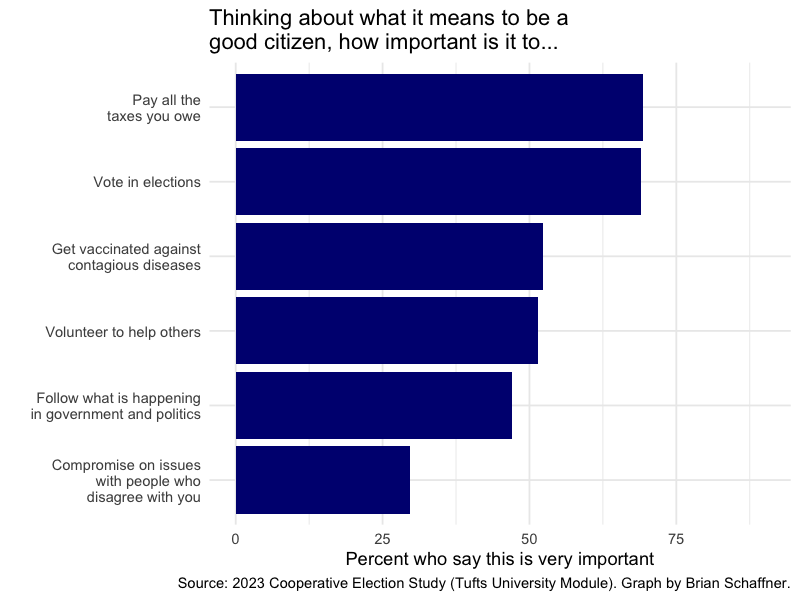
Perhaps most striking in this figure is that few Americans see compromise as a trait that is important for being a good citizen. Just 30% of Americans see compromise as very important for good citizenship. And just one in four respondents say compromise is not too important or not at all important.
Norms are evolving, but compromise is still not a priority
In the next graph, I break out the results for voting and volunteering across generational groups. Baby Boomers value duty-based norms like voting (including voting without knowing much about the candidates) and paying taxes much more than younger generations. Well over 80% of Boomers say that voting in elections is very important for being a good citizen, while only about half say the same about volunteering. No other generation values voting nearly as much as Boomers – only around 60% of Gen X, Millennials, and Gen Z say that voting is very important for being a good citizen.
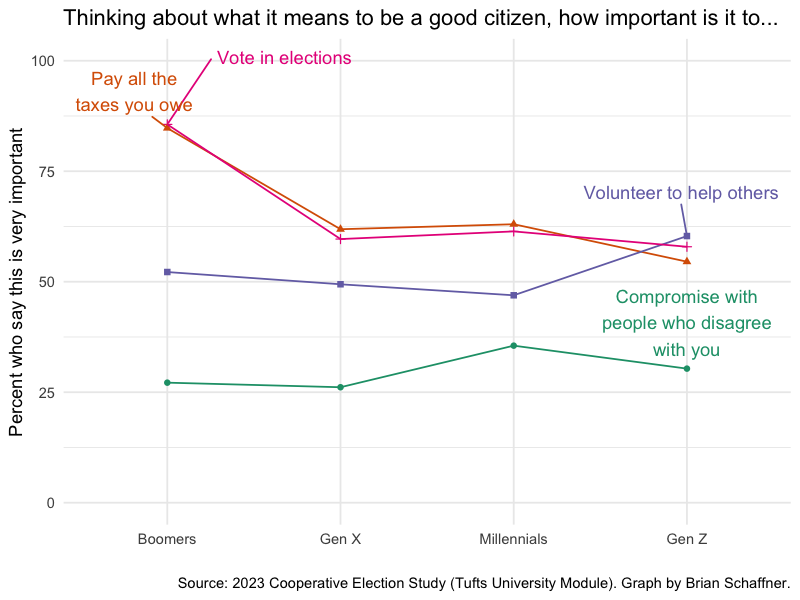
Gen Z, by contrast, is the group that values volunteering the most. About 60% of this group say that volunteering to help others is very important for being a good citizen. Only about half of the other generational groups say the same. In fact, Gen Z is the one group who sees volunteering as being at least as important for being a good citizen as voting and paying taxes. And this doesn’t appear to be simply a function of age. In a 1995 Newsweek survey that asked similar questions, the youngest generation at that time (Gen X) actually placed less importance on volunteering than older generations (such as Boomers).
Most strikingly, just 30% of Americans say that compromising with people you disagree with is important for being a good citizen. Millennials and Gen Z are a little more likely than older generations to say compromise is very important, but this is still the least prioritized norm for these generations.
Conservatives and Trump voters value compromise the least
People who identify as liberal or moderate are more likely to view compromise as an important activity for being a good citizen, with about one-third of these individuals saying it was very important. In comparison, just 20% of conservatives say the same.
Trump supporters, in particular, stand out in not valuing compromise. In this same survey, we asked Americans who they planned to support in their party’s presidential primary. Only 23% of Republicans who planned to vote for Trump saw compromise as very important to being a good citizen. About one-third of those supporting another Republican candidate said the same thing.
Compromise isn’t a big factor in how people learn to be citizens
It’s perhaps not surprising that most Americans don’t see compromise as important for good citizenship. After all, to the extent that U.S. schools engage in a civics curriculum, they typically focus on describing the rules of government and encouraging students to vote. Teachers often avoid discussions of controversial issues, which then limits the extent to which students learn and practice skills like tolerance and compromise.
For those who think that Americans have become too uncompromising in the current era of partisan polarization, one place to start might be educating students to see deliberative skills as a more central component to their roles as citizens.
Brian Schaffner is the Newhouse Professor of Civic Studies in the Department of Political Science and Tisch College at Tufts University. He also serves as a co-director for the Cooperative Election Study and is currently an Andrew Carnegie Fellow to support his book project with Stephen Ansolabehere on The American Mosaic.
