






February 2026 marks the Centennial celebration of Black History Month, which was originally called Negro History Week in 1926. Black History Month celebrates the accomplishments of African Americans to encourage and deepen the study of African American history year-round. Each year, talent shows, museum exhibits, op-eds, artistic productions, and church speeches are a way to increase awareness of Black Americans’ centuries-long fight for racial equality.
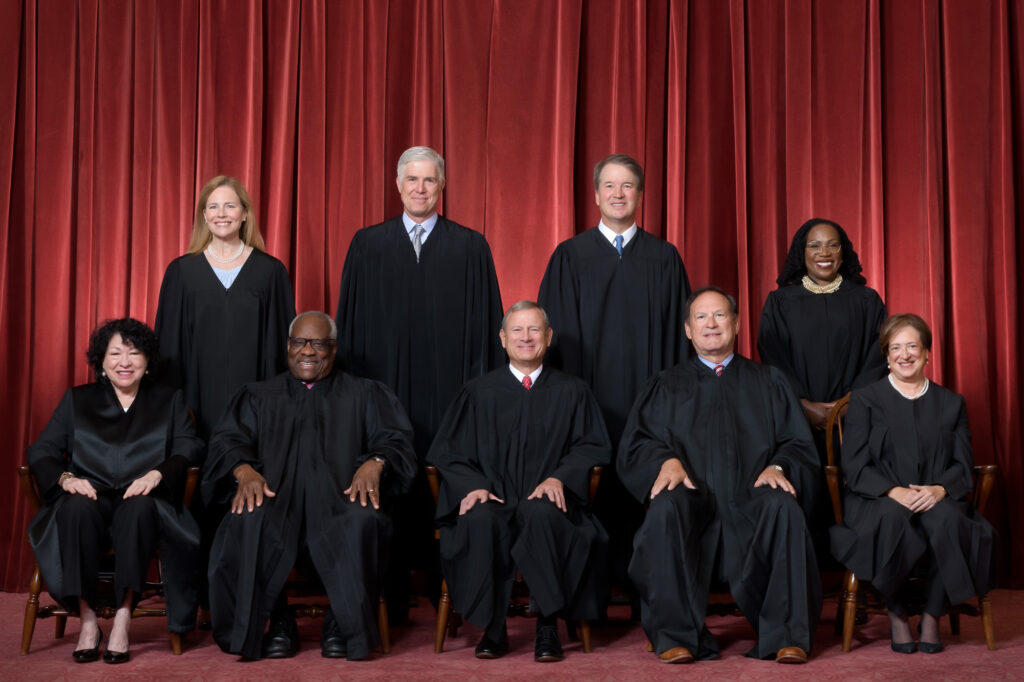
One figure in Black history – the longest-serving Black Supreme Court justice in U.S. history – is less prominently featured. As of February 2026, Justice Clarence Thomas is the longest-serving justice on the current Court and the fifth-longest serving justice in Supreme Court history. But his story was absent from the exhibits in the National Museum of African American History and Culture when the museum first opened. Previous Black History Month celebrations often ignored Thomas, most likely due to his color-blind interpretation of the 14th amendment. As an originalist, Thomas favors restricting federal power and opposes the expansion of civil rights precedents. Thomas holds vastly different views from those of his predecessor on the Court, Thurgood Marshall.
However, spotlighting Thomas serves as an opportunity to recognize the complexities of Blackness and the contours and origins of Black conservatism. This does not mean agreeing with his judicial opinions. Rather, we contend that Black History Month is a time to learn more about the heterogeneity of Black experiences and ideological positions.
Clarence Thomas’ Black Panther era
Justice Thomas once had a brief but foundational “Black Panther-type phase” during his college years in the late 1960s. As one of the few Black students at the College of the Holy Cross, the deeply religious Thomas, who experienced brutal racism in his native Georgia, turned to the Black Power movement to help make sense of his racialized experiences. Thomas became disillusioned with the Catholic church and was deeply upset by the assassinations of both Martin Luther King Jr. and Robert F. Kennedy in1968. His anger toward racial injustice led him to the Black Power Movement. Thomas had a poster of Malcolm X on his dorm room wall – he mirrored the Black Panthers’ aesthetics and helped the Panthers run a free clothing program in Massachusetts.
But Thomas’s Black Panther era abruptly ended in 1969 after he participated in a riot in Harvard Square, where he and other students protested the Vietnam War. Dismayed by his behavior, Thomas realized that while hatred and anger had driven him to participate in the protest, these emotions should not control him. Rather, he went from “anger and hatred to cynicism, and then to trying to figure things out,” he later explained.
Following graduation from Holy Cross, Clarence Thomas enrolled in Yale Law School. Thomas would later blame affirmative action for his struggles to land a high-paying job. To his mind, a white man with a Yale degree was given more consideration than a Black man with a Yale degree who had benefited from affirmative action – and therefore must have been unable to handle the academic rigor of an Ivy League institution. Although he took harder classes and earned higher grades than his white counterparts at Yale, Thomas stated that his Yale degree was only worth $0.15. Thomas believed the stigma of receiving a racial preference prohibited others from viewing his degree as a standout achievement. To this day, Thomas’s grievances with Yale Law School are based on his belief that race-based admission and racism caused him to be treated unfairly.
Thomas writes that he fully stepped into the fullness of his political ideology when he was the head of the Equal Employment Opportunity Commission from 1982-1990 when he realized that he was “independent, strong-willed,” and embraced conservatism.
Black nationalism and black conservatism – more similar than different?
Thomas’s political ideology shifted over the years – but this is not uncommon. Other celebrated figures in Black history, including Martin Luther King Jr. and Kwame Toure, are also most noted for espousing a particular political ideology, yet actually changed political orientation over time. However, Black History Month celebrations often present the political orientations of Black luminaries as static. This inaccuracy leaves people with an incomplete view of notable Black people at best. At worst, this kind of error fails to recognize the contours of Black political ideologies.
The political ideologies of Black nationalism and Black conservatism, in fact, can overlap. Black nationalism as an ideology calls for Black unity, valorizes a distinct cultural identity, and prioritizes economic self-sufficiency and political empowerment. Proponents of Black nationalism, like Marcus Garvey or Malcolm X, viewed systemic racism and oppression as key facets of American society and advocated for separate institutions and nations to enable Black people to operate as fully actualized citizens.
Black conservatism, in turn, emphasizes self-sufficiency and personal responsibility, and support for traditional values, limited government, and free markets. Thomas Sowell, Shelby Steele and Justice Thomas advocate for these principles by critiquing dependency within Black communities. Both ideologies call for Black self-reliance, group solidarity, and building independent institutions that support Black people. And both Black conservatism and Black nationalism decry reliance on government assistance.
Yet, there are key differences among these two ideologies. For example, Black nationalists point to the systemic nature of racism, whereas Black conservatives focus on the individual and see a victimhood mentality as an obstacle to progress. For Black conservatives, personal responsibility and individual achievement are critical stepping stones toward success. Black nationalists, in contrast, take a more communal approach to Black success.
These distinctions – along with his experiences with racism and how he responded – help explain what drives Justice Thomas’s legal findings. Political scientist Corey Robin argues that Thomas is a conservative Black nationalist. Robin contends that Thomas is skeptical that racism can be overcome and is highly adverse to governmental policies that seek to remedy racism. Robin’s book explores how Thomas’s embrace of conservatism is rooted in a Black nationalist framework – a strong belief in self-reliance and racial pessimism – that undergirds Thomas’s jurisprudence.
The broad range of Black political ideologies
Thomas continues to believe that individual attainment rather than government assistance is the way towards success. His Supreme Court opinions reflect his political ideology. Even in his move to the right, Thomas has stayed consistent in his views of the role of racism and how to solve it.
Political scientist Michael Dawson advocates for a more deliberate and nuanced understanding of Black political ideologies. Indeed, skin color is not a proxy for understanding how someone should think. Black political ideologies that inform Black political behavior are born out of state repression, economic deviation, spatial separation, and the assimilation of Black political elites. The distinct nature of Black political ideology takes up the question of what it means to be Black in a society that sees race as a problem, and is rooted in Black life experiences. Understanding the African American political tradition and Clarence Thomas’s place within it illustrates the problems with assuming a dominant ideology or with universalizing remedies for the political challenges faced by Black people.
What Clarence Thomas reveals about Black political thought
Several legal scholars call the current Supreme Court the “Thomas Court,” to recognize that Thomas wields significant influence within a 6-3 supermajority. In recent years, the Supreme Court has issued significant rulings that impact race, often rolling back anti-discrimination rules. Thomas’s sphere of influence appears to be expanding. Along with his wife Ginny, Thomas is ushering in a conservative transformation of modern-day American law.
Understanding how one prominent Black justice thinks helps illuminate the complexity and dynamism of Black political thought, particularly the varied ways Black Americans have sought to remedy America’s “original sin” – racism. Viewing Thomas as a complex political figure – and someone whose core views on addressing racism have remained consistent even as his ideological affiliations have shifted – challenges static or monolithic narratives of Black politics. In this light, Black History Month is not only a celebration of Black culture in America, but also an opportunity to engage more deeply with overlooked or uncomfortable facets of Black political life, including ideological diversity and change over time.
Nadia E. Brown is a professor of government and the director of the Women’s and Gender Studies program at Georgetown University. She is the author of Sisters in the Statehouse (Oxford University Press, 2014) and co-author of Sister Style (Oxford University Press, 2021) with Danielle Lemi.
Christine M. Slaughter is an assistant professor of political science at Boston University and a 2025-2026 Allen Lab Research Fellow at the Ash Center for Democratic Renovation.
Stay up to date on all things politics and political science. Bookmark our landing page and sign up for Good Authority’s weekly newsletter by entering your email address in the box below.