





Democrats have spent the past year and a half debating whether the party needs to nominate more moderate candidates to compete with Republicans in key swing states and districts. These debates played out once again this week in Iowa’s Democratic Senate primary, with the more moderate Josh Turek winning the nomination over Zach Wahls, who ran an anti-establishment campaign and secured an endorsement from liberal Senator Elizabeth Warren (D-Mass.).
If Democrats are serious about wanting to better understand how candidates can portray themselves as significantly more moderate than their party’s reputation, knowing who has actually achieved such success is key. It is also important to understand what perceived moderation means for how voters evaluate those politicians.
Each year, the Cooperative Election Study (CES) asks Americans to place their elected officials on a seven-point ideological scale. They also place the parties on the same scale. A handful of Democratic officials have been able to establish their credentials as being more ideologically moderate than their party, but one stands out above all the rest.
Why John Fetterman stands out
The following plot shows how residents of different states place Democratic senators and governors in relation to how they place the Democratic Party. The CES analysis is limited to states where at least 250 residents placed both the politician and the party, which means we are mostly limited to more populated states.
For the majority of these elected officials, people see little difference between the politician and the party. Eighteen of the 30 Democratic politicians on this list are placed within a quarter point of where people place the party, a fairly small difference on the seven-point ideological scale. Several politicians, however, have established reputations that voters see as significantly more moderate than their party.
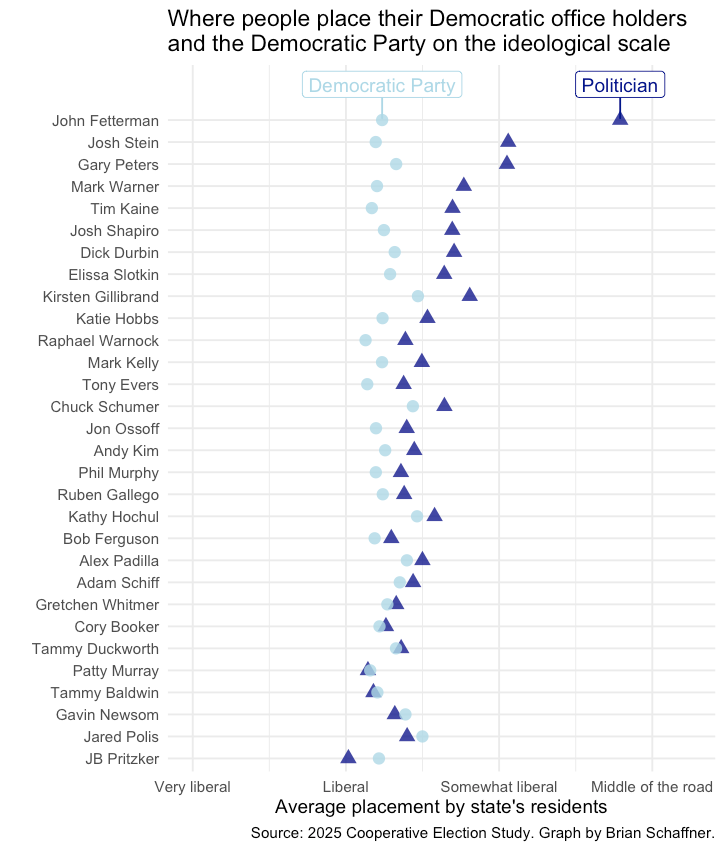
There is one clear standout when it comes to perceived moderation: Senator John Fetterman (D-Pa.). Pennsylvanians, on average, view Fetterman as just to the liberal side of “middle of the road.” This puts him significantly more moderate than any other Democratic senator on this list and a full 1.5 points more moderate than Pennsylvanians see the Democratic Party.
The next most moderate Democratic statewide politicians are North Carolina Governor Josh Stein and Michigan Senator Gary Peters. Both are placed just to the right of “somewhat liberal” by their states, and viewed as about three-quarters of a point more moderate than the Democratic Party. Pennsylvania Governor Josh Shapiro, who has also attracted notoriety for his moderate profile, is viewed as about a half-point more moderate than the party.
What we can learn by comparing Fetterman and Shapiro
The graph below provides some key context for these ratings and helps us to better understand what is happening here. For starters, Republicans see the Democratic Party as quite liberal, placing it closer to the “very liberal” end of the scale than to the “liberal” point. And by that reference point, they see Shapiro as a full point more moderate than the party, and Fetterman as almost two points more moderate. Republicans still place Fetterman closer to “somewhat liberal” than to “middle of the road,” but “somewhat liberal” is quite moderate compared to how Republicans see the Democratic Party.
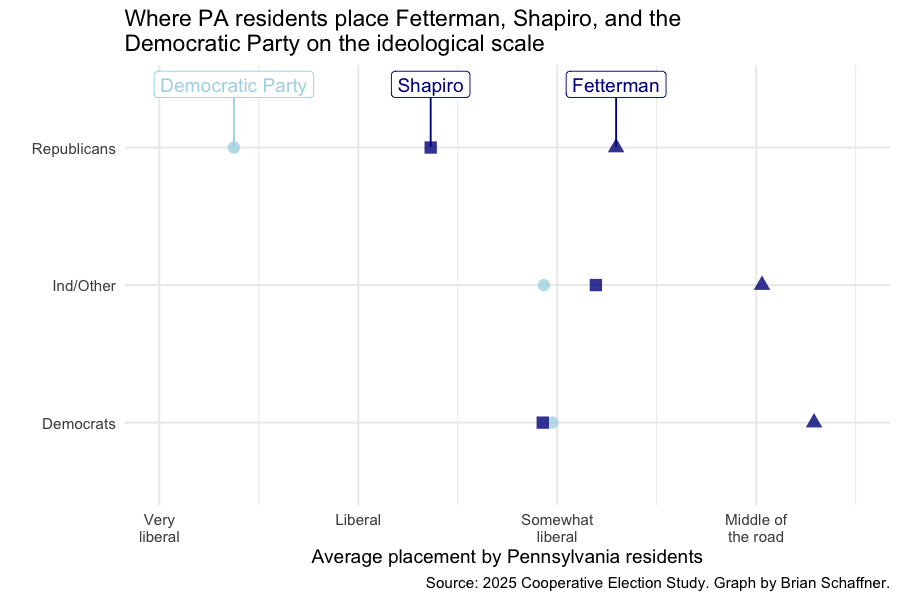
But Fetterman’s status as one of the most distinct moderates in the party doesn’t just come from how Republicans see him. It also comes from how independents and his own party view him. Democrats, in particular, are striking in how they rated Fetterman. In fact, 42% of Democrats saw him as either “somewhat conservative” or “conservative” and 4% rated him as “very conservative.” Democrats are twice as likely to place Fetterman on the conservative side of the scale than on the liberal side.
Shapiro, by comparison, has established a more moderate reputation than his party among Republicans while still being seen as part and parcel with the party by independents and Democrats. Democrats place both Shapiro and the party at “somewhat liberal,” with basically no difference between them.
The balancing act of moderation
It is one thing to nominate candidates whom Republicans grudgingly concede are less liberal than the Democratic Party as a whole. This is the story with Shapiro. It is another thing to nominate candidates whose own party voters look at them and see a clearly different kind of Democrat. This is the story with Fetterman.
This is why Fetterman’s profile has become a problem inside his own party at the same time it is being held up as a model outside of it. The same data that put him a point and a half from the Democratic Party’s perceived position are also what makes a portion of the Democratic base see him as someone insufficiently committed to party values. In the 2025 CES, just one in four Pennsylvania Democrats said that they approved of the job Fetterman was doing in office, while nearly four in five approved of Shapiro.
Fetterman, by contrast, has a 50% approval rating among non-Democrats while Shapiro’s is just 35%. Republicans acknowledge that Shapiro is less liberal than the Democratic Party, but they ultimately still view him as liberal, an ideological profile that few Republicans are willing to support.
That is the trade. A candidate whose moderation registers as strongly as Fetterman’s runs the risk of turning off his partisan base. A Democrat whose moderation is only acknowledged by the other party may see limited returns for that moderation.
Democrats deciding whether to recruit more Fetterman-style or Shapiro-style nominees in 2026 and 2028 will have to decide which of those is the bigger problem.
Stay up to date on all things politics and political science. Bookmark our landing page and sign up for Good Authority’s weekly newsletter by entering your email address in the box below.
