





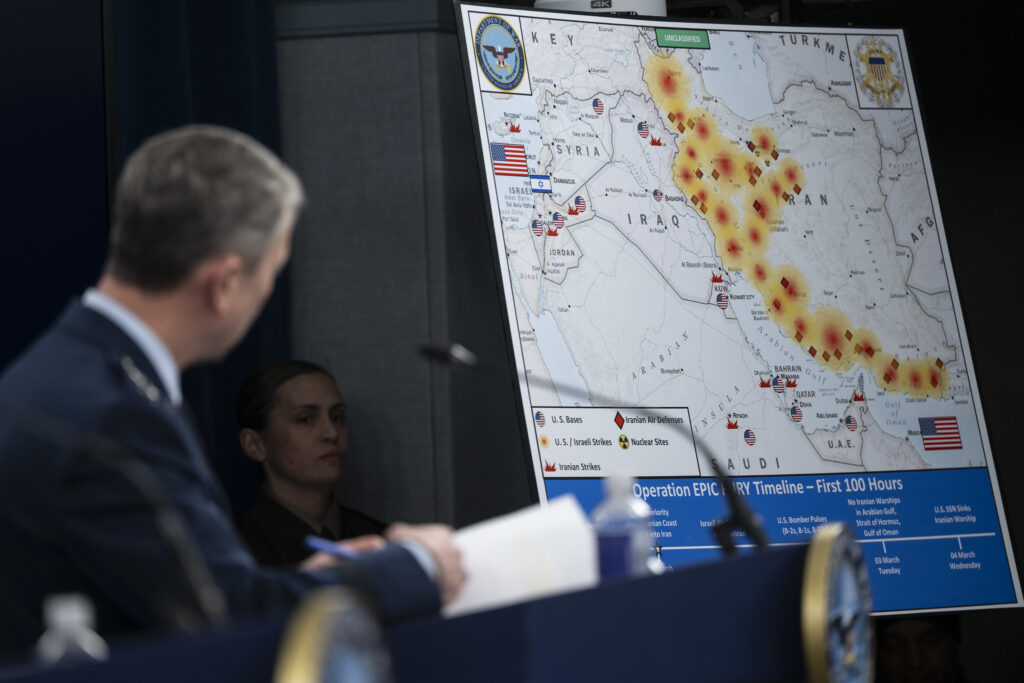
Early claims of a MAGA civil war over the war with Iran were greatly exaggerated. While some prominent conservatives have condemned the war, most Republican voters currently support it.
That’s certainly not surprising. Political science research shows that Americans’ opinions of foreign policy are heavily influenced by their opinions of the president who is guiding it. This is especially true at the onset of military conflicts, when the public has little independent knowledge to push back against the administration’s narrative.
If anything, it’s surprising that GOP support for the war isn’t stronger at this point. A deeper dive into the polling, in fact, shows an unusual amount of ambivalence in Republicans’ views of Iran and Trump’s foreign policy.
The decline (not demise) of isolationist sentiments
Back in 2023, I documented ”the remarkable rise of isolationist Republicans.” The share of Republicans in the Civiqs Daily Tracking poll who thought the U.S. should be less involved overseas steadily increased from 30% in January 2015 to 77% in the summer of 2023.
But as the graph below shows, isolationist sentiments have gradually declined over the past 14 months as President Donald Trump pursued an array of interventionist foreign policies. Democrats, of course, have moved in the opposite direction.
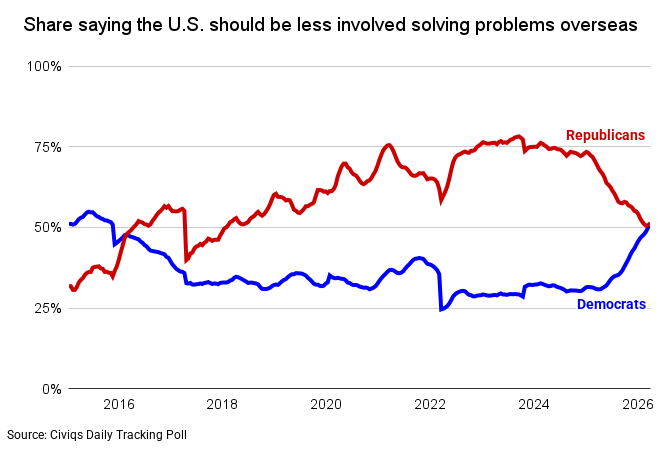
But despite those changes, a slim majority of Republicans (51%) still thinks that the U.S. should be less involved overseas. That share has held steady since the Iran war began, unlike in earlier episodes. For example, there were noticeable declines in Republican isolationism after Trump ordered airstrikes against Syria in April 2017 and Russia invaded Ukraine in February 2022.
Overall, Republicans are still far more isolationist than they were before Donald Trump announced his initial campaign for president in June 2015.
Most Republicans are not strong supporters of the Iran war
Many Republicans seem to have reconciled those lingering isolationist sentiments with their enthusiasm for Trump by only tepidly supporting the Iran war. Recent polls by YouGov-Economist, Pew, and Fox News show that well under half of Republicans strongly support the decision to strike Iran and the president’s handling of the issue:
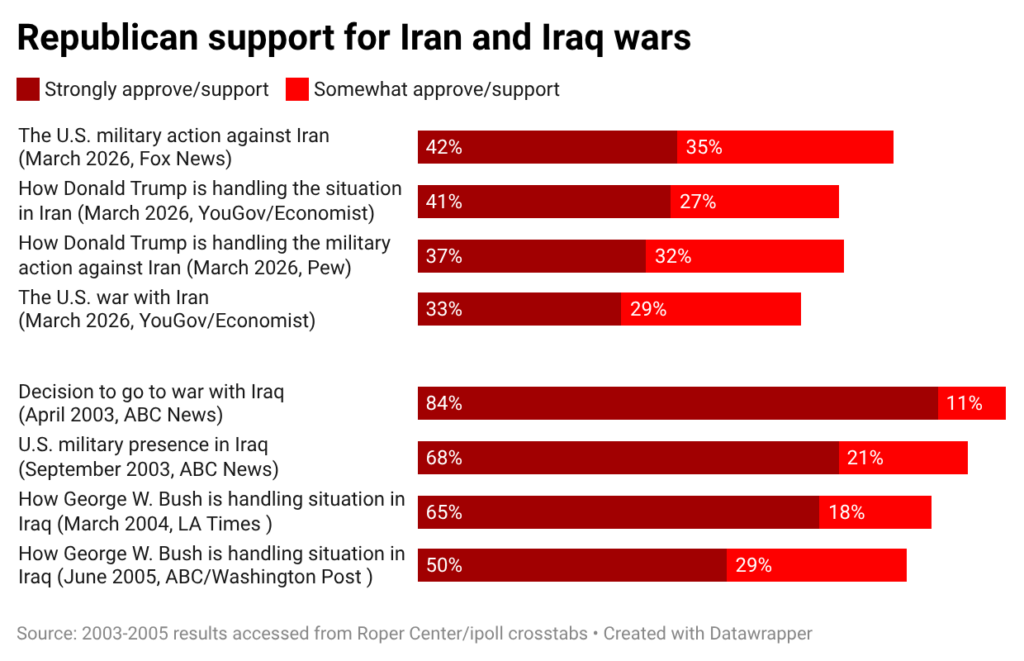
That lukewarm approval contrasts with Republicans’ strong support for the Iraq war in 2003 and 2004. Most Republicans (84%) strongly supported the decision to go to war with Iraq one month into the conflict (April 2003), and 65% strongly approved of how President George W. Bush was handling the situation in Iraq one year into the war. Even as public opinion turned sharply against the war, 50% of Republicans in June 2005 still strongly approved of how Bush was handling the situation in Iraq.
There are additional signs of ambivalence in Republicans’ views of the current U.S. war with Iran. Only two-thirds of Trump voters said that the Iran war is justified in the YouGov-Economist poll, and just 52% of Republicans said that the U.S. will benefit from the war.
Moreover, in a recent YouGov-CBS Poll, 33% of Republicans described the military conflict as “a war of choice.” And 36% said that Americans should not be willing to pay higher gas prices during the war with Iran.
Republican support for the Iran war going forward
In short, Republican views about the Iran war and Trump’s foreign policy are more nuanced than they are often presented. There’s clearly not a civil war among GOP voters over the issue, but there isn’t the same steadfast support from the base that there was for the Iraq war, either.
It appears, instead, that many Republicans are ambivalent. They are simultaneously inclined towards isolationism but also predisposed to support Trump’s policies. It is likely easier for Republicans to reconcile their isolationism with support for the Iran war right now because, as polling also shows, most have accepted the Trump administration’s messaging that the war is only a short-term military “excursion” that the U.S. is winning.
But that raises the possibility that a prolonged conflict that extends beyond the administration’s 4- to 6-week timeline could push some Trump supporters from tepid support to tepid opposition. Indeed, Republican approval of how Trump is handling the issue dropped 8 percentage points over the past week in YouGov-Economist polls.
Stay up to date on all things politics and political science. Bookmark our landing page and sign up for Good Authority’s weekly newsletter by entering your email address in the box below.