





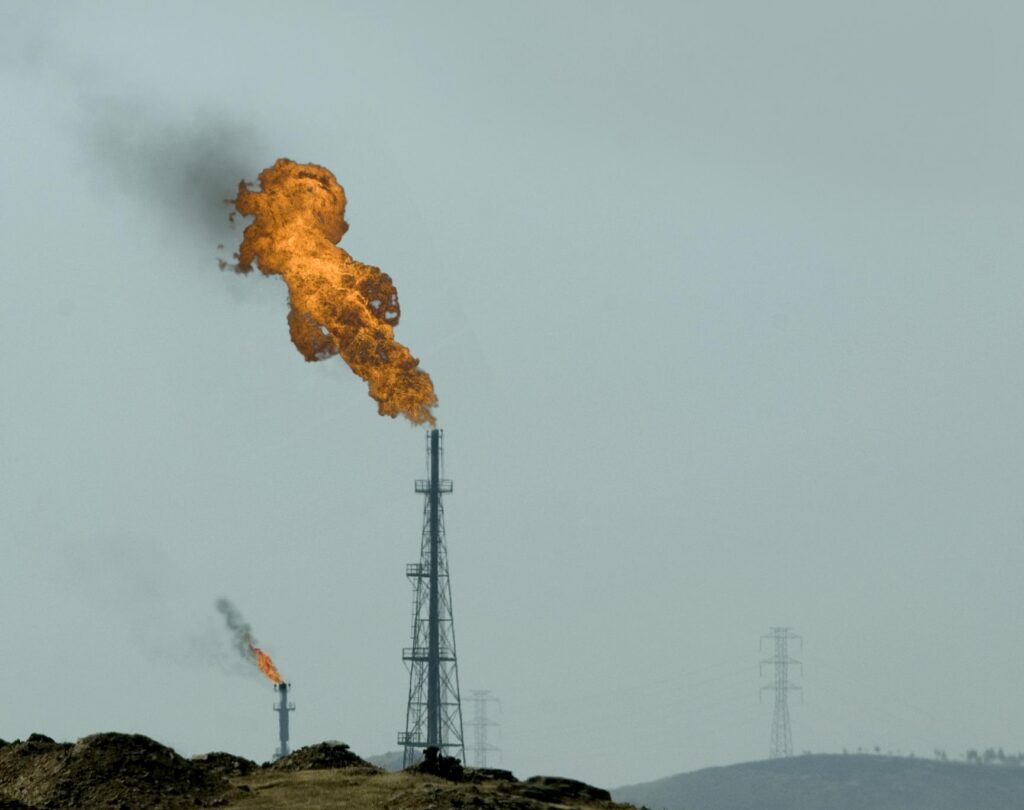
The massive U.S.-Israeli attack against Iran that began on Feb. 28, 2026, is the latest instance of U.S. aggression against an oil-producing state. Since Donald Trump returned to the presidency in January 2025, the United States has launched attacks in seven countries: Iran, Iraq, Nigeria, Venezuela, Syria, Yemen, and Somalia. The first five listed are all significant producers of oil. U.S. military actions are not just about the oil, of course, but oil is a common theme that’s hard to ignore.
Consider that only about 20% of the countries in the world are significant oil producers (more than 100,000 barrels per day), while five of the seven countries that the second Trump administration has engaged in militarily are oil producers. Statistically speaking, that correlation between oil producers and U.S. targets is very unlikely to be random chance (less than 1%). So, while the pattern could be just a fluke, it is worth thinking through the other possibilities.
U.S. foreign policy and oil
Each of these military actions has a distinct character, but oil sets the context. The latest Iran strikes, dubbed Operation Epic Fury, targeted a country that holds the world’s second-largest proven natural gas reserves and ranks among the top ten oil producers globally. Iran’s petroleum sector has been a central prize and central source of grievance in U.S.-Iranian relations since the U.S.-backed coup in 1953.
Strikes on Iraq followed a sustained campaign of attacks by Iran-backed militias on U.S. forces, in a country producing roughly 4.5 million barrels per day – and whose energy sector Washington is anxious to influence. Military action against Venezuela, which lays claim to the world’s largest proven oil reserves, came after Caracas defied U.S. sanctions and accelerated production agreements with Chinese and Russian partners. Strikes on Syria, a comparatively minor oil producer, were conducted against ISIS in a years-long fight across oil-rich territory – the same Deir ez-Zor region whose captured oil fields once made ISIS one of the world’s best-funded terrorist organizations.
Nigeria is Africa’s largest oil producer and an OPEC member, but the U.S. strikes in December 2025 appear driven by U.S. counterterrorism goals – and Trump’s posture as a defender of persecuted Christians. In Nigeria, the role of oil is not obvious – but might be an indirect influence of the resource curse, as I will explain.
Oil markets are rattled
Not unexpectedly, the U.S.-Israel attack on Iran is likely to disrupt the oil market. When markets opened on Sunday evening, Brent crude oil prices briefly surged past $80 per barrel. Traders are trying to price in the possibility that Iranian retaliatory strikes will close the Strait of Hormuz, through which roughly 20 percent of global oil supply transits daily. Still, oil markets are used to turmoil. The Middle East has been in some state of crisis for the better part of five decades, and actual supply disruptions have proven far rarer than the geopolitical headlines would suggest. Whether this time is genuinely different remains the central question for global energy markets in the days ahead.
So, let’s suppose the correlation between U.S. military targets and petrostates is not entirely spurious. What could explain this aspect of U.S. foreign policy? I see four possibilities, though they’re not equally probable.
The first and most conspiratorial reading is that the Trump administration is executing a deliberate, coordinated strategy to suppress global oil supply. Possibly in concert with the U.S. oil industry and/or Trump’s commercial partners in Saudi Arabia, UAE, and elsewhere, is the U.S. aiming to drive up petroleum revenues, profits, and market share to U.S. and friendly producers? In this scenario, attacking Iran, Venezuela, and Iraq is not incidental to energy policy; it is energy policy, pursued through military means. The logic is not without a certain dark coherence: Stranded barrels of oil in sanctioned or destabilized countries are barrels that American companies and their friends won’t have to compete against in the market.
Energy supply cuts can move markets dramatically. Indeed, my own co-authored research showed that the 2022 Russian invasion of Ukraine was enormously costly to Europe. And other research has shown that much of the energy profits from that war flowed to U.S. companies and wealthy investors. Moreover, there is circumstantial (though conflicting) evidence that the Trump administration has been attentive to the preferences of U.S. oil executives, who were among the most enthusiastic supporters of his 2024 campaign. Yet this explanation requires an account of who exactly within the Trump administration is carrying out this strategy. A sustained, globally coordinated strategy would likely require a degree of inter-agency discipline and long-range planning that the second Trump administration has not demonstrated in any other domain.
A more nuanced explanation
The second possibility is more nuanced: The Trump team has multiple, overlapping motivations for each of these military actions. Suppressing non-U.S. oil production is rarely the primary driver for military action, but it is a recurring contributing factor that makes certain targets more attractive than others. In this light, the U.S. targeted Iran – a revolutionary theocracy with a suspected nuclear program – because Iran supports groups that threaten Israel, and because it has opposed American presidents for 40 years. But the fact that crippling Iran also happens to remove a significant competitor from the global oil market is not lost on Trump’s advisors.
Similarly, to the Trump administration, Venezuela was a target in early 2026 because its president, Nicolás Maduro, was an authoritarian who stole an election and jailed opponents. But Trump’s remarks at a Jan. 3 press conference also made it clear that the prospect of opening Venezuela’s oil reserves to American corporate partners is part of the strategic calculation that makes regime change appealing. Oil may not be the principal factor behind the U.S. attack – but oil makes the case for action more persuasive internally, and easier to sell to key constituencies. The U.S. incursion in Venezuela seems like the best evidence in support of this account, but the other cases don’t fit as well.
Two other possibilities
The third explanation is the one I find most persuasive: The U.S. attacks are targeting what we might call “bad actors” in the international system, and the political economy of oil makes petrostates especially likely to be bad actors. Michael Ross and others have shown that oil is associated with the “resource curse”: Countries that produce oil are more likely to be corrupt, governed autocratically, home to insurgent groups, and engulfed by civil war. These countries are even more likely to instigate interstate conflicts, as I demonstrated in my book, Petro-Aggression.
Iraq under Saddam Hussein, Iran under the Ayatollahs, Libya under Moammar Gaddafi, and Venezuela under Hugo Chávez and then Maduro are very different places – but all exhibit some of these pathologies. Not every oil producer falls victim to the oil curse (hello Norway, Canada), but the trend is there. In this account, the effect of oil is indirect: It leads to bad governance, which creates friction with the United States. The U.S. comes to view these states as bad actors, and that leads to military attacks.
The third explanation grows stronger still when you consider that Trump has harbored some of these grievances for decades. Starting in 1979, Iran held U.S. hostages, expropriated from U.S. oil companies, and built an anti-American ideology on the foundation of its petroleum revenues. In the 2000s, Venezuela under Chávez nationalized American assets and used oil money to fund anti-U.S. political movements across Latin America. Stretching back decades, Iraq, Syria, and Libya went against U.S. strategic preferences.
Trump was publicly and repeatedly furious that previous U.S. presidents failed to deliver decisive blows against these adversaries. In his second term – and eager to dominate the news cycle with displays of American strength – it seems plausible that Trump is settling old scores. The oil connection is real, but it is as much historical as it is forward looking: These countries have attracted Trump’s ire partly because their oil wealth gave them the means to act defiantly or disruptively.
A fourth explanation is the most speculative of the lot but deserves consideration. China imports roughly 10 million barrels of oil per day. In recent years a significant portion of that has come from Iran and Venezuela, with Malaysia serving as a key transshipment hub, blending and re-flagging discounted barrels before they arrive in Chinese ports. By attacking Iran and squeezing Venezuela, the U.S. disrupts this sanctions-laundering pipeline.
China still needs the oil, but it now must source it from somewhere else. And the likeliest sources would be the U.S. and its partners (especially Saudi Arabia and the UAE), which stand to pick up market share in the world’s largest importing nation. The strategic prize is not just revenue; it is leverage. A China that depends on U.S.-friendly suppliers for a meaningful share of its energy imports is structurally more vulnerable to U.S. pressure. Beijing is certainly aware of this possibility and has been building China’s strategic reserves to mitigate the risk.
Whether anyone in the Trump administration is thinking in these terms, rather than simply acting on grievance, ideology, and domestic political incentives, is genuinely unclear. The Trump administration has not articulated anything resembling this logic. Attributing this degree of strategic foresight to an administration that often operates by instinct would require a significant leap of faith. But the effect, intended or not, may be real.
Where does this leave us?
None of the four explanations offered here can, on its own, account for the full pattern behind U.S. policy. The honest answer is that different explanations carry different weight for different attacks, and any single-variable account of Trump’s foreign policy goals will be incomplete. Yet there is an understandable temptation to reduce the U.S. military adventurism to Donald Trump’s personal psychology. The impulsiveness, the score-settling, the appetite for dominance: Yes, these all appear to be real factors, and they matter.
But personal psychology and calculated interest are not mutually exclusive. Trump’s instincts may be the engine, but there are passengers in that vehicle – oil industry donors, Persian Gulf players, Israeli strategic planners, and U.S. advisors with their own agendas – who have strong incentives to help point U.S. policy in directions that serve their own goals. The petrostate pattern may be less a strategy than a convergence: Trump’s grievances and impulses aligning, repeatedly, with the material interests of powerful people who know how to make the most of these opportunities. And convergences like this may be more dangerous than a conspiracy, precisely because the connections are harder to see and harder to stop.
Jeff D. Colgan is the Richard Holbrooke Professor of Political Science at Brown University and the author of Partial Hegemony: Oil Politics and International Order (Oxford University Press, 2021) and Petro Aggression: When Oil Causes War(Cambridge University Press, 2013). He is on BlueSky at @JeffColgan.
Stay up to date on all things politics and political science. Bookmark our landing page and sign up for Good Authority’s weekly newsletter by entering your email address in the box below.