






President Donald Trump seems to revel in humiliating rivals at both home and abroad. He has mocked European allies as “weak” and “stupid” – and bullied Ukrainian President Volodymyr Zelenskyy in the Oval Office. Trump has called women reporters “stupid,” “ugly,” and “piggy.” To Trump, political opponents and marginalized immigrant groups have “low IQs.”
And of course, Trump is not alone in taking the combative road. Humiliation is everywhere in contemporary politics. We see it in soldiers’ treatment of prisoners, in regimes as diverse as the U.S., Israel, Iraq, and Syria. We hear it in China’s calls for national rejuvenation as a means to overcome a “Century of Humiliation.” We witness this in Vladimir Putin’s demands to dominate Ukraine. It is surprising, then, that political scientists have written little on humiliation as a core element of politics.
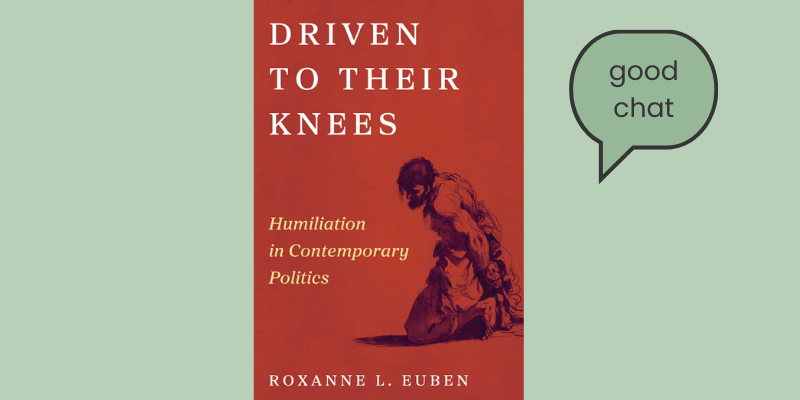
In her new book, Driven to Their Knees: Humiliation in Contemporary Politics, University of Pennsylvania political theorist Roxanne Euben dives into this critical gap, centering on how humiliation has come to pervade, reflect, and reshape our civic life. I sat down with Professor Euben for a Good (though deeply unsettling) Chat.
Stacie Goddard: One of your book’s main arguments is that humiliation is pervasive in politics, and yet we have spent little time defining or thinking about what humiliation is or how it works in our contemporary political life. Can you give us a definition of humiliation, and explain why it is political?
Roxanne Euben: While you may be hard-pressed to put it into words, if you’ve ever been humiliated, you know how it feels. That’s where I begin, because humiliation is a feeling as much as an idea or concept. It’s perhaps best captured by the phrase, being made to “eat dirt.” What I try to do is connect that intuitive feeling to a conceptual definition so that we can figure out how it’s reshaping politics.
We often talk about “being humiliated,” but that passive voice hides what’s so important about humiliation: There are always two figures involved, the one who acts – the humiliator – and the one who experiences it – the humiliated. So a relation of power and powerlessness is at the very heart of humiliation, both as an act and an experience. That’s what makes it so different from shame, although the two emotions are often, and inaccurately, used interchangeably. Shame involves a recognition of your own inadequacy. Humiliation, however, is when impotence imposed upon you by someone with the power to, metaphorically speaking, forcibly shove you into the ground, face in the dust. In political life, there are also always witnesses to it, so humiliation isn’t a private experience but a very public one.
I deliberately use the word “impotence” because it throws a spotlight on how power itself is gendered. Masculinity still conveys the right and expectation of power. In these terms, the ability to humiliate symbolically signals virility – and to be humiliated is to be emasculated. Humiliation is like a visceral switch that converts powerlessness into a condition that’s not only undeserved but intolerable – something that urgently demands to be fixed. That’s what often makes it so politically explosive.
So one of your major points in this book is that to ask if humiliation is “rational or emotional” misses the entire point?
Right, but just to be clear: This isn’t because there are no such things as historical facts. Or that there’s no way to distinguish between truth and delusion. Or that, to be good and tolerant people, we have to avoid judging one another.
My point is more that you and I may agree about when it’s rational and legitimate for someone to feel humiliated, but that doesn’t help with the work of decoding it. And decoding it is politically urgent because, whatever the language, humiliation tends to work symbolically and viscerally as a goad or incitement to act, even violently.
You note in your book that this has really been a subject of moral philosophy, and not of politics. What was it, then, that drew you to the topic of humiliation?
The seed was planted after the photographs from Abu Ghraib, a U.S. military prison in Iraq, began circulating in 2004. Pundits, scholars, and journalists who often agree on little else kept invoking “humiliation” to refer to these photos, but without ever saying what, exactly, humiliation is. Once I focused on it, I started to see it invoked everywhere. We’re told that humiliation is a major driver of international violence. That the U.S. withdrawal from Vietnam is the national humiliation that’s haunted every American foreign venture since the April 1975 fall of Saigon. That Russia was humiliated when it lost the former Soviet republics in 1991. That U.S. troops stationed in Saudi Arabia is a humiliation of Islam. That Trump is the “master humiliator” who can’t tolerate any humiliation. That the rise of Nazism was precipitated by the humiliation of Germany after World War I.
I mean, China even named an entire epoch “the Century of Humiliation.” How can humiliation be at one and the same time an act and an experience, a cause and a consequence, a trope and an event, an emotion, and an epoch? Even more perplexing: Why is there so little effort to define it or even just specify what they mean by it? The one exception, as you rightly point out, comes from moral philosophy, where humiliation is defined as a violation of dignity or respect. The trouble is, this definition tells us almost nothing about humiliation. Instead, humiliation is rerouted into the question of what qualifies as a violation of dignity or respect.
All of this gradually coalesced into a puzzle hidden in plain view. Humiliation is pervasive and politically potent, yet almost no one has made any effort to define what it actually is.
You treat humiliation as political rhetoric, one that can manifest in different ways. It can be visual, verbal, or, as you call it, embodied. What does it mean to approach humiliation as rhetoric?
I wanted to build a conceptual understanding of humiliation from the bottom up, starting with how actual people invoke it, enact it, resist it. That really pushed me to look at rhetoric, as it encompasses many different kinds of public communication, including but not limited to words.
Humiliation rhetoric is expressed verbally, for sure, but also through images and especially through a body language with a consistent vocabulary: male bodies bent over, bowing down, or on their knees. It’s there in the December 2023 videos and photographs of heavily armed Israeli soldiers guarding Palestinian men who are barefoot and kneeling, hands bound and heads bowed, sometimes stripped to their underwear. It’s there in the succession of beheading videos released by ISIS in 2014 where American and British captives kneel at the feet of their executioner, hands bound and heads shaved.
It’s actually kind of amazing how many different contexts and places this same body language recurs. In a sense, it becomes like an affective Esperanto, intelligible to people almost everywhere, no matter what language you actually speak.
Humiliation is pervasive, but you are particularly interested in the study of humiliation in Islamist discourse. Do you think humiliation is particularly present in those political movements?
Islamist rhetoric is definitely saturated with references to the “humiliation of Islam” and repeated exhortations to make the enemies of Islam “taste the humiliation” that has been inflicted on Muslims. Islamists provide no definition of it, nor does the massive commentary and scholarship on Islamism. So, it’s less that these movements are uniquely focused on humiliation than that Islamist rhetoric really spotlights that puzzle hidden in plain view that drew me to the subject to begin with.
You argue that humiliation is pervasive in contemporary civic life. Why is that the case, and what do you think the repercussions are likely to be?
We know that humiliation has pervaded public life in the past as well as the present. We can also see that dominant gender norms linking masculinity to the expectation and exercise of power extend far back into recorded human history. So then and now, humiliation rhetoric works to goad and incite: it turns a sense of powerlessness into the feeling of unendurable emasculation, and makes spectacular acts of virility the only remedy.
At the same time, the world in which humiliation rhetoric now operates is radically different. Perceptions of powerlessness, feelings of humiliation, demands for retaliation are all amplified, accelerated, and intensified by social media, the 24-hour news cycle, and AI. The stakes and costs of humiliation are all ratcheted up in ways unimaginable in previous epochs.
Any way out of this hellhole?
It’s impossible to predict what will happen, but I know it’s hard not to feel completely powerless these days. Based on my research, I’d say the endless cycle of humiliation and retaliatory humiliation that’s particularly conspicuous in politics right now isn’t necessarily inevitable or inescapable. To see this, we have only to look at the different moments and examples of challenges to soul-crushing experiences of domination where people don’t seek to humiliate their humiliators but reject that hierarchy altogether.
The example of the 2011 Egyptian revolution is just one case in point. A chorus of tyrants and experts tell us that the Arab uprisings “failed” because only raw cruel power prevails in politics; the implication is that challenges to overwhelming force are unrealistic and pointless. They’re wrong. We have to bear witness to these moments so that we don’t contribute to the ongoing efforts to erase their achievements from history. And, to paraphrase an important 20th-century theorist, resistance to domination is always possible as long as memory of political challenge survives.