





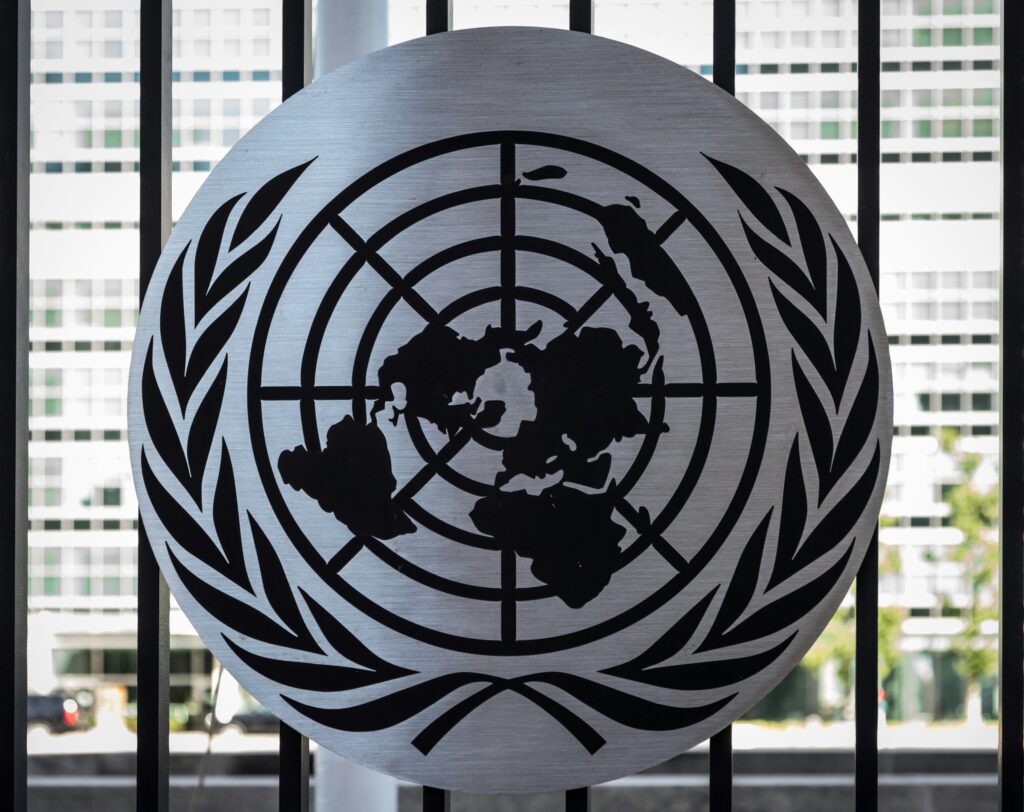
Eighty years ago, on Oct. 24, 1945, the United Nations Charter entered into force. For U.N. Day 2025, Good Authority editor Erik Voeten talked with Anjali Dayal, associate professor of international politics at Fordham University, about what the U.N. has achieved, and the challenges ahead for multilateralism and the U.N.’s role in global peace. Dayal studies U.N. peace operations and the politics of the U.N. Security Council, and is the author of Incredible Commitments: How UN Peacekeeping Failures Shape Peace Processes (Cambridge University Press, 2021). The transcript that follows has been lightly edited for length.
Erik Voeten: The United Nations is celebrating its 80th anniversary this year. You have a podcast about the U.N. titled “To Save Us From Hell.” It’s a reference to that classic quote from former U.N. Secretary General Dag Hammarskjöld: “The United Nations was not created in order to bring us to heaven, but in order to save us from hell.” What do you think the U.N. has done to save us from hell?
Anjali Dayal: The United Nations is sort of a hybrid beast. It’s a global institution that outlaws aggressive war, but it’s organized in an internally contradictory way. On the one hand, the U.N. binds the great powers of its day into an institutional framework for protecting post-colonial sovereignty, order, and rights. On the other, it gives them essentially 19th-century imperial powers to shape international peace and security. For its most idealistic framers, the hope was that the U.N. would prevent a third world war while embracing a kind of global new deal, but even those framers weren’t utopians or optimists. That Hammarskjöld quotation encapsulates the idea instead of an organization engaged in the work of mitigation, helping divert us from the worst possible paths – not a utopian organization designed to produce the best of all possible worlds. I think we can really see that effort to mitigate and divert the worst when we look at two key arenas of the U.N.’s work: peacemaking and peacekeeping in civil war; and advancing public health.
First, U.N. peacekeeping is a historically novel tool that places international troops in service of a negotiated peace. When parties to a conflict sign a peace agreement and are looking for help to implement it, deploying U.N. peacekeepers turns out to be a remarkably effective way to help build peace. It’s certainly not a perfect tool – and at its worst, peacekeepers have abused people they were charged with protecting, or stood by while people died by genocide. And an important critique is that the continued presence of peacekeepers in places like the Democratic Republic of the Congo seems to promise people security, even as peacekeepers simply cannot deliver security in the absence of negotiated political solutions.
And yet in the aggregate, study after study has found peacekeeping is remarkably successful – in fact, the more ways we measure it, the more successful it appears to be, from helping peace last longer to keeping conflict from bleeding across borders, to helping protect civilians under threat from rebel forces. Echoing Hammarskjöld in 2015, former peacekeeping chief Jean-Marie Guéhenno called U.N. peacekeeping “the last station before hell,” and it has seemed to serve that purpose. Peacekeeping also is often part of a complex package of aid and humanitarian and refugee assistance – all systems that are worthy of critique and flawed in many ways, but that can help make the difference between life and death for civilians in conflict zones. Taken together, we can look at it as a multilateral strategy to try and make powerful countries invest in staving off the worst for some of the most desperate people in the world.
Second, even though the World Health Organization (WHO) – a specialized U.N. agency – has been shadowed by COVID-era failures, it’s also had profound global successes. A key example: WHO’s efforts to counter the wild polio virus – the Global Polio Eradication Initiative launched via the World Health Assembly in 1988. Building on the success and example of smallpox eradication, and through technical assistance at a global scale; research, advocacy, and outreach; and global coordination, the campaign oversaw a 99% drop in the reported global incidence of polio by 2000. As Alex de Waal has written, this is a form of progress so deep we tend to take its gains for granted, making governments feel safe neglecting or breaking apart the relevant arrangements “on the assumption that the normal trend was for public health to get better and better.”
We see a parallel trend within the larger U.N. system, if we go back to the framers’ original pitch: an organization that outlaws war and binds superpowers to an institutional framework where they negotiate differences instead of solving them on the battlefield. The U.N.’s 80 years have been far from peaceful, and great power conflicts have killed millions of people across the developing world. But to some extent, the most notable way the U.N. has routed us away from hell is that it has bound these superpowers, however imperfectly, to a legal framework that they seem to find more value in than they do direct confrontation. That may yet unravel, of course, and it’s hard to demonstrate that we haven’t seen direct great power conflict because of the U.N. But as your own work demonstrates, that’s always been an ideological arrangement as much as a convenient one.
Today’s U.N. is experiencing multiple challenges, including a severe budget crisis and concerns that the organization has not played a key role in addressing major conflicts, like the Gaza crisis and the Ukraine war. Do you think there is a risk that more countries will start seeing the U.N. as unimportant for addressing the world’s problems?
There’s definitely a risk that the U.N. becomes less relevant in the next decade, and eventually fades into a kind of vestigial body that simply convenes member states, yet lacks a lot of operational or organizational ability. It might still coordinate agreements on global issues, but one consequence of slashed funding, fading legitimacy, and the U.S. government’s active efforts to try and break consensus around things like the Sustainable Development Goals could be that member states committed to cooperation focus instead on regional organizations. And countries that are less committed to cooperation turn inward.
That said, I don’t think we should write the U.N.’s obituary yet. As recently as September 2024, U.N. member states made a strong, collective statement about reinvesting in the U.N. system and making sure the institution was fit for future purpose. That was before the dramatic U.S. foreign policy shifts and foreign aid cuts in 2025 – but in recent months, countries have coordinated under the U.N. umbrella on things like a new Pandemic Treaty and an agreement to introduce a cargo shipping emissions tax. This last agreement, which the U.S. just delayed, is vital for small island nations in their fight against rising seas.
There’s clearly an appetite for a global organization – and to make this one better. There’s also a need. The international order the U.N. creates may be underwritten by powerful countries, but it’s necessary for smaller countries to survive – both legally and physically. And those smaller member states continue to be the most vocal advocates for a better U.N., not no U.N. So to the extent that those countries continue to be able to exercise their voices in international politics, I think we should expect to see efforts to reinvigorate the U.N., not abandon it.
A long-standing concern is that the United Nations, and especially the Security Council, still reflects the world order as it was in 1946. Whenever I travel outside of Europe and North America, this is the main issue people talk about with regard to the U.N. Is there any prospect for breaking the impasse?
Because the Security Council is by design explicitly and plainly unfair, advocating for change – even as lip service – is a pretty popular political objective. In one hopeful sign, member states adopted the Pact for the Future, a recommitment to multilateralism, in September 2024. This includes an explicit commitment to expand the membership of the Security Council – adding seats to better represent Africa, Asia-Pacific, Latin America, and the Caribbean. Other changes call for reconsidering the Security Council’s working methods and the role of the veto.
So everyone agrees the U.N. Security Council needs to be reformed, but there are two key stumbling blocks to actually breaking the impasse. First, you need the powerful permanent five members of the Security Council – the P5 – to sign off on the very changes to the U.N. Charter that would make them less powerful, which is a heavy lift at the best of times. And second, countries and regional blocs disagree on what exactly these changes should look like – obstructing collective efforts to reform even before we get to the P5 and their vetoes. There are competing reform platforms and new grassroots movements for U.N. Charter revision about the big questions of who should sit on the Security Council and with what powers – and those are all before we get to the important secondary questions of voting rules and procedures. The axiom is basically that everyone agrees the Security Council needs to change, but nobody agrees on how.
I’ve argued there are two primary ways for the U.N. Security Council to become more just and equitable: by embracing more democratic, representative membership, or by producing more equitable outcomes via mechanisms like enhanced transparency or agreements to restrict veto use. I think changes that require revisions to the U.N. Charter, like formally expanding membership or ending veto power, are extremely unlikely. We’ve seen only five amendments to the U.N. Charter since 1945, and the process requires approval from two-thirds of member states in addition to the P5. In the early years of the Biden administration, there was a lot of U.S. energy around Security Council changes, but these efforts faded as war in Gaza dominated the U.S. agenda at the Security Council. And the Trump administration’s approach to the U.N. is antithetical to change – Project 2025 advocated for an à la carte approach to U.N. membership that essentially said the U.S. could abandon any other part of the U.N. system that wasn’t working as it wanted as long as it retained its veto-wielding Security Council seat. Russia has also said it won’t agree to any reforms that touch the veto power, and it’s doubtful the other permanent members would do so either, regardless of what they say publicly.
So there’s maybe no silver bullet for breaking the impasse. If we’re in a moment of flux for the international system, then there’s certainly the possibility that what comes ahead is worse – a Trump administration committed to shoring up the U.N. Security Council’s disproportionate power in service of its own illiberal foreign policy goals would no doubt scupper efforts to update the U.N. system. But we could also see slow change toward something more representative. There are other, less formal ways for the body to change, and transformations that stem from shifts in diplomatic practice might seed the ground for other, more significant changes.
The Security Council has only undergone one formal reform, in 1963. That effort expanded the elected membership in ways that fundamentally changed the Security Council’s work and practices via the newly elected membership’s efforts to build new coalitions, working methods, and new ways to break the P5’s monopoly on power and information, while advancing new conceptions of peace and security and new thematic issues and agendas. And neither the United Kingdom nor France has cast a veto since 1989. Taken together, these shifts mean the Security Council now considers questions of human security; women, peace, and security; and humanitarian aid in ways that have been normalized. So diplomats in these roles today have an opportunity to keep deepening a practice of inclusive multilateralism, and perhaps even trying to strengthen other bodies – like working to build U.N. General Assembly tools for managing peace and security or mechanisms for accountability in mass atrocity situations. It’s not really breaking the impasse, but it might shift some outcomes.