






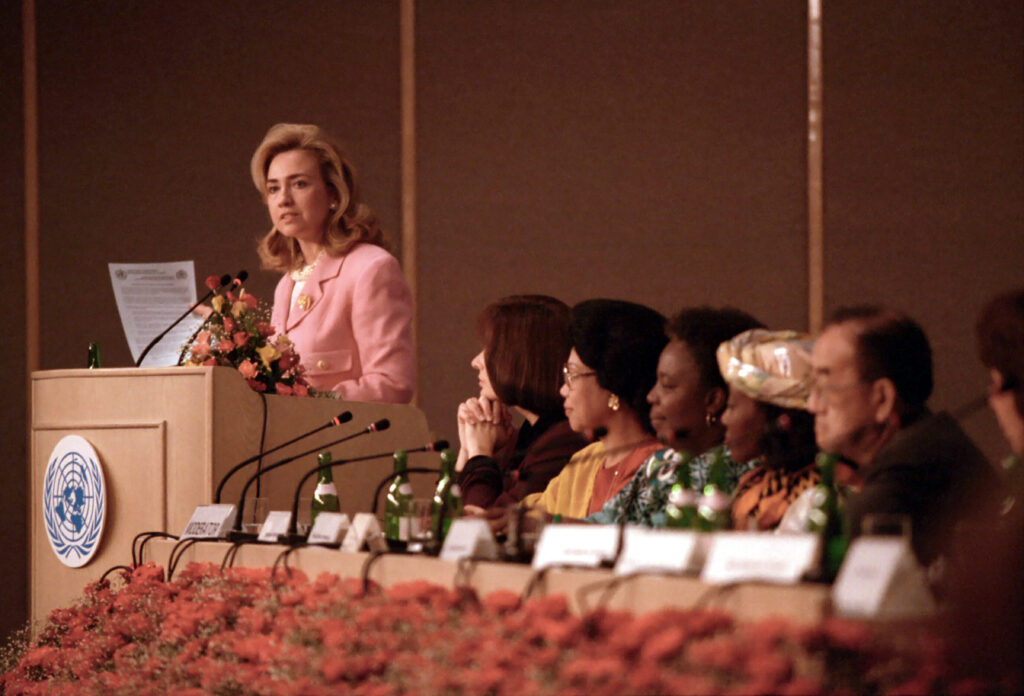
This month we mark the 30th anniversary of the U.N. Fourth World Conference on Women, held in Beijing in 1995. This landmark event resulted in the Beijing Declaration and Platform for Action, a comprehensive policy agenda that remains a pivotal reference point for advancing women’s rights worldwide. This was also the conference where Hillary Rodham Clinton, America’s first lady at the time, gave her now-famous speech, proclaiming that “women’s rights are human rights.”
In the three decades since then, the conference has inspired numerous initiatives and policy amendments, addressing critical issues such as education, health care, and political participation for women. Good Authority editor Stacie Goddard sat down with historian Allida Black for a Good Chat about the September 1995 conference and its relevance to politics and society today. Here’s a lightly edited transcript of that discussion.
Stacie Goddard: It has now been 30 years since the Fourth World Conference on Women, and the Beijing Declaration. Why was this gathering so significant, and why does it continue to hold importance today?
Allida Black: The Fourth World Conference on Women in Beijing was pivotal because it was the first time women’s rights were clearly articulated as human rights on a global stage. Previous conferences in Mexico City, Copenhagen, and Nairobi expanded the dialogue on women’s issues, but Beijing is where these issues were indivisibly linked to human rights. Hillary Clinton’s speech was groundbreaking, stating unequivocally that violations against women are violations of human rights. Despite political resistance to her attendance, her presence and that speech were crucial in setting a new global standard.
Can you elaborate on the connection between that conference and the Universal Declaration of Human Rights?
The Beijing Conference built on the Universal Declaration of Human Rights by integrating women’s rights into its framework. Article 1 of the Declaration, which states that all human beings are born free and equal, was a foundational principle that the Beijing Declaration expanded upon. The conference emphasized that women’s issues are central to human rights, not separate from them. This was a continuation of [former first lady] Eleanor Roosevelt’s vision when she helped draft the Declaration.
The Beijing Conference is really important because it’s where women’s rights as human rights became indivisibly intertwined. And that’s why Clinton’s speech is so important – because nobody in the history of the world has said before the world in such a clearly delineated way that women’s rights are human rights. When women are denied the right to education, it is a violation of their human rights. When women are denied access to reproductive care, it is a violation of their human rights. When women are raped in war, it is a violation of their human rights. So, now returning to the Universal Declaration of Human Rights, you cannot remove women from this equation. They are not a satellite. They are not parallel to it. They’re an integral part of it.
One difficulty with the recorded speech is that the video captures the dispassionate tone of the speech and Clinton’s fierce focus. But the feed of the speech cuts off before you actually hear the reaction of the room. One of the Secret Service agents who was stationed nearby dashed inside. He told me that he had run into the building because he thought a bomb had gone off; the roar of the crowd was that loud.
How did the Beijing Platform for Action, an agenda for women’s empowerment, influence national legislation, given that it’s not legally binding?
The Beijing Platform for Action had a significant impact by setting standards that countries committed to implementing. We can take the example of human trafficking. In 1996, Clinton was working with U.N. Ambassador Madeleine Albright and other people both in the White House and in the Interagency Council on Women to have a series of what was called the Vital Voices conferences, conferences designed to further the rights of women. The Beijing Platform emphasized women’s basic human rights, such as the right to earn an income, travel, have a voice, and organize.
In 1996, Hillary Clinton, alongside Madeleine Albright and others, initiated the Vital Voices conferences, starting in post-Soviet states. These meetings revealed alarming reports of women disappearing, trafficked for economic or sexual exploitation. This issue became a significant policy test post-Beijing, leading to the Palermo Protocol, which condemned trafficking as a severe human rights violation.
In the U.S., Clinton’s team spearheaded the Trafficking Victims Protection Act, supported by a diverse coalition that included the Christian right and labor groups. This resulted in the creation of the Trafficking in Persons Office in the State Department, which was instrumental for 25 years. In 2009, Secretary of State Hillary Clinton, working with Melanne Verveer [the first U.S. ambassador for global women’s issues] advanced the U.S. National Action Plan, integrating women’s safety and security across government policies. These initiatives were direct outcomes of the momentum from Beijing.
Given the current global backlash against women’s rights, is it time for another conference on women?
I would only support a new convention if it reaffirms, rather than weakens, the principles of the Beijing Declaration and the Platform for Action. The challenge today is achieving global consensus without diluting these principles. Instead of a new convention, we need sustained dialogue on universal rights and a reaffirmation of the commitments made. The aspiration of these documents should guide us, allowing for progress when opportunities arise.