






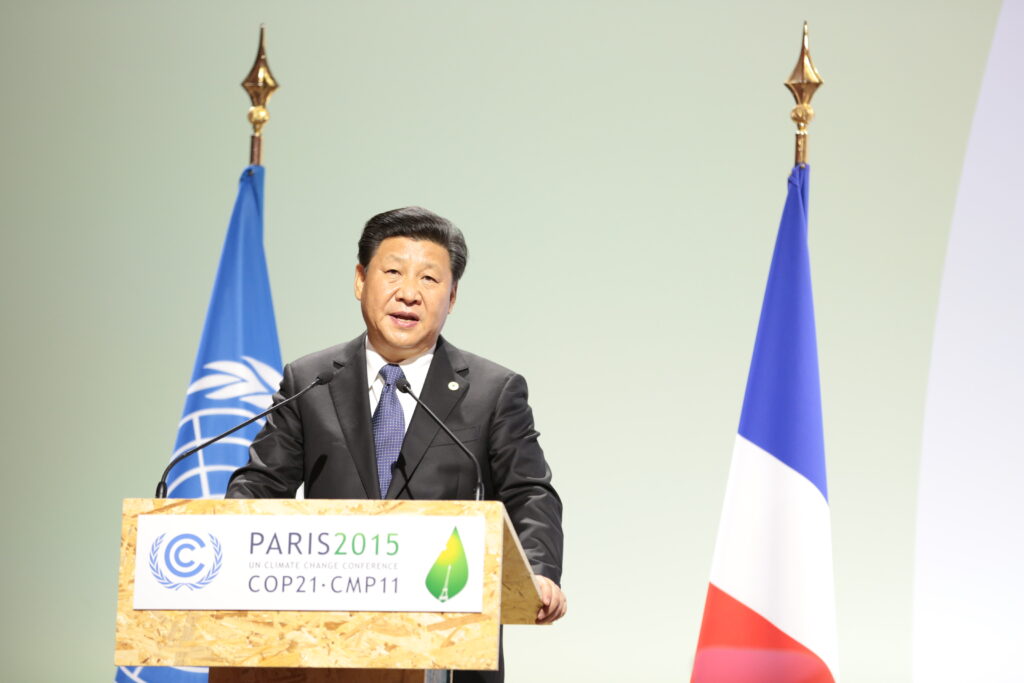
Chinese President Xi Jinping made a surprise (virtual) appearance at the U.N. General Assembly meetings on Wednesday, Sept. 24 to announce China’s new nationally determined contribution (NDC) to global climate action as part of the Paris Agreement processes. For the first time, China specifically pledged to decrease carbon emissions, though the pledged level of such reductions – 7% to 10% below an unspecified peak by 2035 – was disappointing to many analysts. Of course, given the U.S. intention to pull out of the Paris Agreement once more – and the U.S. president just one day earlier calling climate change a “hoax” and a “green scam” – Xi’s announcement at least indicates that China is still interested in pursuing climate action.
China is by far the world’s leading emitter of heat-trapping pollution, accounting for roughly 30% of the global total. This means that Beijing’s actions are of paramount significance for the future trajectory of atmospheric concentrations of greenhouse gases. China is also the dominant producer and consumer of clean technologies – solar, wind, and batteries – that are critical to transitioning away from the fossil fuels that are mainly responsible for planetary warming. A key portion of China’s NDC was expanding installed capacity of solar and wind to 3,600 GW by 2035, up from around 1,400 GW today.
China wants to play a major role in climate solutions
These contrasting facts make China the pivotal actor in global climate politics. This week’s announcement also resembled a similar video announcement that Xi Jinping made five years ago. At that time, Xi pledged that China would not just peak emissions before 2030 but also be carbon neutral by 2060. This level of ambition shocked the world and led to a cascade of other pledges from countries and companies. If Xi was hoping to recapture some of that adulation with yesterday’s announcement, he was mistaken.
China routinely does underpromise and overdeliver, but the level of ambition represented in the emissions and energy transition metrics was particularly weak. Even overdelivering would look like a slowdown from China’s current pace of deploying clean energy and reducing its carbon emissions.
One could go so far as to argue that between the U.S. pulling out of the agreement and China’s pitiful pledge, the international agreements that had long been central to global climate diplomacy are crumbling in significance. But before doomerism takes hold, there is a sense in which the change in climate politics is positive. We seem to be shifting away from global climate politics that focus on climate mitigation as a wicked problem requiring collective action. Instead, more countries are heading towards an energy transition that will cause major distributive effects.
For all of the difficulties of navigating those distributional politics, they are far more tractable than the world of less energy, less consumption, and slower growth that underlaid the prior architecture of climate diplomacy.