





For over 75 years, the Eurovision Song Contest has ruled the charts as the most unique, vibrant, and watched music competition, not just in Europe but around the world. Starting from a base of seven Western European democracies in 1956, the competition steadily grew to encompass Eastern European countries as well as Israel and even Australia.
Russia debuted in 1994, three years after the collapse of the Soviet Union, with “Eternal Wanderer.” In 2008, Russia won the Eurovision Song Contest with Dima Bilan singing “Believe,” backed by world-renowned Russian ice skater Evgeni Plushenko on a bathtub-sized ice rink. Banned from the competition in 2022 following its invasion of Ukraine, Russia is now looking to upturn Eurovision’s hold on sequins and soft power with a new rival contest: Intervision.
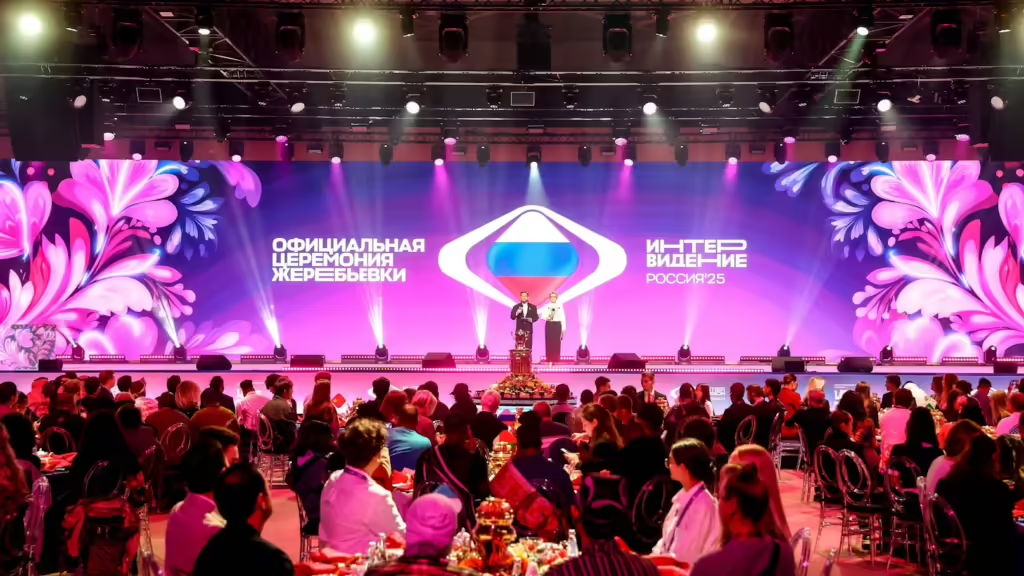
The “Intervision Song Contest” served as a sporadic alternative to Eurovision from 1965 to 1980. Spearheaded by Czechoslovakia and then Poland, the contest primarily featured Eastern European countries but also included Spain and other countries. This 2025 revival, which comes after a succession of unsuccessful attempts, is backed by Russian President Vladimir Putin himself. The contest took place in Moscow on Saturday, Sept. 20, bringing together 23 countries from Europe, Asia, Africa, North America, and South America.
Musically, the lineup stood out for its diversity. Venezuela provided infectious Latin beats, Cuba and South Africa much less so. Vietnam – spoiler alert – won with a somewhat chaotic anthem that sounded suspiciously like the last two Eurovision-winning songs. The organizers capped the night by announcing that next year’s Intervision will take place in Saudi Arabia.
Of course, it’s not just the music that draws global attention. Intervision also gives political analysts plenty to dissect, from its overt messaging to the surprising participation and eventual no-show of the United States.
Intervision matters beyond music
Eurovision organizers reiterate each year that the contest has “never been about politics.” However, recent and historic boycott threats call these claims into question. Already, five member countries – including Spain, one of the “Big 5” founding members – have threatened to boycott Eurovision 2026 if Israel is allowed to enter.
Intervision, on the other hand, according to Putin and Minister of Foreign Affairs Sergey Lavrov (who served as deputy chairman of the contest’s Supervisory Board), is a strictly apolitical contest designed to bring nations together through music and cultural exchange. In practice, though, nothing about Intervision is apolitical, starting with Putin’s opening video monologue in which the Russian president reiterated that Intervision would uphold “traditional values” and showcase the world’s cultural diversity.
Russia is the global convener
Unlike Eurovision, where participating countries must be members of the European Broadcasting Union (EBU), the Russian government directly invited countries to participate in Intervision. Lavrov highlighted that the lineup includes members of the Commonwealth of Independent States (CIS) and members of the Shanghai Cooperation Organization. Also included: all the founding BRICS members (Brazil, Russia, India, China, and South Africa), alongside newer additions such as Saudi Arabia, Egypt, the United Arab Emirates, and Ethiopia. The rest of the list includes BRICS partners like Cuba, Kazakhstan, Belarus, and Vietnam, as well as Venezuela and Colombia – two Latin American countries with ties to Russia. And then, of course, there’s the United States. While not every participating country is authoritarian, most certainly are.
One message is clear: Russia isn’t isolated. Instead, it’s leading a global coalition. The overwhelming dominance of BRICS and CIS countries makes Intervision appear more like a political summit than a music competition. Internationally, the participation of countries like the United States and Venezuela, despite their ongoing diplomatic tensions, underscores Russia’s role as a convener and reinforces the Kremlin’s narrative of international cooperation and peace-building as an endeavor led by Russia, not the West.
Andrii Sybiha, the Ukrainian foreign minister, criticized the event “as an instrument of hostile propaganda and a means of whitewashing the aggressive policy of the Russian Federation.” Russia’s use of the Intervision contest to prove its clout is also a double-edged sword. Azerbaijan’s withdrawal, citing recent tensions with Moscow, shows the fragility of this coalition.
Russia wants to rewrite global norms and values
Beyond the lineup itself, Intervision is purposely a projection of Russian priorities. From the very beginning, Putin positioned the contest as a showcase of “traditional values” and a rejection of the liberal norms that Eurovision celebrates, most notably LGBTQIA+ inclusion. One Russian politician even referred to Austrian drag queen Conchita Wurst’s 2014 Eurovision victory as “blatant propaganda of homosexuality and moral degradation.” During an announcement for Intervision, Lavrov also made a comparison to another cross-cultural event: “I guarantee that there will be no perversion and abuse of human nature as we saw in the Paris Olympics.” In contrast, Russia promised that Intervision will be a “moral” and family-friendly event, as the constant camera shots of children during the allocation draw event suggested.
So why is the U.S. represented – and who decided who would participate?
Most Intervision countries are represented officially, either by sending a delegation to Moscow or through a national broadcaster. The story of the U.S. participation is murkier. Who chose the American singer and jury member remains a mystery, and the lineup changed at the last minute. Just four days before the event, the organizers announced that Brandon Howard (purportedly Michael Jackson’s son) would be replaced by VASSY, an Australian singer of Greek descent – and recent American citizen – singing “Midnight.”
Ultimately, however, the singer never took the stage. When the U.S. turn to present approached, the intro segment quickly cut to the presenters announcing that VASSY had withdrawn due to “political pressure.” An official statement by Intervision attributed the withdrawal to “unprecedented political pressure from the Government of Australia.” By framing the pressure as a degradation of her freedom and offering “all necessary legal and organizational support,” Russia sought to claim the moral high ground. And framing the withdrawal as due to Australian pressure also let Russia retain the pretense of U.S. participation.
Few in the United States likely noticed the participation, program change, or U.S. withdrawal – or considered their implications. Abroad, however, U.S. apparent participation (international or not) carries a different weight. Simply being part of a program dominated by Russia and its allies signaled political and ideological support of Russia’s project. This message is amplified by the participation of Cuba and Venezuela, two authoritarian regimes hostile to the United States – as well as by countries with which the U.S. government has historically had complicated economic, strategic, or cultural ties.
Does it matter if the songs are good or bad?
The run-up to Intervision was rather slow. A handful of countries seemed to take the competition seriously, organizing national competitions and filming music videos for their songs. Others, including the United States, seem barely aware that they were even competing. Four countries – Saudi Arabia, Kenya, Brazil, and the U.S. – did not broadcast the contest at all. Lack of public voting – perhaps unsurprising given the high proportion of autocracies competing – might have dampened enthusiasm for the competition.
Still, dismissing Intervision as irrelevant would be premature. Eurovision itself began with a small audience and endured decades of mockery, until it became one of Europe’s most important cultural events and a significant source of soft power. Similarly, Intervision might undergo a similar transformation and grow into something much larger, with Russia at its center.
Alexandra Guisinger is an associate professor of political science at Temple University, co-principal investigator of the Foreign Policy in a Diverse Society project, and author of American Opinion on Trade: Preferences without Politics (Oxford University Press, 2017).
Mateo Perez Presmanes is a third-year undergraduate student at Temple University studying political science and global studies. His research interests comprise cultural diplomacy, soft power, and national identity.