




“Jimmy Kimmel Live” was back on the air Sept. 23, nearly a week after The Walt Disney Company suspended the ABC late-night talk show for Kimmel’s comments following the death of Charlie Kirk. The suspension sparked a controversy over cancel culture and the Trump administration’s pressure toward broadcast networks. In recent days, some Republicans have faced criticism for calling for a government-led crackdown against offensive speech. After all, one of President Trump’s first executive orders on Jan. 20, 2025, was a promise to “ensure that no Federal Government officer, employee, or agent engages in or facilitates any conduct that would unconstitutionally abridge the free speech of any American citizen.”
Such a turnabout among Republicans would seem to suggest a fundamental ideological change. Is a party typically associated with limited government now embracing the expansion of government power to shut down political expression it doesn’t agree with?
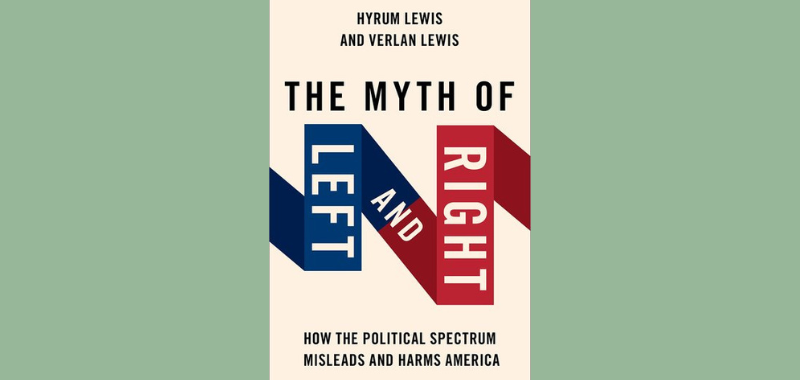
But a 2023 book suggests this is just more of the same in American politics. According to Hyrum and Verlan Lewis in The Myth of Left and Right, the two primary U.S. parties bundle together an unrelated set of political positions – and these positions change over time. Therefore, the authors point out, it doesn’t make sense to speak of the “left” and the “right.”
Is politics a clash between two worldviews, the left and the right?
The authors contend that although policy positions are often dressed up in principled language, justifications based on some essential compass are misleading. For example, are conservatives guided by a belief in limited government? The authors demonstrate that neither left nor right maintains consistent positions on “big government.” In fact, both sides advocate for greater or lesser government intervention depending entirely on the issue at hand and the historical moment. The recent Kimmel episode seems to validate the point.
Consider also the notion that conservatives are cautious about change. But if the status quo is high taxes, those on the right stand for change. Similarly, just as conservatives seek change when it suits them, liberals often desire to preserve elements of the status quo that they favor. For instance, before Roe v. Wade was overturned, Americans on the left wanted to preserve the status quo. Whether a person or a group resists or accepts change thus depends entirely on their view of the status quo on any given issue.
Aren’t some issues set in stone?
But don’t people on “the left” share certain political positions – and aren’t supporters of the left logically opposed to some coherent worldview of those “on the right”? Is there such a thing as a fixed set of left-wing and right-wing principles? The authors’ unambiguous answer is a strong “No.” They explain:
In the realm of social policy alone there are hundreds of distinct and unrelated issues, such as free speech, immigration, gay marriage, drug restriction, racial justice, abortion, law enforcement, and religious liberty, and yet we still use the term “socially conservative” or “socially liberal” as if all these disparate issues were one. Is someone who favors both gay marriage and stronger border enforcement socially “right wing” or “left wing”? The question itself, like the model that frames it, is meaningless.
Lewis and Lewis conclude that specific policy opinions or decisions to support candidates are not rooted in ideological essences, whether opposition vs. openness to change, or preferences for big versus limited government. Instead, what truly connects policy positions is people’s allegiance to others who self-identify in the same way (as being liberal or conservative; or on the left vs. the right). This social theory of ideology is also supported by research by John V. Kane, and a version of this was articulated in books by Christopher Achen and Larry Bartels and Donald Kinder and Nathan Kalmoe.
In other words, the political spectrum doesn’t reflect people’s philosophical values. Instead, it indicates their tribal commitments. “Ideologies do not define tribes, tribes define ideologies,” the Lewis brothers say. To say that parties or factions define, or try to define, what counts as left-wing or right-wing is surely worth considering.
The book looks at specific issues that may seem familiar but become quite striking when viewed together. These examples include dramatic changes in trade policy attitudes where parties reversed their positions in recent memory, to decades-old examples of reversals on foreign policy, and many others.
Is it possible to “move” left or right?
Lewis and Lewis conclude that people make statements about “moving left” or “moving right” – but such statements are meaningless. Here, I would retort that it’s surely possible for two parties to become “more distant” from each other on specific issues. So, even if the meaning of the left and right is socially (not philosophically) determined, I believe it is possible, and sometimes even informative, to make directional claims.
Consider a simple example: If Democrats’ preferred minimum wage is $15, and Republicans support $7.25, we have a coherent spatial ordering. And if we asked voters about their ideal number, we could place all voters on a line. It would make sense to say that a voter who believes “Democrats aren’t generous enough” is decidedly left-wing. We can then test a theory of issue voting by checking whether people with this view still vote for Democrats, given that Republicans are “more distant.”
Say I change my mind about the minimum wage, and conclude there should be no minimum wage at all. Then it seems coherent to say that “I moved to the right,” at least on this issue, or on the economic dimension. The book argues against a one-dimensional model of politics, and its critiques of such a model are excellent. But I believe spatial models of ideology can be useful if we make room for multiple dimensions.
The authors are correct to note that the role of principles in politics is sometimes exaggerated. And they point out that few people consult their deepest (essential) values when evaluating a new policy. Nevertheless, when I see a right-wing party cutting taxes and regulations, I am not surprised. (Though it is true that both U.S. President Bill Clinton and U.K. Prime Minister Tony Blair were business-friendly while representing the left, while President George W. Bush expanded the federal government, despite calling himself a conservative.) By the same token, if I see people on the left protesting austerity or privatization I am also unsurprised. This is likely because these actions do follow logically from other positions people hold.
Follow the leader – but not always
Yet how do we explain the fact that Republicans become more supportive of the minimum wage when they are exposed to hand-picked statements from their party leader who once took a pro-minimum wage position? In a survey experiment run by Michael Barber and Jeremy Pope, this is precisely what happened. This suggests that the initial position held by (some) Republicans was not strongly held; voters didn’t stick to some principle about being supportive of hierarchy, opposed to change, or preferring less government involvement in the labor market.
Importantly, however, voters do not always “follow their leader.” Remember how his supporters reacted when Trump admitted he got a covid-19 booster shot? Recent research also finds that “when a person believes an issue area to be more important, party cues are less likely to move that citizen’s position.” Mia Costa’s work shows, via several experiments, that Americans prioritize policy alignment and constituent services over partisan loyalty when evaluating representatives. In a similar vein, Elizabeth Simas shows that voters’ beliefs about policy often explain their behavior.
If I wanted to bolster the book’s argument, I could also look for evidence that people are equally happy to see policy change in either direction. And there is indeed such evidence. Patrick Egan has shown that the status quo is sometimes the least popular option among voters, who view both liberal and conservative policies as preferable to the existing policy. So, if citizens (sometimes) merely want “something to be done,” this would suggest that they are not guided by deeply held principles.
Still, it seems that people strongly attached to “their tribe” would not go along with a policy change that would move the status quo away from the one supported by their co-partisans. So if sometimes people merely clamor for something to be different, that would seem like a point not only against the essentialist theory, but also against the social theory of ideology.
Despite these qualifications, this is an intellectually stimulating book. Among its many insights, two stand out. First, when parties change positions, they inevitably change the practical meaning of “liberal” and “conservative.” Second, given that parties represent bundles of disparate issues, precision matters. That suggests we’d do better to describe positions in specific, issue-based terms rather than relying on nebulous claims that parties or groups are conservative or liberal.
Jan Zilinsky is a 2025-2026 Good Authority fellow.