





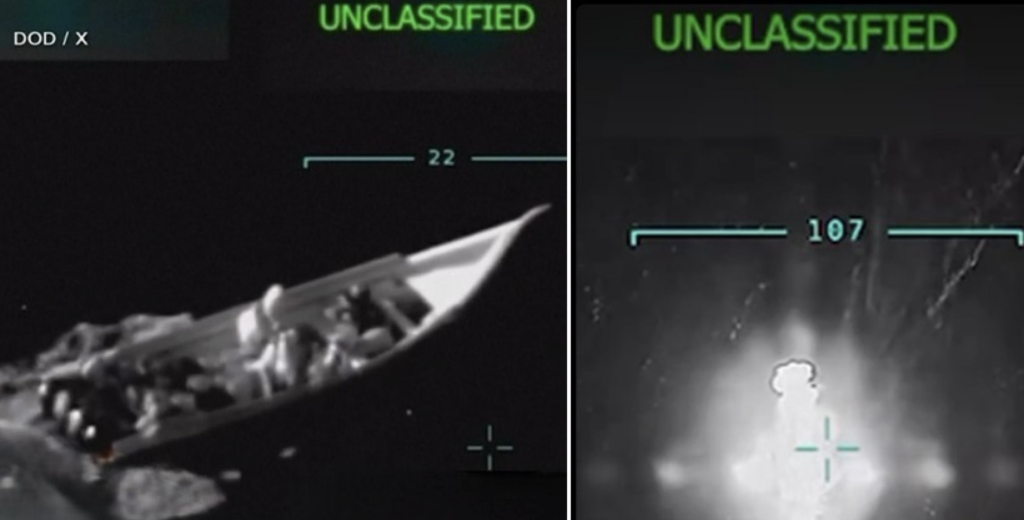
In the past month, the Trump administration has applied increasing military pressure on the Maduro regime in Venezuela. In addition to numerous military strikes on boats in international waters, Trump recently announced that he is considering land-based strikes in Venezuela.
Legal experts question the legality of these boat strikes under domestic and international law, citing the lack of evidence of imminent attack, and the fact that no group of Venezuelan narco-traffickers is at war with the United States. The Trump administration countered that the strikes are justified because the U.S. is in a “non-international armed conflict” with Venezuelan drug cartels nonetheless, without providing evidence. In the midst of these strikes, the head of the U.S. military’s Southern Command, whose area of responsibility includes the Caribbean and South America, resigned.
It is difficult to fully grasp the Trump administration’s current foreign policy goals in relation to Venezuela. The current strategy will not impact U.S. fentanyl overdoses, as fentanyl is primarily made in Mexico. And if the goal is to oust Nicolás Maduro and install a regime friendly to the U.S., the Trump administration seems to be ignoring numerous lessons from the past.
What’s happened so far?
In August, the Trump administration began building up U.S. military forces in the Caribbean: boosting the number of troops and naval and air assets. A U.S. military base in Puerto Rico, unused since 2004, has now reopened and become a hub for military activity in the region. The estimated 10,000 troops represent the largest U.S. deployment to the region in decades.
Since September, U.S. Special Operations forces have carried out at least seven strikes on boats in the Caribbean – purportedly Venezuelan drug-running vessels. These strikes have killed at least 28 people. The sixth attack hit a semi-submersible, a type of vessel sometimes referred to as a “narco-sub.” This attack, unlike the previous ones, left two survivors, neither of whom was Venezuelan.
In the midst of this overt military activity, on Oct. 15, Trump confirmed authorizing the Central Intelligence Agency to conduct covert operations in Venezuela. This type of authorization, known as a presidential finding, is usually “a highly sensitive and tightly guarded state secret.” Trump did not reveal the parameters of the authorization, but presidential findings may authorize the CIA to undertake actions such as carrying out targeted killings or supporting rebel movements.
Trump’s crackdown on Venezuela – and the U.S. war on drugs
Professors of international studies Jonathan Rosen and Roberto Zepeda explain that Richard Nixon first declared the U.S. war on drugs in 1971, but it was under Ronald Regan that drugs came to be framed as a national security threat. Then, following the Sept. 11, 2001, attacks, the U.S. war on drugs fused with the war on terror. Narco-terrorism became a foreign policy buzzword. Thus, Trump’s emphasis on narco-terrorists and drugs as a national security threat is consistent with the rhetoric U.S. officials have long used to frame the drug trade.
Likewise, drug interdiction – attempting to stop drug shipments from reaching their destination – has been an important pillar of the U.S. war on drugs. Yet blowing up boats and killing those aboard, without actually searching the vessel or following the legal process to formally charge suspected drug-runners, is new. Prior to the recent strikes, the Coast Guard would pursue boats suspected of carrying drugs, confiscate any drugs they found, and arrest those on board. Only if the boat’s crew refused to comply would U.S. officers use force.
Is Venezuela a big source of fentanyl?
The Trump administration claims the attacks are necessary to stop Venezuelan cartels from bringing fentanyl into the United States. Legal questions aside, the strikes on these vessels seem unlikely to have any effect on the U.S. fentanyl crisis. Venezuela is not a major player in the drug trade – and produces only limited drugs. And while Venezuela forms part of the broad map of drug transit routes, it represents a relatively minor one.
Regarding the specific attacks, the Trump administration has provided no evidence that the targeted boats were trafficking drugs. In at least some cases, the evidence suggests they were not. InSight Crime, a think tank focused on organized crime, analyzed information on the first boat strike and did not find the boat consistent with drug trafficking vessels. And Colombia’s President Gustavo Petro claims that the Sept. 15 attack hit a Colombian fishing boat that was adrift with its distress signal up due to engine failure.
A strategy for regime change in Venezuela?
Neither Venezuela itself nor the specific boats hit appear to represent targets of strategic importance in combating the U.S. fentanyl crisis. Thus, we might instead consider the boat strikes as part of a broader strategy to bring about regime change in Venezuela, which is how the Maduro regime is treating U.S. actions.
Research by political scientists Alexander Downes and Lindsey O’Rourke can inform how we think about this recent U.S. initiative as a foreign policy strategy. Downes and O’Rourke explored how covert efforts to bring about regime change affect relations between the target country and the intervening country. Two of their findings are particularly relevant to contemporary U.S.-Venezuela relations. First, they find that the majority of covert efforts to bring about regime change fail, and failed efforts increase the likelihood of conflict. Second, they find that even successful efforts generally fail to improve relations between the two countries.
The research is equally grim when it comes to other outcomes. Studies show, for example, that foreign-imposed regime change rarely leads to democratization – and has been associated with declines in real income. Historical precedent and contemporary scholarship both suggest that replacing a leader without implementing economic development strategies or institution building makes better relations and democratization even less likely.
U.S. policy as “a real life Sicario”?
It is hard to understand how contemporary U.S. policy towards Venezuela would bring about various potential goals: reducing drug flows into the U.S.; improving U.S.-Venezuela relations; or bringing about democracy and improved economic conditions within Venezuela – an outcome that might ease pressures on Venezuelans to emigrate.
Trump’s announcement that he cleared a path for covert CIA intervention increases the likelihood for protracted conflict. The Maduro regime responded by increasing military exercises and volunteer militia training. Even if a U.S. intervention were to succeed in removing Maduro from power, the U.S. has defunded or attempted to defund organizations that would have supported development and institution building abroad – like the Agency for International Development (USAID) and the National Endowment for Democracy (NED). In the past, these organizations would be working to bolster U.S. strategic interests in the region.
In a recent interview with the BBC, Mick Mulroy, former assistant undersecretary of defense, said that the presidential finding authorizing CIA action opened space for “perhaps a real life ‘Sicario’” in reference to the 2015 film. Sicario tells the story of an operation by a mix of U.S. intelligence and law enforcement agencies to take out a high-level Mexican cartel boss. A.O. Scott’s 2015 New York Times review of the film notes that the operation is “carried out with almost complete disregard for national sovereignty, the rule of law or basic human decency.” Scott continues, noting that U.S. government authorities act “not in the name of justice or security but rather of expediency and order.” Mulroy’s allusion suggests a dark vision of current policy toward Venezuela – and perhaps of U.S. foreign policy more generally.