





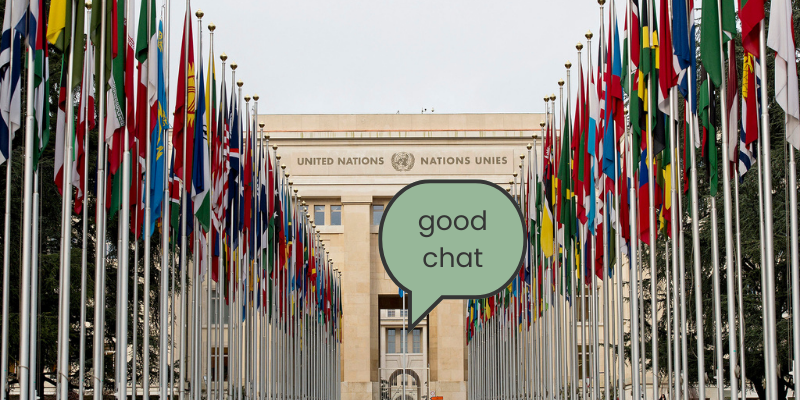
On Jan. 7, 2026, the Trump administration announced that the United States would withdraw from 66 international organizations. Secretary of State Marco Rubio explained the decision: “It is no longer acceptable to be sending these institutions the blood, sweat and treasure of the American people, with little to nothing to show for it.” To discuss the move, Good Authority editor Christopher Clary checked in with Brian Greenhill, associate professor of political science at the University at Albany and author of Transmitting Rights: International Organizations and the Diffusion of Human Rights Practices. His insights, lightly edited for clarity and length, are below.
Christopher Clary: When you saw the list of organizations that the United States was withdrawing from, did anything surprise you?
Brian Greenhill: My initial reaction was shock at the sheer number of organizations that the U.S. plans to withdraw from. Of course, included in that list is the U.N. Framework Convention on Climate Change (UNFCCC) and the Intergovernmental Panel on Climate Change. By withdrawing from these two organizations – on top of the fact that Trump had already ordered the U.S. to again withdraw from the Paris Agreement – the administration has put a final nail in the coffin of any remaining hopes that the U.S. will continue to remain engaged with multilateral climate efforts in the coming years.
However, it is at least somewhat reassuring that some especially prominent international organizations [IOs] were not on the list. The U.S. has – at least for now – not chosen to withdraw from the United Nations as a whole, or from the World Bank, the International Monetary Fund, and NATO. Nor has it withdrawn from the OECD, the club of economically developed countries that plays a subtle but significant role in shaping policy on a whole host of economic, political, and social issues. Were the U.S. to have chosen to withdraw from these major IOs, we would be having a very different conversation about the future of global governance.
It is also important to remember that despite Trump’s rhetorical disdain for “globalism” and his frequent bashing of America’s friends and allies, he is not entirely opposed to the principle of multilateralism. Back in September of last year, when the U.N. was celebrating its 80th anniversary, Donald Trump embraced the opportunity to address the closing session of the U.N. General Assembly. In a long and meandering speech where he railed against the U.N.’s work on migration and climate change, he nonetheless said that he thinks the U.N. “has such tremendous potential.” He did not offer any sort of vision for how the U.N. might change to realize that potential, but in my view, the fact that he appears to view the U.N. as an important forum for international cooperation – vs. choosing to ignore it altogether – suggests that at least on some level he understands that the U.N. has a role to play in legitimizing the actions of powerful countries.
This move seems consistent with advocacy from within the Republican Party over the last couple of years. Anjali Dayal in her conversation with Good Authority contributor Erik Voeten last year called it an “à la carte approach to U.N. membership” where “the U.S. could abandon any other part of the U.N. system that wasn’t working” in Washington’s view. But do we have any sense of how the American public thinks about the U.N. system?
Unfortunately, people like me who study international organizations are always having to remind ourselves that most ordinary people have very little interest in the work of the U.N. or most other international institutions. This is clear from the fact that even major news outlets like the New York Times did very little reporting on the story of widespread disengagement from IOs that we are discussing here, although they did have some more to say about the U.S. withdrawal from the UNFCCC.
Average citizens often have very limited knowledge of international institutions. (For example, in a survey that I conducted a few years ago, I found that 53% of U.S. adults admitted to never having heard of the International Criminal Court). Nevertheless, Americans have a general preference for a rules-based international order. Evidence of this can be seen across a range of different studies that show that the public is more likely to support policies that are consistent with international law than those that are not.
Another interesting finding from recent opinion surveys is that despite the fact that the U.S. public has elected a president who appears to hold international institutions in contempt, the American public has a more favorable view of the United Nations than we realize. A Pew survey from 2025 found that 57% of Americans approve of the U.N. while only 41% disapprove. This a margin of support that would be the envy of most recent U.S. presidents. And it is consistent with some of my own research that suggests that the U.S. public is more likely to support policies when they have been endorsed by the U.N.
How do you think about the consequences of a world with weaker (and potentially fewer) international organizations?
There is no doubt that the reelection of Donald Trump in 2024 has thrust the liberal international order into a moment of crisis. Trade barriers have shot up, norms around sovereignty and territorial integrity are coming under great strain, and the prospects for deeper international cooperation on climate and human rights are not looking good.
But the fact the current U.S. administration is making a big show of walking away from many of the post-World War II institutions of global governance does not necessarily mean that the era of cooperation through IOs is over. In their recently published book, Exit from International Organizations, political scientists Inken von Borzyskowski and Felicity Vabulas argue that there has been long history of powerful countries using acts of withdrawal, or sometimes just the mere threat of withdrawal, to exert leverage over IOs and their fellow member states. Given this perspective, we can perhaps view current policy as signaling the ongoing evolution of the international institutional order, rather than its imminent collapse.
Of course, the decision to withdraw from these 66 IOs is not inconsequential. Many of these organizations do vital work. Yet at the end of the day, governments around the world continue to search for ways to solve collective action problems. In most cases, IOs can provide at least a partial solution to these problems. Countries will still want to find ways to conduct trade with each other, safely fly planes from one country to another, manage transboundary pollution, and impose some guardrails around the use of force.
One possibility is that most IOs will continue to exist, but the U.S. will relinquish its leadership role in many of them. If so, an important question to consider is whether these organizations can retain their liberal characteristics if powerful authoritarian countries, like China, step into the vacuum that the U.S. leaves behind. One thing that we can say for certain, though, is that right now we are at a critical moment in the history of the liberal international order.
Stay up to date on all things politics and political science. Bookmark our landing page and sign up for Good Authority’s weekly newsletter by entering your email address in the box below.