




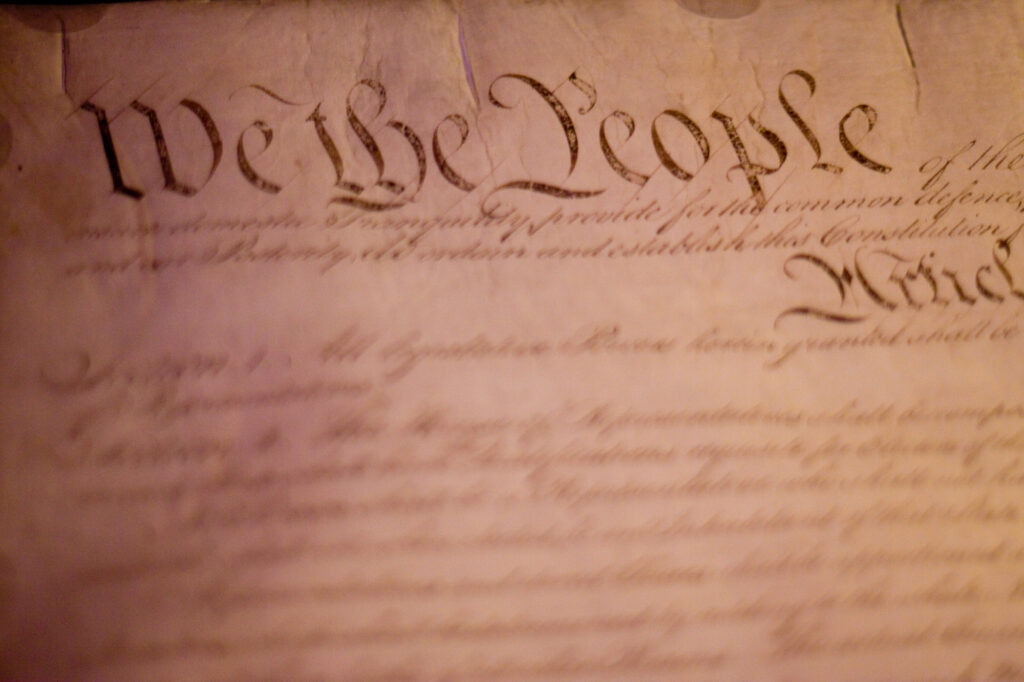
Donald Trump’s recent interview with the New York Times made headlines for many reasons – including for his comments about the alleged mistreatment in America of white people, his regrets about not aggressively reversing the results of the 2020 election, and his suggestion that the U.S. might establish a years-long presence in Venezuela as it consumes its petroleum reserves. But what might have raised the most eyebrows was Trump’s suggestion that he is constrained in international affairs by nothing more than his “own morality.” Many were shocked by this statement, yet few may be aware how it directly contradicts the philosophy underpinning the Constitution itself, as defended by its authors.
The U.S. Constitution was expressly drafted to account for humanity’s foibles and moral failings. In some ways, this has been understood as a “modern” intervention in politics. Ancient civilizations had relied more expressly on the virtue of rulers to keep republics from descending into chaos and disorder. Prominent among long-standing guidelines was Plato’s Republic, in which Socrates advocates for a constitutional order in which all power is concentrated in a small set of “philosopher-rulers.” These rulers have the power to make and enforce all of society’s rules and control all its institutions.
Students today can hardly conceive of such concentration of powers and always object to Socrates’s proposals. But to stimulate further classroom discussion, I remind them of Socrates’s presumptions: With enough effort, he hoped to educate people who were both stunningly wise and virtuous. These rulers would undergo a 50-year education; they would be tested for their ability to refuse all temptations to promote their own good over that of the republic; they would be denied the rights to own property and even have their own families, to protect against the encroachment of self-interest on their rule. That’s how concerned Socrates was that outside influences might corrupt their virtue. If we could actually have such people, I press students, are Plato’s philosopher-rulers a terrible idea?
No room for philosopher-rulers in America
Like students today, the American Founders were highly dubious of Plato’s assumptions and flatly denied his premise. In Federalist No. 49, James Madison singled him out for his implausible assumption: “a nation of philosophers is as little to be expected as the philosophical race of kings wished for by Plato.” There are no philosopher-kings in the real world, Madison insisted.
Alexander Hamilton pressed even further. Not only were philosopher-rulers implausibly utopian, but humanity is far worse than imperfect. It is in significant part wretched. As he warned in Federalist No. 6, constitutional projects must never forget that “men are ambitious, vindictive, and rapacious.”
James Madison would ultimately explain in Federalist No. 51 how America could produce a functional government. As he famously argued there:
Ambition must be made to counteract ambition. The interest of the man must be connected with the constitutional rights of the place. It may be a reflection on human nature, that such devices should be necessary to control the abuses of government. But what is government itself, but the greatest of all reflections on human nature? If men were angels, no government would be necessary. If angels were to govern men, neither external nor internal controls on government would be necessary. In framing a government which is to be administered by men over men, the great difficulty lies in this: you must first enable the government to control the governed; and in the next place oblige it to control itself.
Madison spelled out checks and balances
This is the core justification of our constitutional system of checks and balances. Acknowledging our imperfections is an essential element in creating a system that can control those imperfections. Madison and the other Founders sought to design a constitution where each branch had its own motives, along with the power to check the encroachments and tyrannical designs of the other two branches. As he insisted, also in No. 51, it is of “great importance in a republic not only to guard the society against the oppression of its rulers, but to guard one part of the society against the injustice of the other part.” This only happens when there is a robust system of checks and balances.
To be sure, over the past nine years, Trump has demonstrated that Madison’s system was more fragile than most Americans had assumed. The United States Congress has perhaps the most powerful check in this system: the ability to remove presidents from office and banish them from every holding office again. This is, of course, the power of impeachment and removal. But Americans learned in the first Trump administration that the Senate would not actually use this power. The Supreme Court likewise has powerful checks available in ruling against presidential actions, as it did in Youngstown Sheet & Tube Co., when it told President Harry Truman in 1952 that he could not seize the nation’s steel plants, even to sustain U.S. efforts in the Korean War. But the current court has instead ruled in July 2024 that presidents possess near-perfect immunity from all legal scrutiny while in office.
Are there checks on presidential power in 2026?
Given the weakening of these checks, it should be unsurprising that the president declared last week in the New York Times interview that “there is one thing [that can check him]. My own morality. My own mind. It’s the only thing that can stop me.” To be sure, it can be acknowledged, the president has not had the benefit of the extended moral education afforded to Socrates’s philosopher-rulers.
For context, the president was referring to checks on his behavior in the international sphere, where the executive traditionally has the greatest freedom to act. Yet even within this realm, the Constitution carefully constrains presidential power – both with regard to the declaration of war and to the negotiation of treaties. As John Jay wrote in Federalist No. 64, the power to make treaties is particularly vulnerable to corruption and as such must be divided between the “most enlightened and respectable citizens” – namely, according to his expectations, the president and the Senate, each serving as a check on the other.
Trump’s rejection of the Senate’s constraints may be unsurprising. But it’s also effectively a constitutional revolution, overturning the most basic presuppositions of the Founders. There’s a clear divide between Trump’s suggestion that he will be constrained only by his “own morals,” and Madison’s declaration in Federalist No. 10 that “neither moral nor religious motives can be relied on as an adequate control” on government powers.
To be sure, Madison and even Hamilton thought it was good to have virtuous and wise rulers. It is likely they thought it even necessary to have a decent number of them in office. But it would be foolish to assume leaders can be effectively constrained by fundamentally decent impulses. Plato’s “race of philosopher-kings” was wrong because we can never be certain of having them in office, as Socrates ardently wished. That was utopianism – great for classroom discussion, but not for the realities of managing real people in a fledgling republic.
Setting aside the question of what Trump’s “own morality” might be, a political system that has abandoned its constitutional checks in favor of relying entirely on an executive’s personal morality seems like a bad bet. And it would also be a thorough rejection of every advance the Founders sought to make to the new science of politics in 1787.
David Lay Williams is professor of political science at DePaul University and an affiliate at the University of Chicago’s Stone Center on Wealth Inequality and Mobility. He is author of The Greatest of All Plagues: How Economic Inequality Shaped Political Thought from Plato to Marx (Princeton University Press, 2024).
Stay up to date on all things politics and political science. Bookmark our landing page and sign up for Good Authority’s weekly newsletter by entering your email address in the box below.