






Elections can catalyze the public’s engagement with domestic and foreign politics as voters evaluate their electoral options. Prior research has found U.S. voters more attentive to domestic political issues as elections approach. However, scholars have paid somewhat less attention to studying how elections influence the public’s engagement with foreign policy. The Foreign Policy in a Diverse Society (FPDS) project, led by Nyron Crawford, Alexandra Guisinger, and Katja Kleinberg and funded by the Carnegie Corporation of New York, set out to track the impact of the U.S. presidential election cycle on how the public views foreign policy. This project followed U.S. public opinion for the two-year election cycle preceding the November 2024 presidential election, as well as the period after the election, including responses to the January 2025 inauguration and to President Trump’s first 100 days in office.
Here’s what we learned. From April 2023 up to the November 2024 election, Americans expressed higher anxiety about global issues than domestic issues. But they also reported relatively less media attention and less political activity related to global issues/foreign policy. Furthermore, we observed strong post-election shifts in anxiety, attention, and activity on foreign policy matters.
How we conducted our research
FPDS contracted NORC at the University of Chicago to field nine quarterly surveys on the AmeriSpeak panel, a representative probability panel offering a high-quality, nationally representative sample. We conducted surveys in both English and Spanish. And importantly, for more granular analysis, in over half of the survey waves, we oversampled African Americans, Hispanics, and Asian Americans/Pacific Islanders to ensure at least 500 responses from participants identifying with each of these racial and ethnic groups. Cumulatively, over two years starting on April 13, 2023 and concluding May 28, 2025, we collected over 19,700 measures of Americans’ engagement with foreign policy.
Across the nine survey waves, FPDS repeatedly measured the public’s responses in three categories: anxiety about domestic and global events; attention to domestic and foreign news; and political activities related to local, domestic, and international politics.
Anxiety amongst the American public
Political scientists Bethany Alberton and Shana Gadarian suggest that “[a]nxiety occurs when individuals appraise a situation as being unpleasant, highly threatening and uncertain,” or “when the situation seems out of control.” To understand Americans’ concerns in the lead-up to the November 2024 election, at the start of each survey, FPDS asked participants to rate their level of anxiousness from 0 (not anxious) to 5 (extremely anxious) on issues organized in three areas: the economy, domestic issues, and global issues. Economic issues included rising household costs, shortages, job losses, and financial instability. Domestic issues included crime, identity-based threats, protests, and local environmental concerns. Global issues included war and terrorism, border security and migration, global market instability, and pandemics and climate change. Figure 1 displays weighted mean responses by wave across each type of anxiety grouping.
Overall, respondents during the survey period generally expressed the highest levels of anxiety on global issues. Anxiety on economic issues spiked in spring 2025 in our final survey fielded after the new Trump administration’s first 100 days in office. In all cases, anxiety spiked in the run-up to the election, matching expectations that recent presidential campaigns, particularly negative campaigns, highlight areas of concern among the American public and may serve to exacerbate anxiety as part of an electoral strategy.

Source: Crawford, Guisinger, and Kleinberg, Foreign Policy in a Diverse Society Survey, Waves 1-9, www.fpds-surveys.org/data.
Within the category of global anxiety, respondents expressed greater anxiety on all items as the election progressed, with the largest increase appearing on border security and migration issues. Respondents also expressed greater concerns about war and terrorism in November 2023, as the conflict in Israel and Gaza increased. After the 2024 election, security-based concerns (war and terrorism and border security and markets) dropped precipitously, while concerns about economic insecurity from global markets spiked.
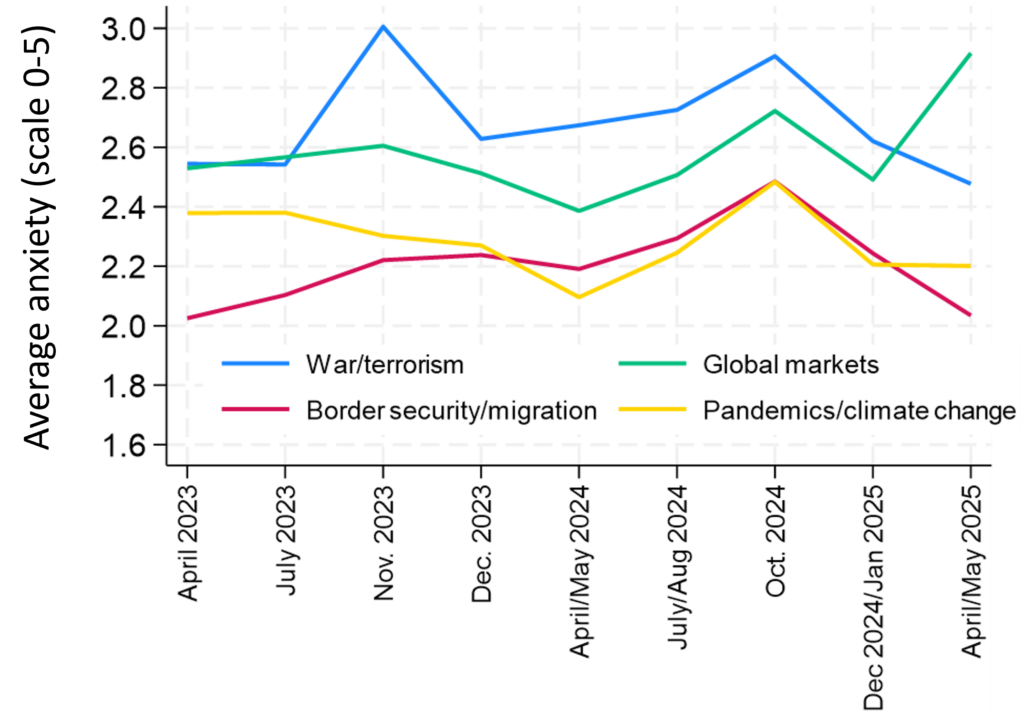
The election also appears to be a watershed point in the sources of anxiety on global issues. As shown in Figure 2, war and terrorism consistently received the highest scores, except in the spring 2025 survey, in which economic concerns vaulted past war and terrorism. Much of the change arose from substantial partisan differences. Comparing the survey fielded in October 2024, immediately before the November 2024 election, to the survey fielded in April/May 2025, after 100 days of the Trump administration, Republicans reported that anxiety about war dropped by over 25%, anxiety about the border dropped by 35%, and anxiety about the global economy dropped by 20%. In contrast, Democrats reported 40% higher anxiety about the global economy.
Interest in domestic issues increased as the 2024 presidential election neared
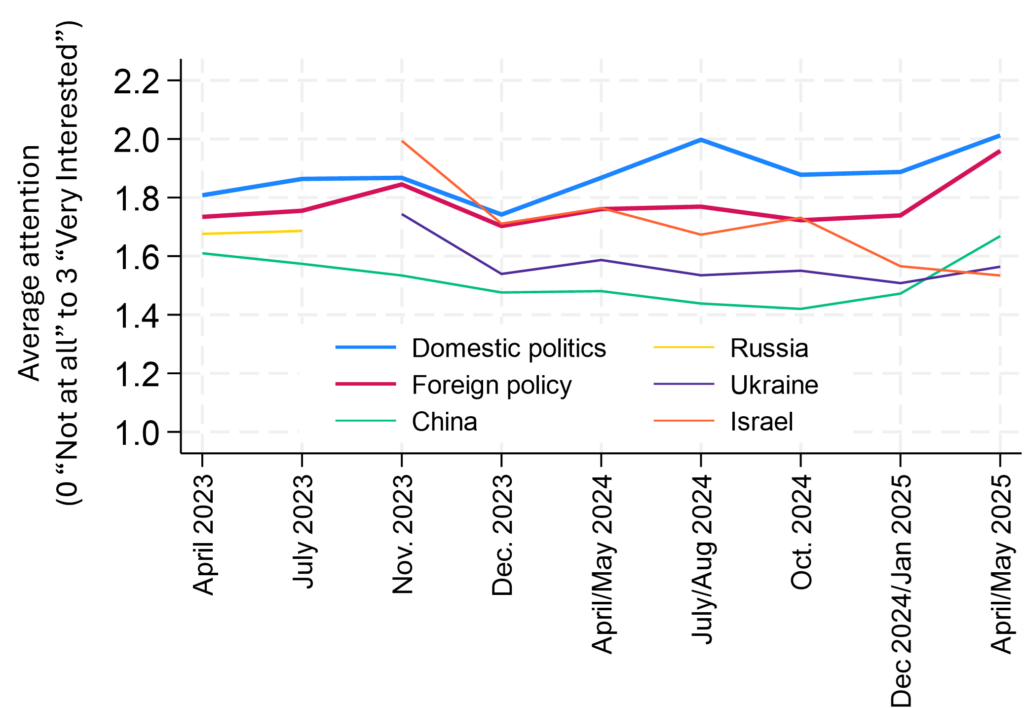
Various political conflicts, domestic and abroad, now occur in what Nobel laureate Herbert A. Simon described as an “attention economy.” People’s attention is scarce but highly desirable for consumption. We asked respondents about when they followed the news – how interested they were in domestic or foreign policy, or the politics of another nation (e.g., China, Russia). For analysis purposes, FPDS assigned each response a value from 0 “Did not follow” to 3 “Very interested.” Figure 3 displays the weighted average responses to news about U.S. domestic politics, U.S. foreign relations, and the politics of another nation.
Across the two-year election cycle, respondents mostly prioritized U.S. domestic news. Additionally, we observed increased interest in U.S. domestic news in the lead-up to the 2024 presidential contest. This uptick is consistent with the assumption that voters seek out information as an election nears. However, interest in news about U.S. foreign relations (except for the period surrounding the Hamas incursion into Israel in October 2023) showed little change across the election cycle, and spiked only after the election.
But political activity on global issues lags that on national and local issues
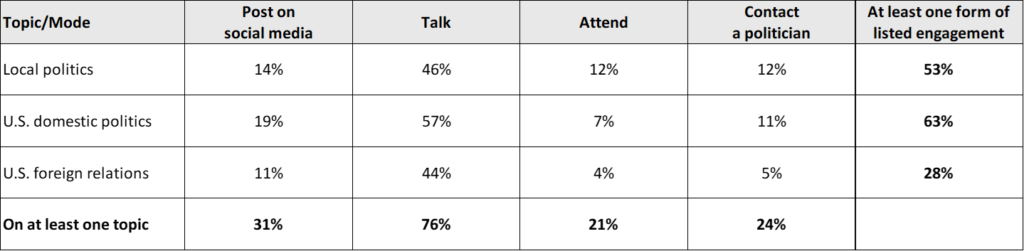
Theories of democracy emphasize the importance of public political participation. To the extent citizens have a role in a democratic society, they must be capable of meaningful engagement. Democratic regimes rely on their citizens to be informed and take an active role. One challenge here is the number of touchpoints for engagement. People may discuss national politics yet overlook their local mayor, or vice versa; they may engage in domestic politics one way and approach foreign policy in another manner. To assess the relationship between non-voting political behavior at certain levels of politics (e.g., local, national/domestic, foreign), FDPS asked participants to check which types of political engagement they had recently undertaken (post on social media, talk to others, attend a meeting, or even contact a politician) and on which topics (local politics, U.S. domestic politics, U.S. foreign relations).
As displayed in the table below, participants reported talking (76%) substantially more than any other type of engagement, like posting on social media (31%), attending a meeting (21%), or contacting a politician (24%). Overall, participants were much more likely to report engaging in U.S. domestic politics (63%) than either local politics (53%) or U.S. relations with other countries (28%). Overall, participants were much more likely to report engaging in U.S. domestic politics (63%) than either local politics (53%) or U.S. relations with other countries (28%).
Overall trends may not reflect a universal “American” electoral cycle experience
While aggregated data offer a broad overview of the public’s response, the FPDS data are intentionally designed to enable cross-group comparisons by race and ethnicity, gender, age, and other groupings. Forthcoming analysis will highlight where the electoral cycle correlated with the convergence of behavior and where, more often, the electoral cycle exacerbated previous divisions in American society.
Nyron N. Crawford is associate professor of political science and faculty fellow in the Public Policy Lab at Temple University, and author of the Marked Men: Black Politicians and the Racialization of Scandal (New York University Press, May 2024).
Alexandra Guisinger is an associate professor of political science at Temple University, and author of American Opinion on Trade: Preferences without Politics (Oxford University Press, 2017).
Funded by the Carnegie Foundation of New York, the Foreign Policy in a Diverse Society (FPDS) project is led by Nyron Crawford (Temple University), Alexandra Guisinger (Temple University), and Katja Kleinberg (Binghamton University, State University of New York).