






As President Donald Trump heads to Alaska for a “feel-out meeting” with Russian President Vladimir Putin, what do Americans think about the Ukraine war, and U.S. support for Ukraine? This will be the first meeting between the two leaders since 2019. The discussion of a negotiated ending to the Russia-Ukraine war comes at a critical point, both for Ukraine and for U.S. politics. Increasingly, American public discourse around foreign aid is couched in terms of a zero-sum trade-off against domestic economic issues, especially food prices.
An October 2023 survey experiment fielded by the Chicago Council on Global Affairs highlighted the potential influence of this zero-sum language. When that survey included language about the potential costs to U.S. household bills, a lower proportion of respondents expressed willingness to support Ukraine for “as long as it takes” (47%). When the question included no reference to U.S. household costs, 57% of respondents backed this level of support for Ukraine.
Donald Trump’s second term in the White House has strengthened those who want to frame U.S. support for Ukraine in zero-sum terms – and push the concept that any aid to Ukraine means less support for Americans. The Biden administration was steadfast in its commitment to sending aid to Ukraine. In contrast, the Trump administration has already paused aid to Ukraine twice, first in March and again in July. And a number of Republican politicians are increasingly vocal about cutting Ukraine off. In March 2024, Representative Marjorie Taylor Greene (R-Ga.) posted on X (formerly Twitter) that “the swamp” only wanted to “send money to Ukraine” – and raised her rallying cry: “STOP sending money abroad, and fix AMERICA FIRST.”
Guns vs. butter
The “guns vs. butter” trade-off between military spending and domestic welfare spending has long been a topic of debate. The theorized dilemma for politicians is that every dollar directed towards military spending to support security goals is one diverted from domestic spending in support of economic goals. In 1953, President Dwight Eisenhower highlighted this trade-off in his “Chance for Peace” speech:
Every gun that is made, every warship launched, every rocket fired signifies, in the final sense, a theft from those who hunger and are not fed, those who are cold and not clothed.
Scholars disagree on whether there really is a trade-off between guns and butter. Part of the disagreement emerges from different conceptions of the trade-off. While Bruce Russett’s 1969 analysis identified a trade-off between defense spending and private consumption spending, his study in 1982 found it harder to establish a trade-off in governmental social spending. Additionally, not all presidents accepted the trade-off; Lyndon Johnson simply asked Congress for both. Analysis by Masako Ikegami and Zijian Wang (2023) argues that the effects of the guns vs. butter trade-off are smaller in developed economies such as the United States. The relationship might even be reversed in some environments. Guy Whitten and Laron Williams (2011) argue that “guns yield butter”: Military spending can act as a fiscal stimulus, and or even function as welfare to service members through benefits.
Yet whether the guns vs. butter trade-off is an economic reality, debates about military spending often assume the public sees it this way. A 2025 study by Stefano Sacchi and co-authors looked at 10 industrialized democracies and found significant public opposition to welfare retrenchment to fund greater military spending. Representative Kevin McCarthy R-Calif.) expressed this bluntly before his (brief) stint as House speaker: “People are gonna be sitting in a recession and they’re not going to write a blank check to Ukraine.”
Do all Americans see Ukraine as a guns vs. butter issue?
While some Americans might think about aid to Ukraine as an either/or choice in terms of guns vs. butter, is that view uniform in American society? We wanted to see whether the American public’s response varies across a variety of political and socioeconomic characteristics. When our recent survey frames this support as a zero-sum trade-off, how much do individual circumstances condition the willingness to continue support for Ukraine? In April 2025, the Foreign Policy in a Diverse Society project conducted a survey of approximately 3,000 Americans via the National Opinion Research Center’s AmeriSpeak platform. The survey ensured sufficient samples of African Americans, Asian Americans, and Hispanic Americans to specifically compare support across race and ethnic identities.
To provide context, the survey briefly outlined the guns vs. butter paradigm against the background of the Russian invasion of Ukraine. The text notes that “One consideration is that the conflict has made economic necessities like food, gas, and energy more expensive.” Respondents then chose the option that aligned more closely with their perspective: whether Ukraine should be urged “to negotiate a settlement as soon as possible…in order to help struggling American families,” or whether it is more important “to punish Russia…even if it hurts struggling American families.” In our analysis, we sought to isolate the variables of respondents’ race, gender, annual income, age, education level, and partisan affiliation.
Figure 1. Americans of color, women and older respondents are more concerned about the needs of American families

Just over half of white respondents leaned towards further aiding Ukraine, “even if it hurts struggling American families.” In contrast, no other racial and ethnic group saw a majority opt to do so. Men were more willing than women to prioritize aid to Ukraine, as were older Americans, vs. younger Americans.
Figure 2. College-educated Americans and Democrats are more committed to sending aid to Ukraine
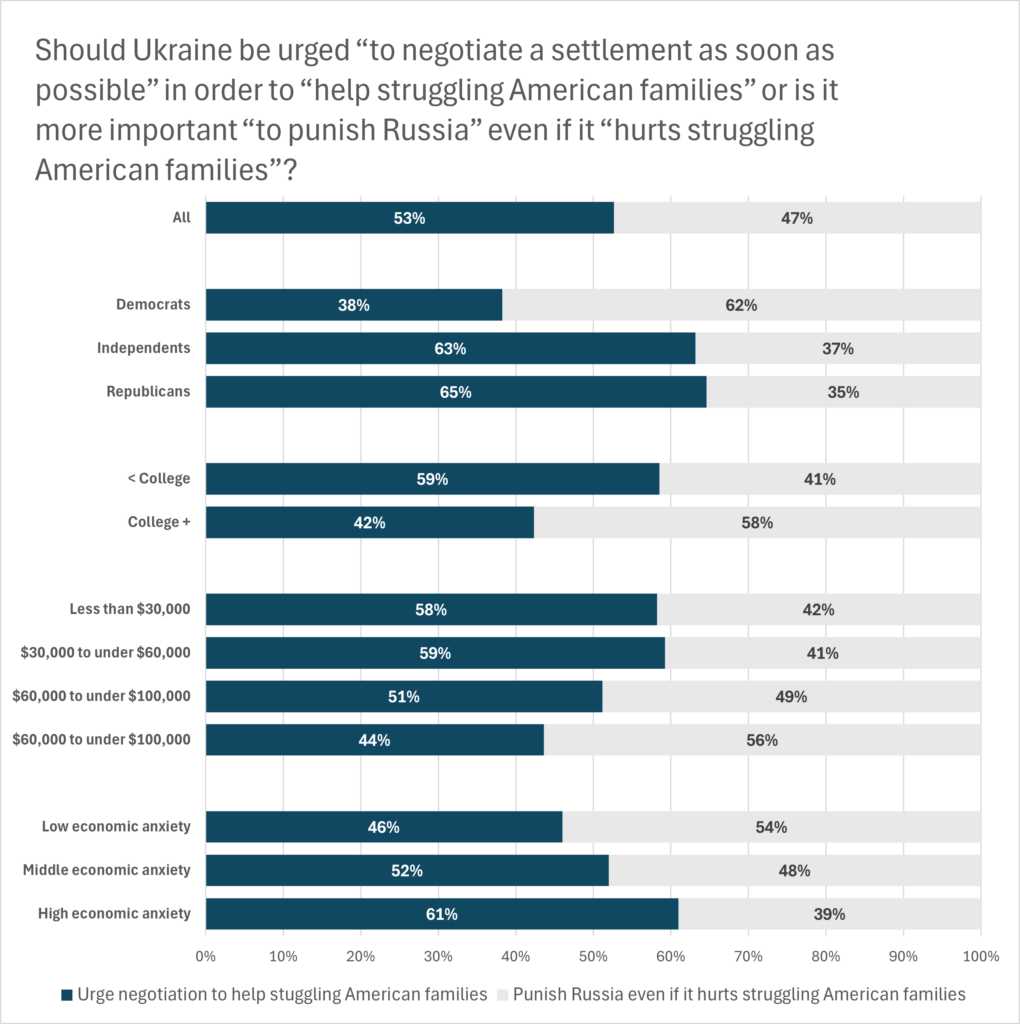
The most significant differences were identified when studying educational levels and partisan affiliation. In particular, Democrats and college-educated Americans were significantly more committed to sending aid to Ukraine, even when that aid was presented as a trade-off in meeting the needs of struggling American families.
The marked divide between Democrats (62% in favor of punishing Russia even if it “hurts struggling Americans”) – the highest level of any group identified in the survey) and Republicans (35%) is important to note. This divide potentially speaks to the GOP push to make support for Ukraine a guns vs. butter trade-off – and the “America first” rhetoric currently emphasized by the Republican party and the Trump administration. It further suggests a pivot away from the hawkish foreign policy that was formerly a GOP standard. In 2011, for instance, Senator Marco Rubio (R-Fla.) proclaimed, ”foreign aid is also an important part of America’s foreign policy leadership.” Rubio now serves as secretary of state – rising within a party whose base has come to reject that view, and with a president who openly bullied his Ukrainian counterpart.
Interestingly, while descriptive results highlighted in Figure 2 show a straightforward relationship between lower income classifications and a higher propensity to support negotiations “to help struggling American families” when accounting for other characteristics, our analysis did not find a significant correlation between income level and preference in the guns vs. butter divide. That might be because income today may not reflect worries about tomorrow.
We therefore also examined support for aid to Ukraine by the degree of respondents’ economic anxiety. The survey included a few questions asking respondents to rate their level of anxiety around financial concerns, ranging from personal concerns (“rising household costs”) to the macroeconomic level (“banking and stock market instability”). We then averaged respondents’ self-reported scores to get an aggregate score of their economic anxiety. The survey characterized the top quartile as having “high economic anxiety,” and the bottom quartile “low economic anxiety.” Indeed, there appears to be a relationship between economic anxiety and preferences in the guns vs. butter debate: A majority of respondents reflecting low economic anxiety were more willing to aid Ukraine, “even if it hurts struggling American families,” and vice versa.
Like most issues in American foreign policy, Americans’ views of aid to Ukraine reflect some economic concerns – along with a lot of politics.
Alexandra Guisinger is an associate professor of political science at Temple University, co-principal investigator of the Foreign Policy in a Diverse Society project, and author of American Opinion on Trade: Preferences without Politics (Oxford University Press, 2017).
Elizabeth N. Saunders is professor of political science at Columbia University and author of The Insiders’ Game: How Elites Make War and Peace (Princeton University Press, 2024).
Xi Teng Tay is a rising senior studying political science and computer science at Swarthmore College. He is interested in the interactions between democratic politics and public policy issues such as redistribution and the welfare state.



.jpg)