






When we hear about mental health and politics, there’s a lot of focus on how liberals appear to have worse mental health than conservatives. That may or may not be true, as Brian Schaffner and his co-authors have noted. See Derek Thompson for more on this.
But there’s been less study of a different question: Does mental health correlate with how you view political figures? Some new research by Matthew Baum and a group of political scientists sheds some light.
Their hypothesis is that people who report feelings of depression are more likely to support populist candidates. Their logic is that depression can lead to a sense of helplessness and alienation, and populist politicians speak to those feelings – such as by framing ordinary people as victims of powerful elites.
But the opposite may be true for non-populist politicians. Depressed people may support them less because they transfer some of their negative feelings and mood onto incumbent officeholders.
Baum and colleagues look at two different surveys, one from 2020 and one from 2024. Both asked about approval of Joe Biden and Donald Trump. Depressive symptoms were measured with a common instrument, the Patient Health Questionnaire. The authors look for a relationship between a scale based on these questions and approval of Biden and Trump while also accounting for a set of other factors (age, race/ethnicity, sex, education, income, religious service attendance, evangelical Christian identification, partisanship, ideology, and self-reported stress and anxiety levels).
These surveys provide evidence for both hypotheses. Here’s the relationship between depressive symptoms and support for Trump:
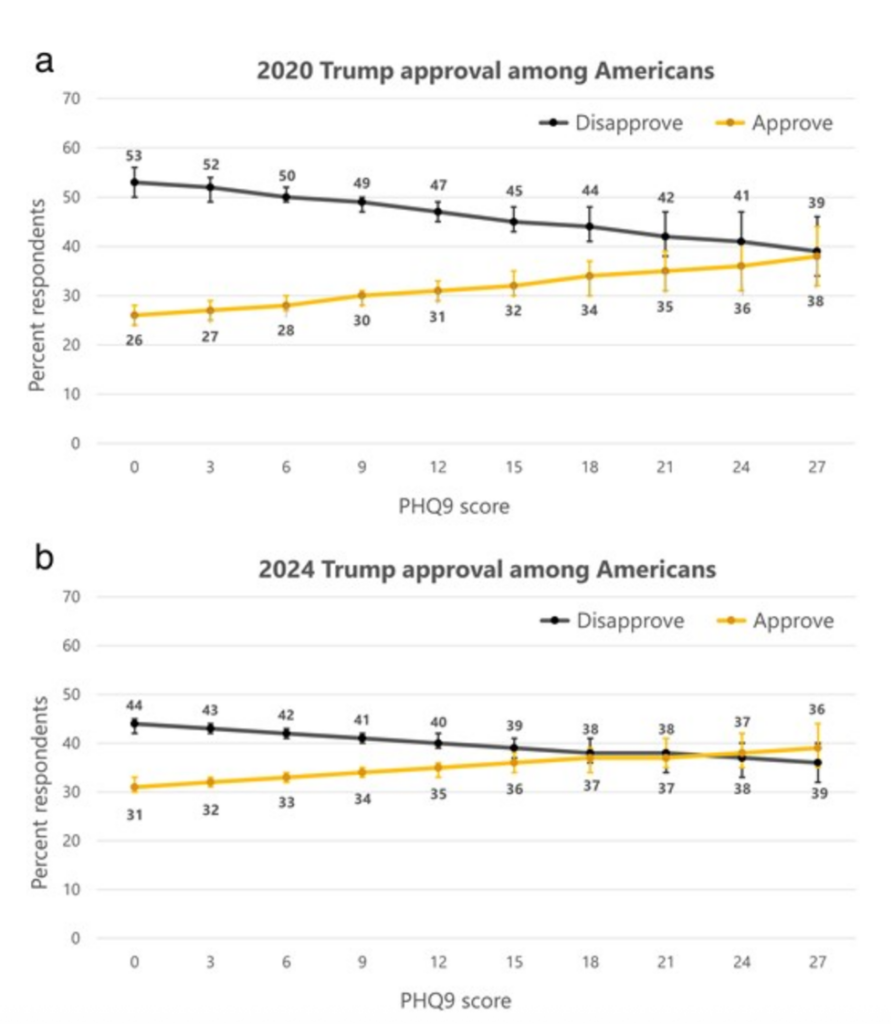
As you move from fewer reported symptoms to more symptoms, approval of Trump goes up. But the opposite is true for approval of Biden:
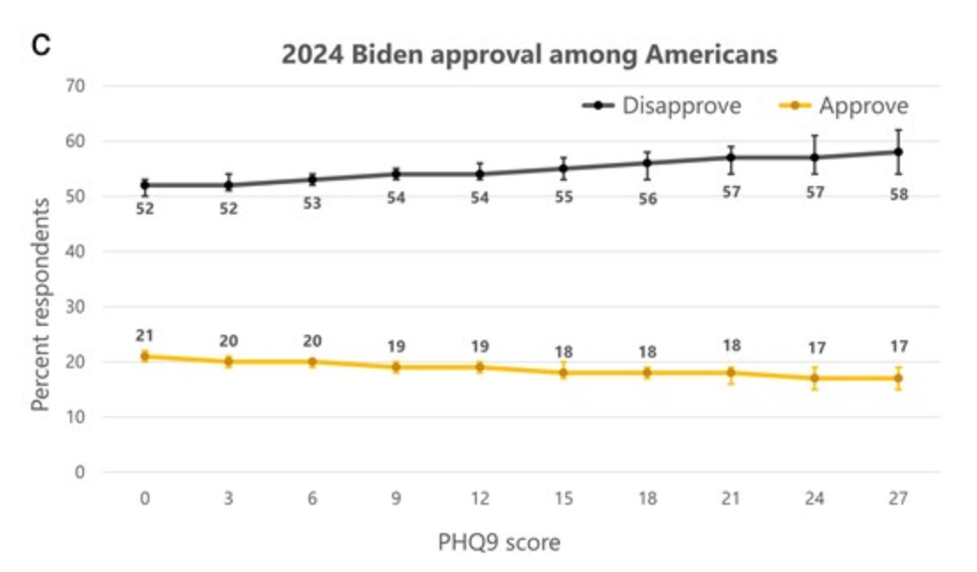
There is an important nuance, however. The relationship between depressive symptoms and views of Trump and Biden is stronger for Democrats than Republicans. (Perhaps the title of this post should have been “Depressed Democrats are more likely to support Donald Trump.”) But why? The authors hypothesize that depression leads people to attend to new information, particularly negative information. That information then leads them to update their attitudes. However, other work has found that conservatives and Republicans are more loyal than liberals and Democrats, and less responsive to new information.
Of course, there is the obvious question about correlation versus causation. The authors readily acknowledge this and provide some additional analysis that is helpful. The 2024 survey includes some respondents who were also interviewed in 2023 and were asked similar questions. This allows them to see whether changes in depressive symptoms between 2023 and 2024 were associated with changes in approval ratings. And they were. But clearly, more needs to be done.
Other limitations of the analysis, also noted by the authors, include the limited focus on the U.S. and on only Biden and Trump. You’d want a broader base of evidence. And it would be helpful, they add, to investigate how exactly depressive symptoms are changing the aspects of political behavior that may eventually shape their assessments of politicians.
But the paper makes some clear progress on an underexplored topic: how political attitudes may be affected not just by people’s demographics or values, but by their health and especially their mental health.