






Last week, Donald Trump told reporters, “A lot of people are saying maybe we’d like a dictator.” Rather than dwell on what’s deeply problematic about that sort of offhand comment, I want to explore the specific question: How many people might like a dictator?
The word “maybe” is going to be very important here. Whenever we ask ordinary citizens for their opinion about a complex topic, we should always (always) assume that their opinions are a bit…messy – logically inconsistent, dependent on circumstance, and hard to characterize as strictly “pro” or “con.”
In the public opinion literature, this is known as ambivalence. Because people have conflicting values or considerations in their heads, they cannot easily come to a single definitive opinion about an issue. Abortion is a good example. People’s support for abortion depends on the trimester in which the abortion occurs, among other things. People’s opinions have an “on the one hand, on the other hand” quality.
This brings us back to dictatorships and democracy, and specifically to this newly published article by political scientists Calvert Jones and Michael Cowan: “Pro-Democratic, but Not Anti-Authoritarian? Understanding Ambivalent Attitudes Toward Regimes.”
Jones and Cowan take a massive amount of survey data from dozens of countries. The survey asks people this question: “I’m going to describe various types of political systems and ask you about each one as a way of governing the country. For each one, would you say it is a very good, fairly good, fairly bad, or very bad way of governing this country?”
One option is “having a democratic political system.” Another is “having a strong leader who does not have to bother with parliament and elections.” Overall support for democracy is much higher than support for this “strong leader.” However, if you combine very/fairly good and very/fairly bad, and then compare how people answer both questions, you get this:
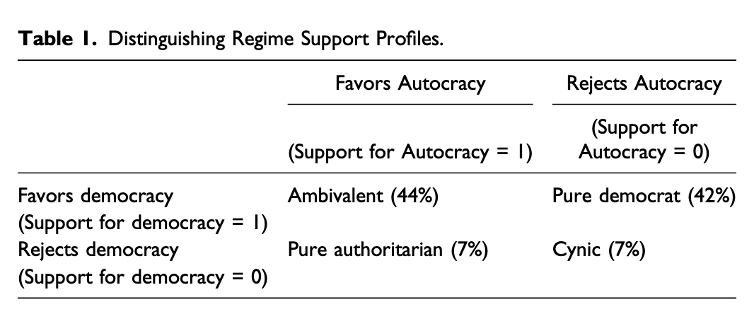
That table is based on surveys conducted among various countries between 2017 and 2022. Take a look at the upper righthand quadrant: 44% of respondents are ambivalent – that is, they say democracy is a good system and a “strong leader who doesn’t have to bother with parliament and elections” is a good system. That is slightly higher than the percentage who favor democracy but reject autocracy (42%) – aka the “pure democrats.” Relatively few people (7%) favor autocracy but reject democracy.
What’s more, Jones and Cowan show that the percentage of respondents who are ambivalent has increased from about 30% in the mid-1990s to this 44% level. Meanwhile, the percentage of people who are pure democrats has declined from around 60% to 42%.
The exact percentage of ambivalent people varies across countries, of course. It is a bit lower in Europe (32%) and in the United States (30%).
The exact percentage may vary with question wording as well. Jones and Cowan report on results from a Pew Research Center survey of multiple countries in which people were asked “Would ___ be a good or a bad way of governing our country?” Two of the options were “A democratic system where representatives elected by citizens decide what becomes law” and “A system in which a strong leader can make decisions without interference from parliament or the courts.” Overall, 23% of the sample in this survey was ambivalent.
Jones and Cowan also investigate the correlates of ambivalence. Overall, people who have less knowledge about what democracy is are more likely to be ambivalent. So are people who express a general preference for order, based on questions about the importance of obedience, respecting authority, and prioritizing security over freedom.
Perhaps encouragingly, Jones and Cowan also find that people’s ambivalence can be reduced – and their support for democracy increased – when given basic information about the difference between democracy and autocracy. Specifically, they did an experiment in which some respondents were randomly assigned to read this:
Recent research clarifies the definitions of two types of government. Democracy is defined as ”a form of government in which people choose leaders by voting.” Democracies include checks and balances, and also civil liberties. Autocracy is defined as ”a form of government in which a country is ruled by a person or group with total power. These governments often have weak parliaments and no independent court system, and limited civil liberties.”
People who read that information subsequently expressed less ambivalence. Of course, the challenge inherent in any such experiment is translating those results into the real world, where people may not routinely encounter that kind of information.
To me, the big lesson is this: It may seem that democracy and autocracy are polar opposites, but in the minds of many people, they are not. Unfortunately, this gives would-be autocrats some running room in public opinion. At a minimum, “the people” are never going to be the solid bulwark against creeping authoritarianism that we might want them to be.