






Since 2000, Gallup has asked Americans whether they consider a range of personal behaviors and certain policies to be morally acceptable or morally wrong. Many, but not all, of these are in the domains of sex and reproduction. The most recent survey that included these questions was conducted in May 2026.
Gallup’s summary of the results emphasizes trends in a handful of behaviors for which the most recent survey showed clear declines in perceived moral acceptability: using birth control, having a baby outside of marriage, gambling, teenagers having sex, and cloning animals.
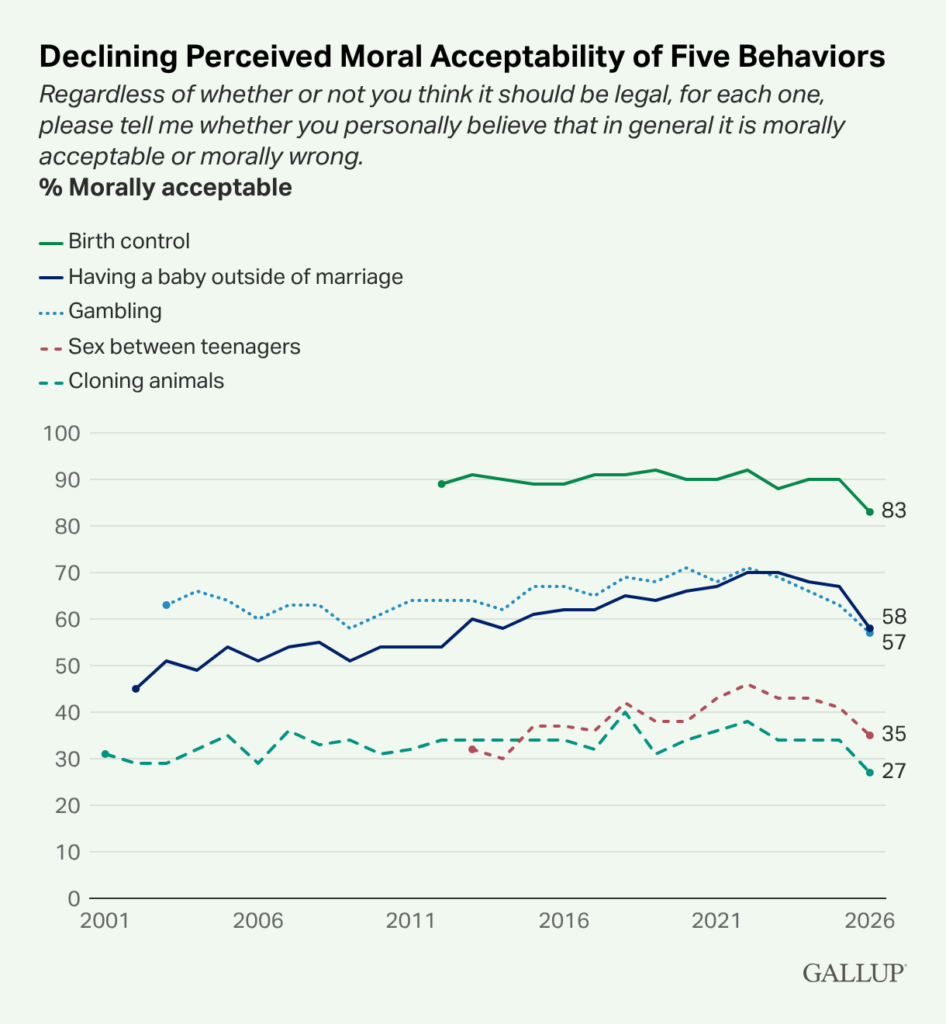
But there is even more going on than that graph suggests. Let’s look at the trends in all of the questions in the Gallup data, conveniently posted as a PDF at the bottom of Gallup’s write-up.
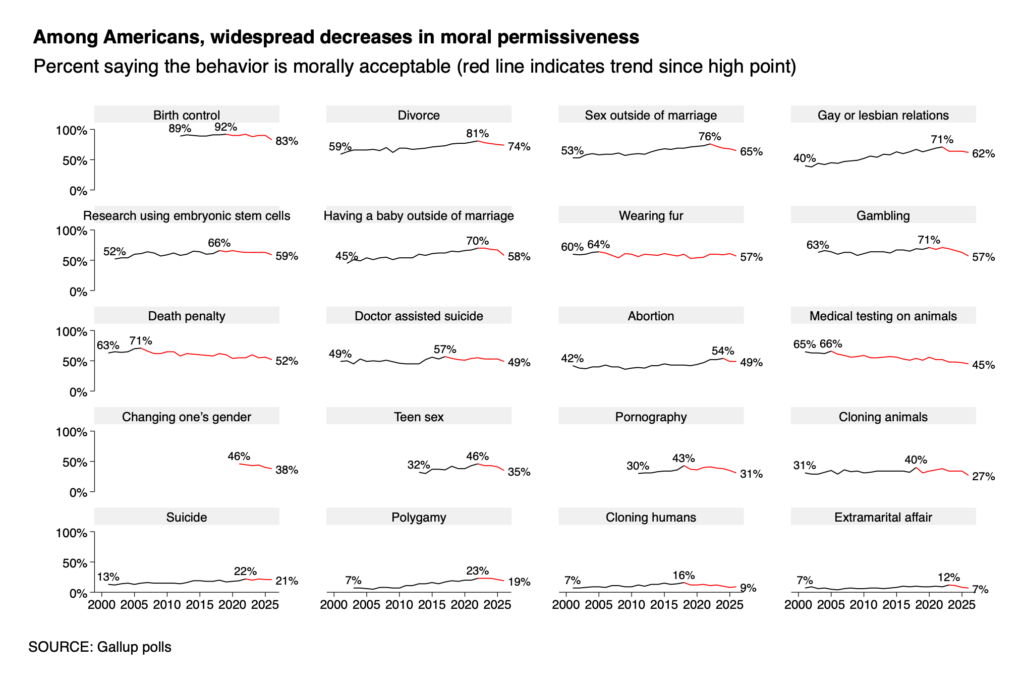
The panels are ordered by moral acceptability as of 2026. So, the largest percentage of Americans say birth control is morally acceptable (top left), while the smallest percentage say that an extramarital affair (“Married men and women having an affair”) is morally acceptable (bottom right). Most of the rest say the behaviors are morally wrong, with a small number expressing no opinion or volunteering that the behavior is not a moral issue or saying some version of “it depends.”
Check out the trends
Inside each panel, I’ve noted the point at which the largest percentage said the behavior was morally acceptable – the “peak of permissiveness,” as it were. After that point, the lines are colored red.
What I found interesting is that there are declines in permissiveness across nearly every single behavior or issue. Some of those declines are long-standing. We’ve known for a while that support for the death penalty is decreasing, a trend that may reflect both declining crime and increased attention to cases in which death row inmates were later exonerated. There are also long-term declines in acceptance of wearing fur and medical testing on animals. I think those trends are likely separate phenomena – both from each other and from the other items in the series.
More recently, there have been declines in moral acceptance of issues involving sex, reproduction, and relationships: birth control, divorce, sex outside marriage, gay or lesbian relations, medical research using embryonic stem cells, having a child outside of marriage, abortion, changing one’s gender, teenage sex, pornography, polygamy, and extramarital affairs.
There have also been declines in acceptance of gambling, doctor-assisted suicide, and the cloning of animals or humans. (Opinion about suicide itself is largely stable.)
What are we to make of all of this?
After the new Gallup results came out in May, a common interpretation was a “a rising puritanical streak” or a “more puritanical view of personal liberty.” Other recent trends that I’ve written about – increasing gender traditionalism and decreasing support for marijuana legalization – are consistent with that interpretation.
But before we imagine a nation of wannabe John Winthrops, it’s worth acknowledging the countervailing evidence. For one, we should not read too much into these survey questions about moral acceptability. For example, even though there was a 5-point decline between 2024 and 2026 in the percentage of people who said that abortion was morally acceptable, these very same Gallup polls do not register similar shifts in views about the legality of abortion or identification as pro-choice or pro-life.
Another cautionary note
These shifts are not large, usually amounting to several percentage points. They may not be statistically meaningful given the margins of error in these surveys. And for a number of issues, such as divorce and birth control, large majorities continue to believe the behaviors are morally acceptable. Americans remain more permissive than they were 25 years ago.
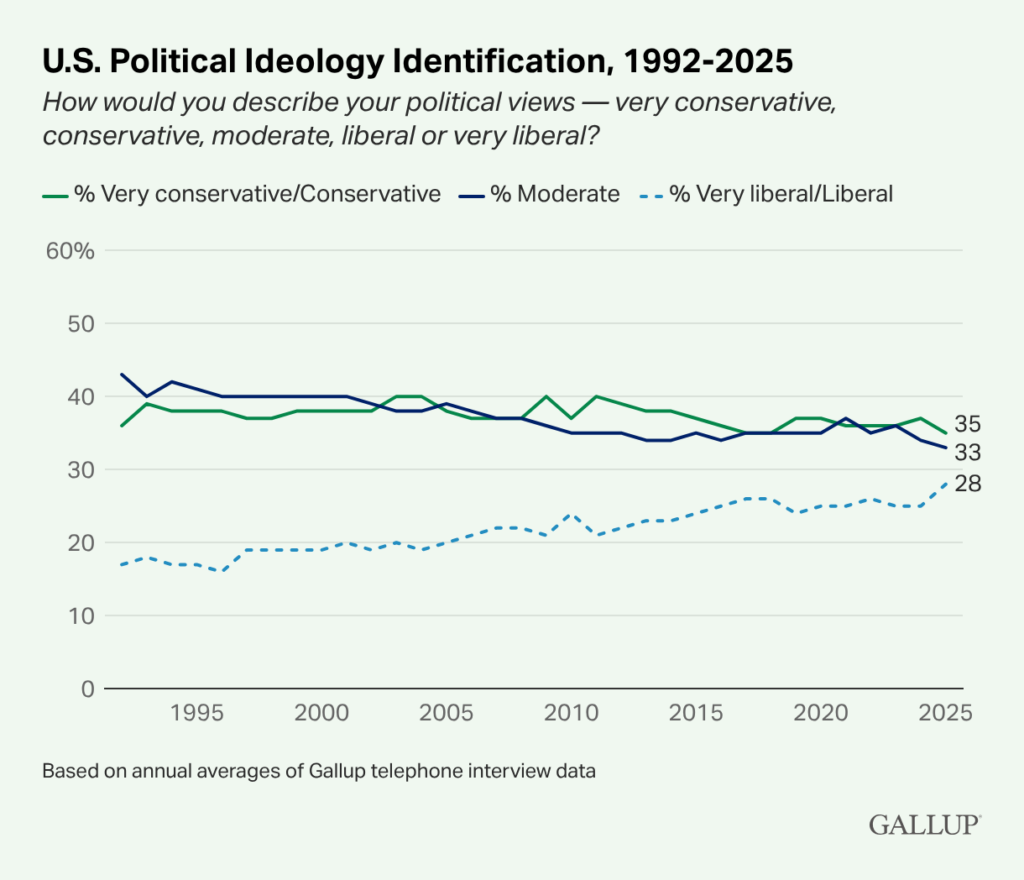
Moreover, this puritanical streak hasn’t translated into any kind of generalized conservatism. There’s no additional support for capital punishment, which for a long time was seen by most Americans as the appropriate response to the most significant moral transgression. There’s no increase the percentage of Americans calling themselves conservative:
And there is always the question of whether survey responses are just cheap talk. Does a modest decline in the perceived moral acceptability of pornography actually translate into fewer people watching porn? We’ve long known that what people say in a survey may not translate into actual behavior. As Richard LaPiere put it in a famous article, “Only a verbal reaction to an entirely symbolic situation can be secured by the questionnaire. It may indicate what the responder would actually do when confronted with the situation symbolized in the question, but there is no assurance that it will.”