






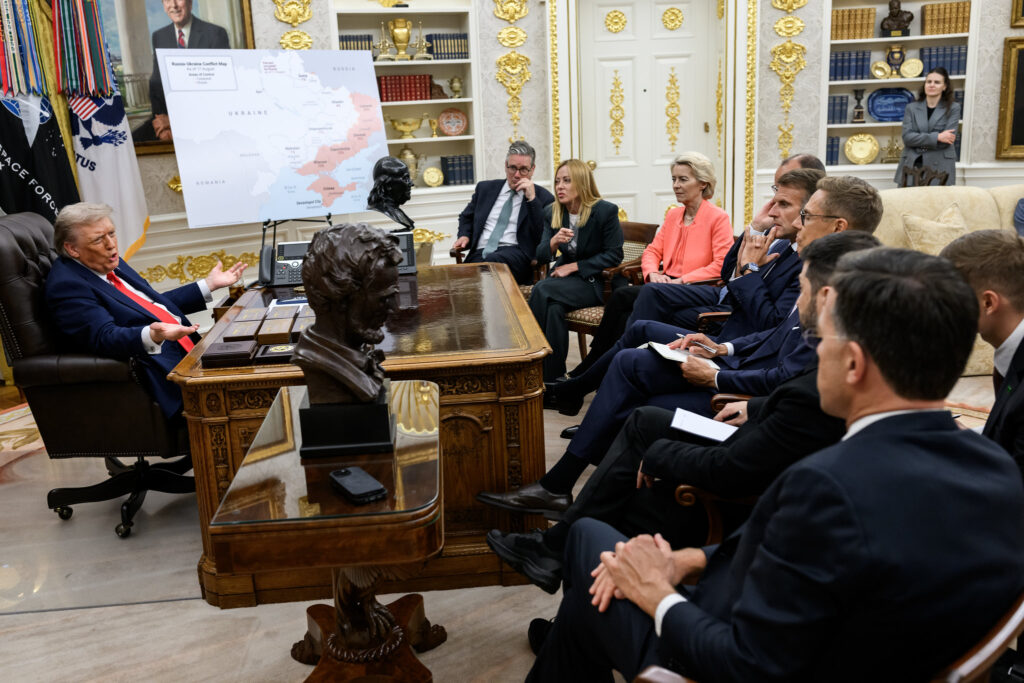
The Trump administration has launched a new peace plan that would give Russia much of what it wants: recognition of its sovereign control over Crimea, Luhansk, and Donetsk; guarantees that Ukraine will not be admitted into NATO; limitations on the Ukrainian army; and the reintegration of Russia into the global economy. The Europeans have countered with their own plan that walks back some of the territorial concessions and the limitations on the Ukrainian military, and it strengthens the security guarantees for Ukraine.
Ultimately it will be up to Ukraine and Russia to decide which, if any, agreement they are willing to accept. But the differences between the Europeans and the Trump administration reflect fundamentally different understandings of what shaped the conflict in the first place. The Europeans, for good reasons, reflect back on their past failures to deter Russian President Vladimir Putin.
In a new article, Jana Lipps and I examined why some European politicians long favored a more hardline approach while others supported accommodation. We find that tacit support for Putin often came from mainstream parties and, much like in the United States, from politicians swayed by Putin’s culturally conservative appeals. Women and politicians that support LGBT rights were more hawkish. Here’s how this research can help us understand the current conflict.
Spiraling versus deterrence
Good Authority editor Stacie Goddard wrote an incisive Good to Know post about two contrasting logics underlying the outbreak of war: the spiralling and the deterrence logic. The spiralling logic, advanced most forcefully by John Mearsheimer, claims that the U.S. and Europe pushed Russia into the conflict by assertively pursuing Ukrainian membership in NATO and the European Union. This view assumes that Putin had no real interest in taking Ukrainian territory until the West took steps that started threatening Russian security. From this perspective, the Trump proposal makes perfect sense: Give Russia what it wants and peace will ensue.
The deterrence logic, embraced by most European political leaders, holds that the West’s failure was not that it pushed Putin into a corner. Instead, they find fault with the West’s willingness to consistently accommodate Putin’s transgressions, including Russia’s military incursion into Georgia in 2008, the 2014 annexation of Crimea, and persistent Russian military actions in Donbas. Adherents of this view point out that NATO undertook no concrete steps towards Ukrainian membership after the 2008 Bucharest Summit Declaration.
Moreover, Putin has frequently stated that he sees Ukrainians and Ukrainian territory as inseparable from Russia. Thus, many Europeans assume that Putin cannot be trusted to abide by a peace deal, even one that is highly favorable to Russia. Instead, they view this peace deal as just another foolish instance of appeasement, and likely to lead to further trouble down the road.
So why did Europe accommodate Putin?
The European position now stems in part from a realization that they accommodated Putin too much in the past, partially due to economic interests. For example, Germany’s industry has long depended on cheap natural gas that arrived via pipeline from Russia. This is a legacy of former Chancelor Willy Brandt’s Ostpolitik during the Cold War, and close relationships between German leaders and Putin. While the German government swiftly imposed strong sanctions after Russia’s full-scale invasion of Ukraine in 2022, it failed to credibly announce a willingness to do so before the invasion, which is the whole point of deterrence.
Yet, there was always considerable disagreement among European politicians both within and between countries. To better understand this, Jana Lipps and I gathered a dataset of votes on 1,140 resolutions and amendments that explicitly targeted Russia in the Parliamentary Assembly of the Council of Europe (PACE) between 2007 and 2021. The resolutions were either about how severely to criticize Russia’s international or domestic transgressions, or whether to suspend or reinstate Russia’s PACE delegation. What makes PACE a fertile ground for research is that while it is an international parliament, its members are national parliamentarians – the same people who shape national policy.
Mainstream support for Putin in Europe
The European parties that explicitly support Russia and Putin tend to be legacy communist parties or far-right parties. Yet, we found high tacit support for Putin among mainstream parties, especially in countries that are not directly threatened by Russia. With tacit support we mean support for reintegrating Russia into the international community and toning down language that condemned Russia for human rights abuses or annexing Crimea. Social Democrat (center-left) parliamentarians, in particular, often voted to accommodate Putin.
European media have documented the financial and personal ties between far-right politicians and Russia, including accusations that Germany’s AfD politicians were spying for Russia. But there is also considerable evidence in the public record that Russia successfully engaged with parliamentarians from mainstream parties, including PACE presidents like Dutch Senator Rene van der Linden, who engaged with a Russian spy and Russian nationalists while lobbying for the removal of E.U. sanctions.
The investigations surrounding U.S. lobbyist Paul Manafort alleged that Mevlut Cavusoglu, PACE president from 2010 to 2012 and later the Turkish minister of foreign affairs, asked for a $230,000 payment to offer a favorable assessment of the 2012 Ukrainian elections. This would support the pro-Russia administration of Ukrainian President Viktor Yanukovych.
Pedro Agramunt, the Spanish PACE president from 2016 to 2017, was removed from office after traveling with a Russian delegation to Syria and painting a favorable picture of Russian human rights practices there.
Mike Hancock, a British Liberal Democrat member of Parliament, was booted as chair of the liberal ALDE group. The concerns centered on his consistently pro-Russian views, and his string of young, good-looking Russian female assistants who had access to ALDE’s computer systems.
Russia also organized two international forums on the “Development of Parliamentarism.” As one Belgian participant put it:
It was only during networking hour […] that we “experts” recognized one another and understood that we had been herded into the Forum project in our capacity as “Friends of Russia” who happened to have some local or international standing and perhaps enough gray hairs to look serious.
While a lot of the media attention focuses on far-right parties that may accommodate Putin, it’s important to remember that Russia has also cozied up to mainstream politicians, turning some of them into what the Germans call “Putinverstehers”: people who may not agree with Putin but understand him and are willing to make deals.
Putin’s culturally conservative turn
A second finding from our research is that Putin’s culturally conservative turn divides European politicians. Since 2012, Vladimir Putin has embraced an increasingly hardline cultural conservatism. Triggered in part by the Pussy Riot protests and fears of a “color revolution,” the Kremlin intensified appeals to “traditional values,” aligning itself with the Orthodox Church, nationalists, and disaffected working-class voters. This shift produced sweeping restrictions on LGBT rights, efforts to roll back gender equality, and the targeting of feminist and human rights activists as “foreign agents.” The same rhetoric shaped Putin’s justification for the 2022 invasion of Ukraine, which he cast as a struggle to defend Russia’s moral sovereignty against Western values.
In the United States, cultural conservatives have increasingly embraced Putin. We see evidence of this among European parliamentarians as well. Moreover, compared to other politicians from their national parties, we found that female parliamentarians became less likely to vote with Russia after 2012. We also found that legislators who signed LGBT rights declarations were less likely to support Russia than other members of their national party delegations. Thus, women and politicians who support LGBT rights correlates were more hawkish about Russia, while cultural conservatives were more dovish.
These findings suggest that Putin’s cultural conservatism may increase his appeal among like-minded Europeans but it also makes him more dangerous to others. For some Europeans, then, Putin poses not just a territorial but also an ideological threat.