





In early July, Ukrainian law enforcement targeted several individuals involved in anti-corruption work. Vitaly Shabunin was accused of “evading military service” and misappropriating a humanitarian aid vehicle for personal use. Shabunin, an anti-corruption activist, claimed the case against him was politically motivated. Then, two staffers from the National Anti-Corruption Bureau (NABU) were arrested for suspected ties to Russian intelligence.
In late July, Ukrainian president Volodymyr Zelenskyy spearheaded a series of moves against two independent anti-corruption institutions: NABU and its partner agency, the Special Anti-Corruption Prosecutor’s Office (SAPO). The final straw came when lawmakers from Zelenskyy’s party in the Verkhovna Rada (Ukraine’s parliament) proposed a bill that effectively subordinated NABU and SAPO to the prosecutor general – an office appointed by the president, with the consent of the Rada. The Rada voted for the legislation and Zelenskyy signed the new law on July 22, claiming it would “cleanse” the anti-corruption bodies of “Russian influence.”
Ukrainians quickly protested
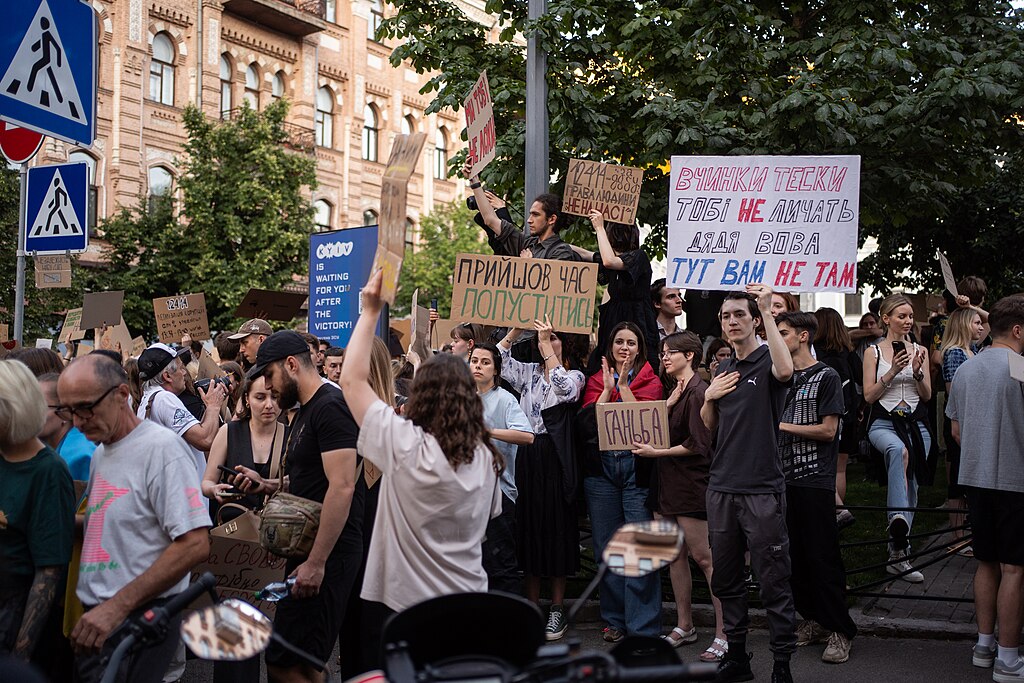
The day the law was passed, Ukrainians took to the streets – in defiance of martial law – chanting “Veto the law!” Young people were at the forefront of demonstrations across the country. Many held signs bearing messages like “All animals are equal, but some animals are more equal than others” (a line from George Orwell’s Animal Farm) and “Why the f*** do I need a system that works against me?” (from a song by the Ukrainian rock band Zhadan i Sobaki). From July 22-25, international conflict monitor ACLED recorded over 60 protests in more than two dozen Ukrainian cities. A July 25-26 survey of Ukraine’s urban population found that 69% of city residents fully or partially supported the protesters. Respondents in the youngest survey bracket – ages 18-24 – expressed the greatest level of support: 82%.
In response to the public’s outrage – and 10 days of widespread protests – Zelenskyy submitted a new bill restoring independence to the two anti-corruption bodies, NABU and SAPO. The Ukrainian parliament passed the new legislation by a large majority. This move calmed public opposition, but has left a shadow over Zelenskyy’s presidency. Ukrainians still stand united in defense of their country. In the short term, however, Zelenskyy’s image has been tarnished.
Ukrainians are well aware that it would be impossible – and unconstitutional – to hold elections during the full-scale war with Russia. But these protests show Zelenskyy’s power as a wartime president is not without limits.
What’s the story behind these two anti-corruption bodies?
NABU and SAPO were established after the 2013-2014 Euromaidan revolution, which ousted corrupt and increasingly authoritarian incumbent president Viktor Yanukovych, who had backed away from a prior commitment to closer ties with the European Union. NABU investigates high-level corruption – including among government officials. SAPO oversees these investigations, representing the Ukrainian government in court. The prosecutor general cannot intervene in their investigations, and other agencies may not open duplicate cases.
The independence of these agencies has come under attack before, during the presidency of Zelenskyy’s predecessor, Petro Poroshenko (who made his money in the candy business). In 2017, Poroshenko’s attempt to subvert anti-corruption reforms triggered a swift reaction by Ukrainian civil society activists and international organizations like the European Union and International Monetary Fund.
What do Ukrainians think about corruption in their country?
Interestingly, although Ukrainians are swift to defend against any perceived attacks on anti-corruption efforts, they remain skeptical about the effectiveness of the work of these agencies. I analyzed survey data from five waves of nationally representative surveys on corruption, which were conducted by the Kyiv International Institute of Sociology from 2015-2024. Here are a few key insights:
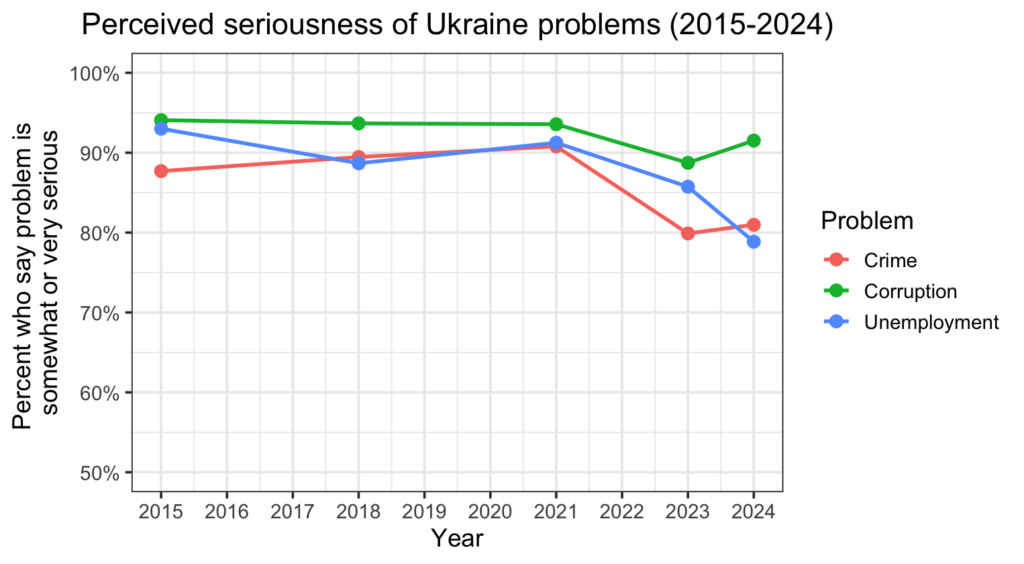
- Corruption regularly ranks among the issues of highest concern to Ukrainians – above even crime and unemployment. In all of these waves, around 90% of Ukrainians surveyed said that corruption is “somewhat” or “very” serious. However, citizens’ perceptions of corruption appear to be much higher than their actual experiences with corruption.
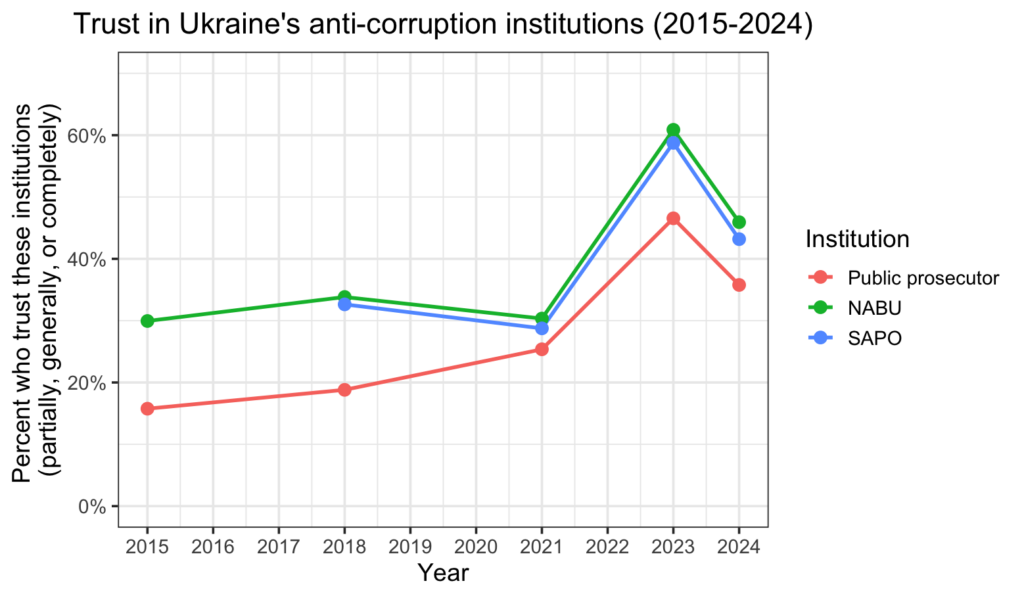
- Trust in anti-corruption institutions increased after Russia’s full-scale invasion in February 2022. In 2021, about 30% of Ukrainians expressed at least some trust (3, 4, or 5 on a 5-point scale) in NABU and SAPO. After the invasion, trust surged to 60% – a rally-around-the-flag effect that was observed everywhere from Zelenskyy approval levels to Ukrainians’ support for democracy. Although trust in NABU and SAPO has diminished since 2023, Ukrainians still trust these institutions more than the public prosecutor (who is a political appointee).
- Part of the general lack of public trust appears to stem from the fact that the vast majority of Ukrainians don’t know much about what these anti-corruption agencies are actually doing. In 2018, about 30% of Ukrainians said they were “aware of any anti-corruption measures, reforms, or campaigns carried out in the past 12 months” by NABU; by 2021, less than 10% were aware of NABU’s activities.
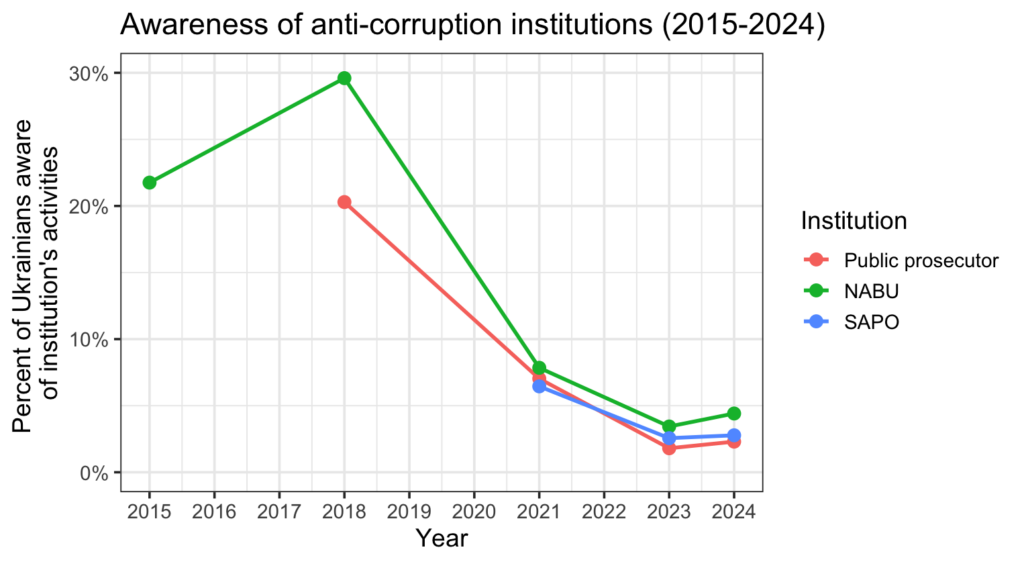
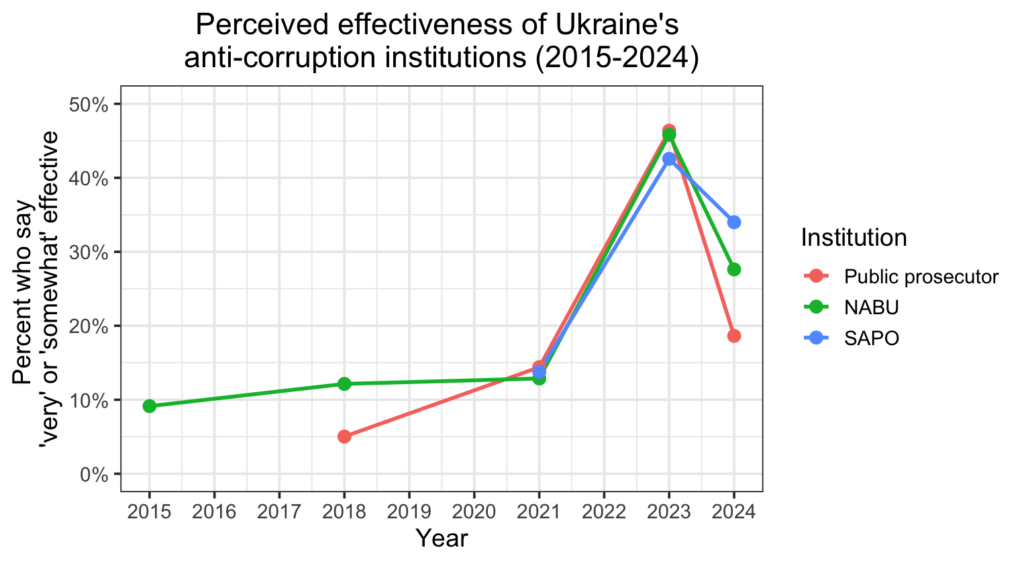
- Of those respondents who said they are aware of what Ukraine’s various anti-corruption agencies are doing, only a minority think they’re effective. Perceived effectiveness also increased after Russia’s full-scale invasion – presumably part of the same wartime rally phenomenon.
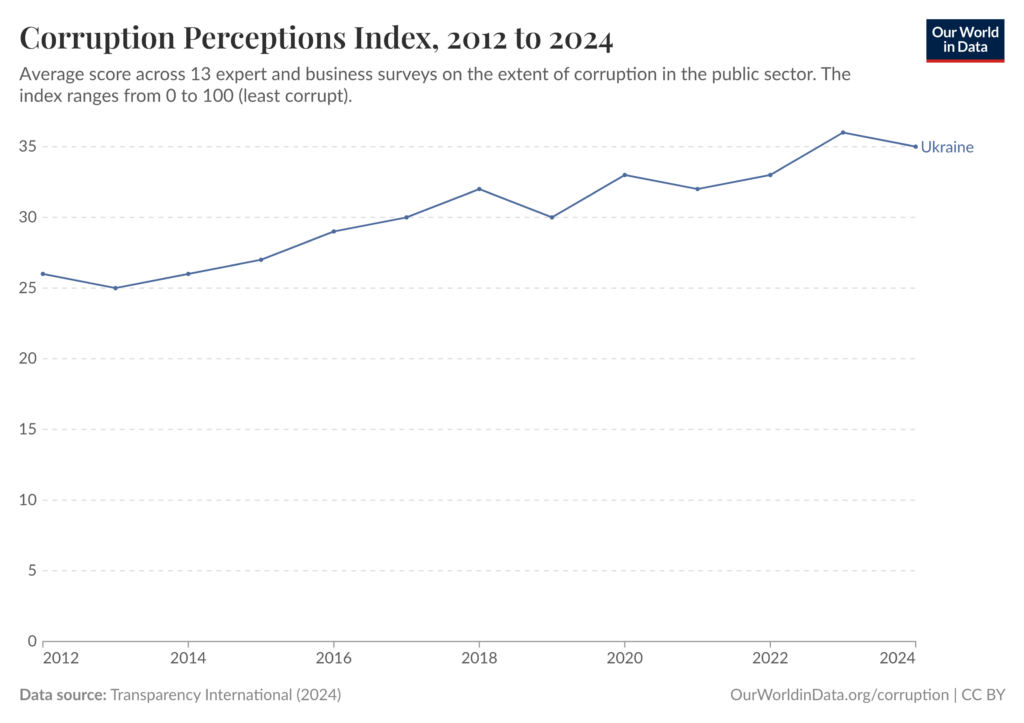
- Ukrainians’ eagerness to criticize their government is nothing new. These latest protests don’t mean that anti-corruption reforms aren’t working. Ukraine’s score on Transparency International’s annual Corruption Perception Index, which combines expert and business surveys estimating corruption in the public sector, has increased consistently since 2013. There’s still considerable room for improvement – especially considering Ukraine’s goal of E.U. membership.
What does this protest – and Zelenskyy’s response – say about Ukraine politics?
One of the most significant takeaways from the past month’s events is that even the ongoing war did not deter Ukrainians from defending their democracy against perceived assaults or mismanagement. As people took to the streets, Russia continued to conduct missile and drone strikes throughout Ukraine. And the Ukrainian government is still responsive to citizens’ demands – even in wartime conditions, when “normal” politics remain suspended.
At the same time, this episode suggests that Zelenskyy does not have carte blanche to pursue his preferred policies. Political rivals like Kyiv Mayor Vitali Klitschko spoke out against the efforts to undermine NABU and SAPO. Although elections are not on the immediate horizon, Zelenskyy may face further criticism as other politicians perceive an impending return to business as usual.
Was this just a political blunder?
So why did Zelenskyy decide to downgrade the two independent anti-corruption agencies? This appears to have been a major political blunder for Ukraine’s wartime president. Analysts offered at least two theories to explain why he initiated the law. One possibility is that NABU’s investigations had started investigating the activities of Zelenskyy’s inner circle, including Deputy Prime Minister Oleksiy Chernyshov, who was implicated in a kick-back scheme for a large-scale real estate development project. Another possibility is that Zelenskyy was concerned that NABU’s investigations risked igniting domestic political conflict at a time when the country should be united against Russia.
Unfortunately, any signs of disunity are a boon for Russian propaganda seeking to portray Ukraine as a corrupt Western puppet and Zelenskyy as an illegitimate leader. But it’s important to correct any misconceptions regarding the Ukrainian president. Zelenskyy is not – as Donald Trump has called him – a “Dictator without Elections.” He is a wartime president who made a political mistake and quickly corrected it – largely thanks to the efforts of outspoken Ukrainians who see it as their responsibility to keep their leaders accountable.
Isabelle DeSisto is a 2025-2026 Good Authority fellow.