






Partisan gerrymandering is intensifying only days after the Supreme Court’s ruling in Louisiana v. Callais. Here in Tennessee, Republicans quickly voted to eliminate the state’s only Democratic-held U.S. House district. Other states are moving in the same direction.
For people concerned about the dilution of Black voting power, legislative redistricting has been a primary focus. But the Voting Rights Act (VRA) also had consequences at the local level. And as questions swirl about what the Callais decision could mean for vote dilution claims under the VRA, it’s important to remember that history.
How the VRA changed local elections
A valuable new piece of research on this subject is “The Judicial Prohibition of Black Vote Dilution: Consequences for Political Representation and Public Good Provision in U.S. Municipalities,” by Ferran Elias and Andreas Kyriacou of the University of Girona.
Here’s the background. Prior to the Voting Rights Act and subsequent amendments and judicial interpretations, it was common for local electoral systems to prevent Black voters from being able to elect any Black candidates. Often, this was done via at-large systems, in which the town, city, or county voted as a whole for local officeholders, such as on a city council. In a majority-white electorate marked by racially polarized voting, at-large elections often meant that candidates preferred by Black voters were defeated by white bloc voting.
But in district-based local elections, where individual officeholders represent a specific portion of the city or county, Black candidates could win because there were typically areas of these places where lots of Black voters lived. Here is an example from Elias and Kyriacou of how at-large versus district elections look in Florence, Alabama:
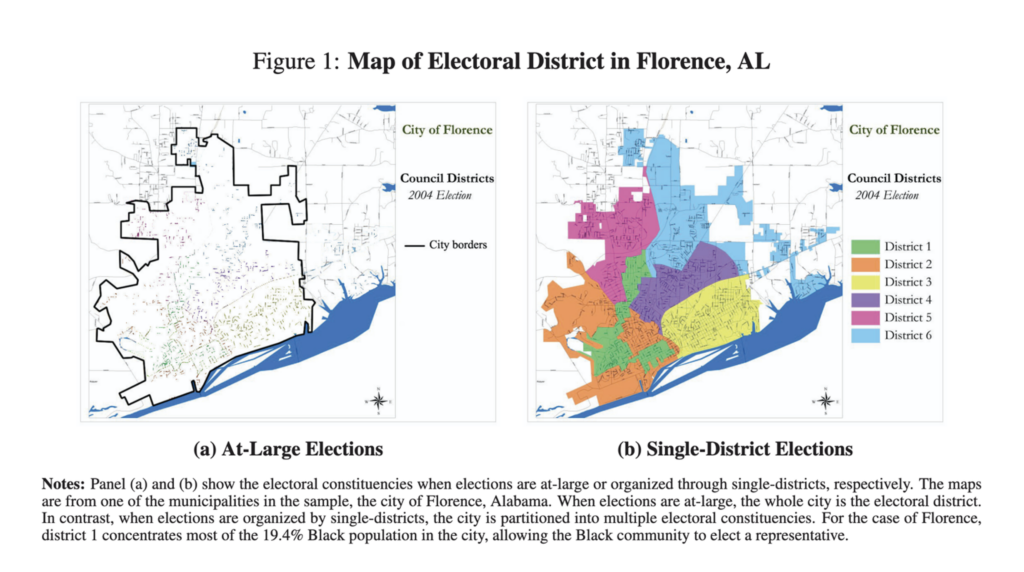
Beginning with court decisions in the 1970s, and especially after Congress amended the VRA in 1982 and the Supreme Court decided Thornburg v. Gingles in 1986, more and more localities shifted from at-large to district elections between 1973 and 1990. Although the Court has more recently narrowed major VRA protections, including in Shelby County v. Holder and Louisiana v. Callais, these institutional changes to local elections largely persisted.
How different election rules affected Black representation
Elias and Kyriacou trace the effects of different electoral rules across 130 cities from 1970-1990. These 130 cities all had substantial numbers of Black residents and also at-large elections. These are cities where the shift to district elections could matter.
And that shift did matter. Initially, there were almost no Black representatives on municipal councils in any of these places, even though some cities were as high as 40% Black. But cities that moved from at-large to district elections experienced a 20 percentage point gain in Black representation on municipal councils.
In turn, this brought the percentage of Black representatives on councils closer to the Black share of the populations of those places. As the authors write about the cities that shifted to district elections, “Black residents made up roughly 26 percent of the population in 1970 but held only 3 percent of council seats, whereas by 1990 they accounted for 32 percent of the population and 26.2 percent of seats.”
What greater Black representation meant for public policy
The change to district elections had consequences for municipal policy as well. Cities that shifted to district elections spent more money on fire protection and water utilities, although not on sewage, police, roads, or parks.
Why would changes in electoral rules, and thus Black representation, lead to changes in city spending patterns? There is evidence that this spending benefited Black neighborhoods in particular:
- Between 1970 and 2000, cities that moved to district elections saw an increase in the share of Black-occupied homes that had complete plumbing, which is consistent with the increased spending on water utilities. There was no change in white-occupied homes.
- The rents of Black-occupied housing units increased, which may be evidence of the improving quality of these units. (The growth in the rents of white-occupied housing was about half as large.)
- The Black share of the population also increased, which is consistent with growing interest from Black people in living in these cities (and may also have helped increase rents).
The authors summarize these patterns: “Black representatives become influential actors and are able to shape public spending to improve public goods provision in historically underserved neighborhoods while also generating broader benefits across the city.”
What happens now?
Already, there is discussion about what the Callais decision will mean for local politics and elections. Some opponents of the decision have raised the concern that localities might shift back to at-large systems. We don’t yet know what will happen. But this research suggests what such a shift might produce: fewer Black representatives and worse services for Black residents.
Stay up to date on all things politics and political science. Bookmark our landing page and sign up for Good Authority’s weekly newsletter by entering your email address in the box below.