



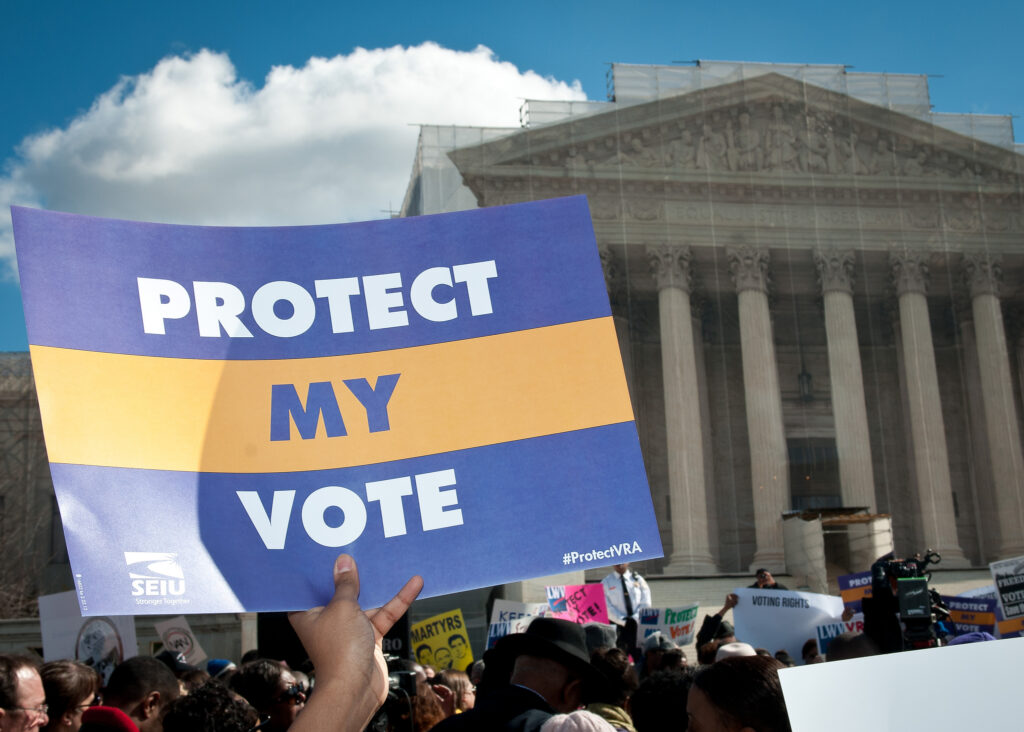
Questions about racially motivated voting restrictions gained new relevance last week when the U.S. Supreme Court overturned a key component of the 1965 Voting Rights Act (VRA) in Louisiana v. Callais (2026). The decision effectively ended the protections of the VRA’s Section 2, which sought to ensure that voters of color had fair representation in elections. This ruling now opens the door to the potential elimination of majority-minority districts in numerous states.
Political scientists regard the Voting Rights Act as the change that made America a full democracy, because it made nearly all U.S. adults eligible to vote. Prior to the VRA, white supremacists in the South and elsewhere used literacy tests, poll taxes, felony disenfranchisement, and other near-total bans on Black election participation.
The erosion of VRA protections began with the Supreme Court’s 2013 decision in Shelby County v. Holder. Conservatives on the court have justified ending VRA protections by pointing to how the VRA reduced racial disparities in voter turnout and representation. Liberals on the court have likened ending VRA protections to throwing away an umbrella because it has kept you dry. These debates over racial inequality remain at the center of American politics.
In light of this, we were interested in the extent to which the U.S. public supports some of the policies used to disenfranchise Black voters – including policies that were struck down in the 1960s.
To do so, we fielded a representative survey of 2,000 Americans through YouGov in March and April 2026. Roughly half of survey participants were re-contacts from prior surveys, and half were new respondents.
We focused on three Jim Crow voting restrictions: literacy tests (which the 1965 VRA outlawed), poll taxes (eliminated by the 24th Amendment in 1964), and felony disenfranchisement (which remains in force in some states).
Here’s what we found
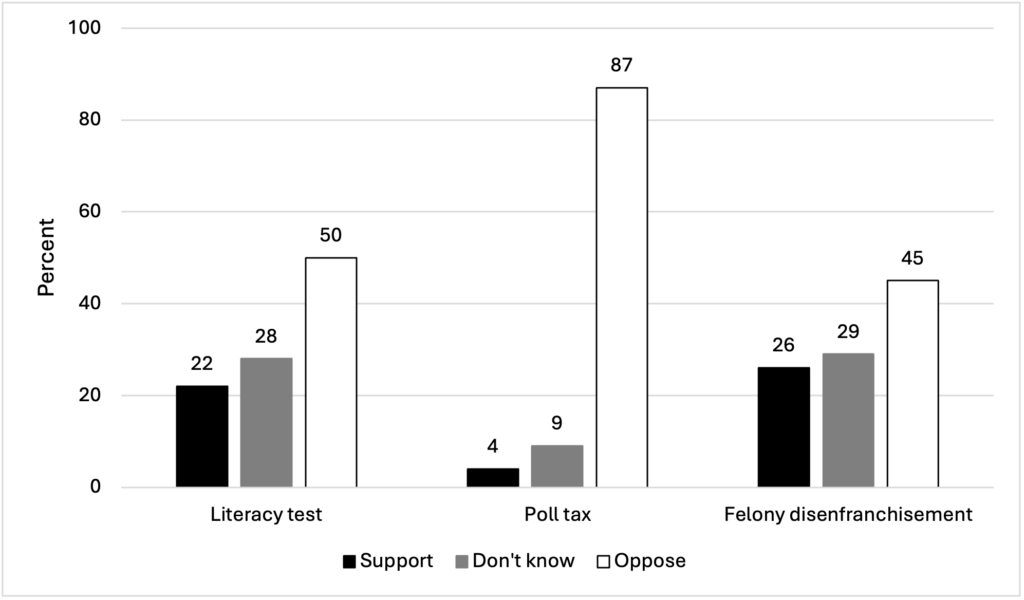
The good news is that Jim Crow voter restrictions are very unpopular today, as the figure below shows.
Literacy tests like Alabama’s 1965 test featured political knowledge questions administered arbitrarily by local white officials. The goal was to prevent Black Americans from participating in elections, and these tests often gave exemptions for white voters. Some Americans still complain about low levels of voter knowledge and call for such tests to be reinstated.
We asked, “How would you feel about a law requiring Americans to pass a political knowledge test to vote? Supporters say it makes election outcomes more informed. Opponents say voting tests are designed badly to exclude other types of voters who are informed enough.”
In our survey, 22% supported literacy tests, 50% opposed, and 28% were unsure.
Poll taxes targeted poor people, who were disproportionately Black under a Jim Crow economy that reproduced many of the conditions of enslavement. We asked, “How would you feel about a law requiring Americans to pay a $50 fee to vote? Supporters say voters should show they care enough to choose well. Opponents say voting fees are actually intended to exclude other types of voters who care just as much.”
Just 4% of respondents supported poll taxes, with 87% opposed, and only 9% were unsure.
Policies disenfranchising people convicted of felonies are different. Several states still have these laws on the books, affecting about 5 million Americans. A disproportionate number are Black citizens who are affected disproportionately, due to biases in arrests, convictions, and sentencing. In some Southern states, 10% of all adults are disenfranchised. And in Wisconsin, four lawmakers proposed a bill in 2026 to prevent former inmates who had served their prison time from voting unless they had completed paying any fines or fees.
We asked, “How do you feel about laws in some states where Americans convicted of a felony lose the right to vote for the rest of their lives? Supporters say those voters have bad morals that worsen election outcomes. Opponents say those laws are intended to unfairly exclude other types of voters who are moral enough.”
Here’s what we found: 26% expressed support, 45% were opposed, and 29% were unsure.
So who supports these voting restrictions?
Support for Jim Crow voting restrictions is much higher among Republicans (vs. Democrats) in our survey, and among people who deny (vs. acknowledge) the contemporary impacts of anti-Black discrimination. Party and race views are also highly related: Three-quarters of Republicans deny the impacts of anti-Black discrimination, compared to just 13% of Democrats.
Republicans are twice as likely to endorse literacy tests, four times more likely to endorse felony disenfranchisement, and five times likelier to endorse poll taxes – though each of these barriers to voting reflects a minority view among Republicans. Even GOP support for poll taxes is miniscule, we found.
On literacy tests and poll taxes, we find no differences between white Americans and people of color, and no differences comparing Southerners and non-Southerners. We do find that white Americans and Southerners are seven points more likely to support felony disenfranchisement, compared to the views of people of color and non-Southerners on this issue.
What does this mean for voting rights in America?
Our results fit with broader declines in support for explicitly anti-Black views since the mid-20th century, even as other forms of anti-Black sentiment remain prevalent. However, racial inequalities remain stubbornly high, reflecting the existence of many institutions that preserve those inequities. We also know public opinion is fluid, and public views can change dramatically when trusted leaders take new positions.
There are many current and proposed voting policies that reduce the political participation and power of eligible American voters, with disparate – and even targeted – harms for racial and ethnic minorities, lower-income people, and others. Our survey suggests many Americans don’t agree with these efforts. Supporters of an American democracy in which everyone has an equal say in determining what governments do are likely watching for ways to guard against threats to representative elections and voting rights in every form they take.
Nathan P. Kalmoe is executive administrative director of the Center for Communication and Civic Renewal at the University of Wisconsin-Madison. His current book project is titled “How We Make American Democracy: A Practical Guide to a Free & Fair Future” (under contract with University of Chicago Press).
Michael W. Wagneris the William T. Evjue Distinguished Chair for the Wisconsin Idea and faculty director of the Center for Communication and Civic Renewal at the University of Wisconsin-Madison. He is coauthor of Battleground: Asymmetric Communication Ecologies & the Erosion of Civil Society in Wisconsin (Cambridge University Press, 2022).
Stay up to date on all things politics and political science. Bookmark our landing page and sign up for Good Authority’s weekly newsletter by entering your email address in the box below.