





On Apr. 25, the al-Qaeda-linked Jama’at Nusrat al-Islam wal-Muslimin (JNIM) and Tuareg separatists from the Front for the Liberation of Azawad (FLA) launched the largest coordinated assault of Mali’s 14-year civil war. They hit the international airport for Bamako (Mali’s capital city), Kati (a garrison town 15 kilometers from the capital), and the cities of Sévaré, Mopti, and Gao. A suicide car bomb killed Defense Minister Sadio Camara, and destroyed his residence. By nightfall, FLA fighters had retaken Kidal, a strategic northern city that the Malian government and its Russian allies had fought hard to secure during the civil war.
These attacks reshape what is at stake far beyond Mali’s borders. The country was already in a humanitarian crisis. Human Rights Watch documented 8.8 million Malians in need of aid as of 2024, with more than 575,000 people displaced since 2023. Senegal, Côte d’Ivoire, Mauritania, and Niger, the countries that buffer the Sahel from the Atlantic and the Sahara, are already fighting insurgencies that bleed across Mali’s borders. And the international community that had previously contained the civil war in Mali for more than a decade beginning in 2013 is now consumed by the war between the United States, Israel, and Iran, with neither the bandwidth nor the inclination to respond.
In December, I argued here on Good Authority that the JNIM siege of Bamako would test the international community’s tools for containing extremist violence, and that the outcome would matter far beyond Mali. These new attacks have settled that test. The strategy of expelling the U.N. and hiring Russian mercenaries has failed. Mali’s government is left with very few solutions.
Why the post-U.N. strategy failed
When Mali’s junta forced French and U.N. forces to withdraw in 2023, the government argued to Malians that the international community had not pursued JNIM aggressively enough. The government then claimed Mali soldiers and the junta’s Russian allies from the Wagner Group would.
The city of Kidal was a test case. Kidal had been a Tuareg rebel stronghold in Mali’s far northeast for a decade. The 2015 Algiers accord had effectively ceded governance of the region to the rebels. The junta captured Kidal on Nov. 14, 2023, two weeks after pushing U.N. peacekeepers to vacate their base. This swift action, the junta claimed, was proof of the government’s new strategy. But just last week, 18 hours of fighting unmade that case.
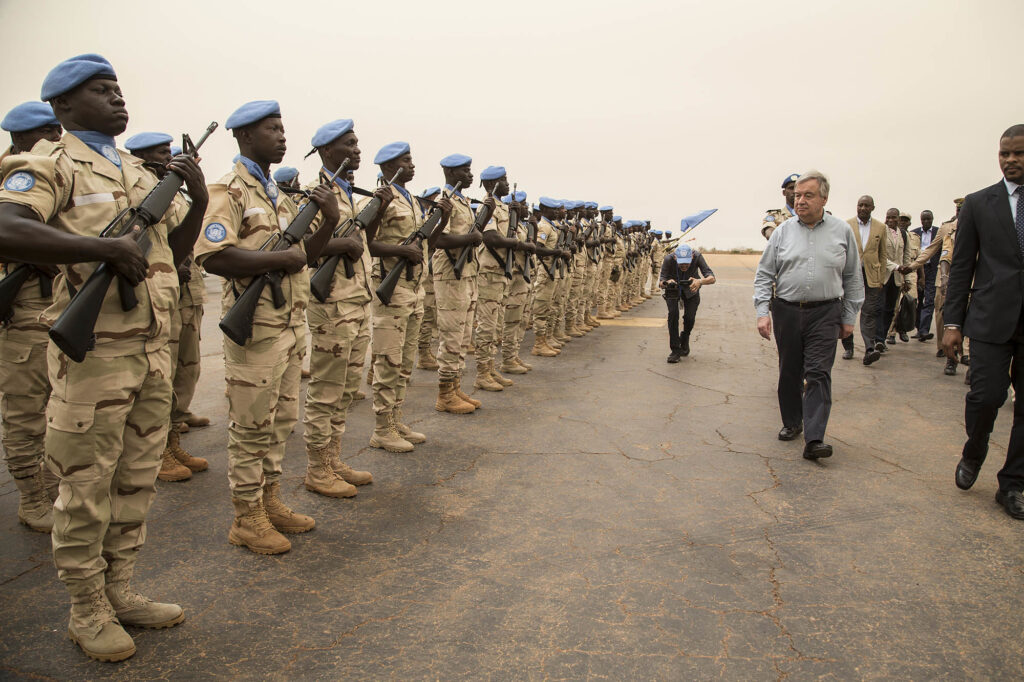
The government’s Russian allies – both the nominally private Wagner Group and the state-run Africa Corps – have proven unreliable at best. At its peak, the U.N. Multidimensional Integrated Stabilization Mission in Mali (MINUSMA) fielded more than 13,000 uniformed personnel. In contrast, the Africa Corps replacement now fields between 1,000 and 1,500 troops. Joint Malian military and Russian operations have accounted for nearly 1,500 civilian deaths between the U.N.’s exit in December 2023 and June 2025, roughly four times the toll attributed to JNIM in the same window. After a July 2024 ambush by an armed group killed as many as 80 Wagner fighters, Russian doctrine in Mali shifted from active counterinsurgency to bunker defense, drone strikes, and military training, suggesting an overall strategic retreat.
But counterinsurgency conducted by Russian mercenaries on behalf of an unaccountable host government has produced neither deterrence nor accountability, the record shows. Over the past year, this strategy has left an increased number of dead civilians. And Mali’s insurgent groups have graduated from rural raids to coordinated assaults on the capital.
Why no help is coming
The foreign governments that contributed troops, money, and political attention to MINUSMA from 2013 to 2023 are now consumed by an entirely different theater of operations: the war in Iran and the broader regional instability.
Other former international partners of the Malian regime have been affected in important ways by the joint American and Israeli campaign against Iran since Feb. 28. President Trump’s Apr. 12 naval blockade has knocked global shipping through the Strait of Hormuz to 5% of pre-conflict levels. And 20% of the world’s seaborne oil passes through that waterway. The governments that funded MINUSMA – whether China, the United States, or France – now seem uninterested in a Mali response while so much of their attention is focused on the Iran crisis.
What Mali’s insurgents have learned
Moreover, JNIM has evolved in doctrine to learn how to attack Russian forces and the Malian military. In the 2010s, AQIM, JNIM, Boko Haram, al-Shabaab, and the Islamic State in Greater Sahara made African counterterrorism efforts a Western preoccupation. Mali was at the very center of that pattern. For over a decade, France, the United Nations, the United States, and the European Union committed personnel, funds, and political attention to contain extremist violence on the continent. Those efforts had mixed success, but prevented Mali’s collapse for over a decade. JNIM and other extremists made these operations their explicit target. When the U.N. balked at the junta’s military goals, the government turned to Russia.
JNIM has now targeted Russia’s military presence in Mali, as well striking the regime that depends on Russian arms, and made a public offer to remove Russia from the conflict. In this stage of the war, JNIM’s expansion is driven less by spectacular ideological violence than by patient territorial accumulation in places the Malian government has abandoned.
The northern part of the Apr. 25 operation, far from the government heartland in the south, was a joint FLA-JNIM action. The Bamako and Kati strikes, however, were conducted by JNIM alone. The Apr. 25 fighting appeared to put into practice a de facto territorial power-sharing agreement between JNIM and the FLA.
What comes next?
Mali quietly became Africa’s second-largest lithium producer in 2025, anchored by the Chinese-controlled Goulamina mine, just 100 km from Bamako. JNIM control of Mali would leave a critical node in the EV-battery supply chain into the hands of an al-Qaeda affiliate.
If JNIM’s previous actions are any indicator, a JNIM-controlled Mali would be a humanitarian catastrophe. This would also intensify the Sahel migration corridor towards Europe. And it would place a sovereign Islamist extremist regime – and a potential sanctuary state – on the doorstep of countries like Burkina Faso and Niger, both of which are already managing similar insurgencies. Also affected would be countries like Benin and Cote d’Ivoire, which are working hard to prevent the spread of such insurgencies inside their borders.
Nearly 15 years after an Islamist insurgency threatened to gain control of Mali, a new one seems poised to do so again. In 2013, France and the U.N. intervened to help the Malian government stop the insurgents. Those forces are no longer there and the Malian army’s Russian-backed campaign has not filled the gap.
With its victories, JNIM does not need to take Bamako tomorrow. It needs only to outlast the government and the interest of the government’s international allies. Whether Mali becomes the first sovereign Islamist extremist state in West Africa now depends less on JNIM’s military progress than on whether anyone outside the region is still watching.
William G. Nomikos is a 2025-2026 Good Authority fellow and the author of Local Peace, International Builders (Cambridge University Press, 2025).
Stay up to date on all things politics and political science. Bookmark our landing page and sign up for Good Authority’s weekly newsletter by entering your email address in the box below.
