






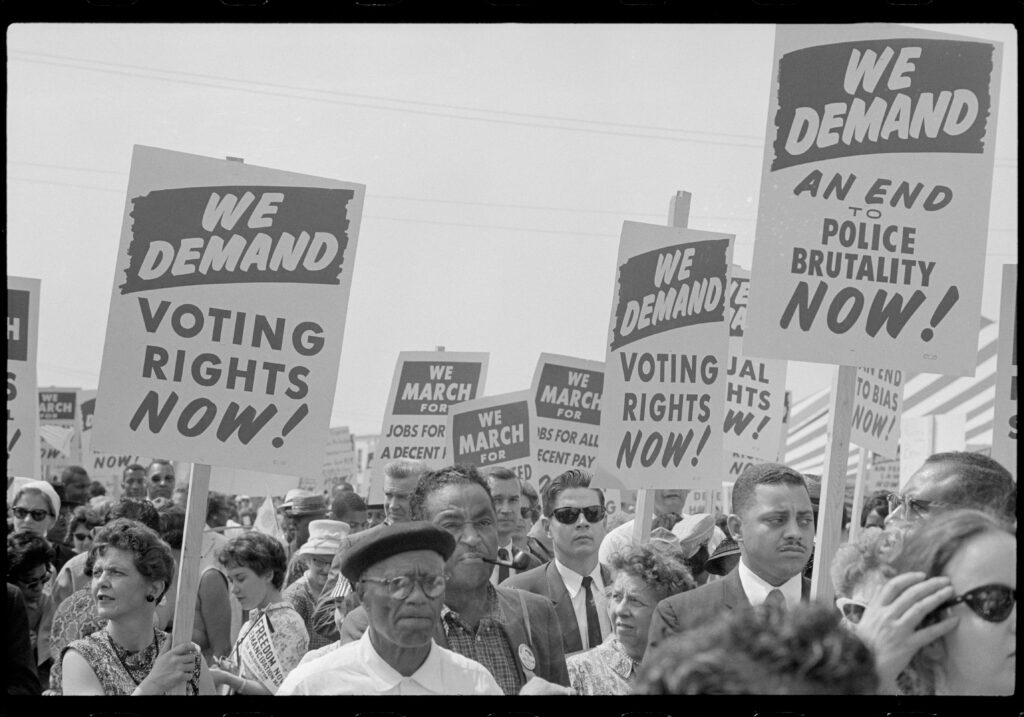
Last week, the Supreme Court heard oral arguments about a key component of the 1965 Voting Rights Act (VRA). The Court’s VRA rulings indelibly shape the contours of Black political representation in America. This particular case centers on Louisiana’s congressional maps. The case revisits the constitutionality of racial gerrymandering, which allows states to draw cohesive and geographically compact districts that contain a minority population. Unlike partisan gerrymandering, racial gerrymandering is legally permitted under the 14th Amendment. This draws directly from the Equal Protection Clause and was first recognized in Shaw v. Reno.
Here’s what’s at stake: A state’s Black population may no longer have the opportunity established under the VRA to elect a representative of their choosing. One central tool for enforcing the VRA has been the creation of majority-minority districts. These are electoral districts in which a racial minority or minority groups make up the majority of the district’s total population. These districts have helped to ensure that the makeup of the U.S. House of Representatives comes closer to reflecting the nation’s racial and ethnic diversity. To be clear, as Good Authority fellow Eric Juenke explains in detail, “As of January 2025, most racial and ethnic groups remain underrepresented in Congress.”
If the Supreme Court now decides in favor of white voters who have challenged the constitutionality of racial gerrymandering, what happens next? How might the potential elimination of majority-minority districts impact Black representation – and the broader progress in Black political involvement? Here’s what our research shows.
Why should we care about majority-minority districts?
Black disenfranchisement is both a historical and contemporary phenomenon in U.S. politics. Whether through voter suppression tactics, limiting absentee and early voting, enacting poll taxes, or implementing the grandfather clause, Black Americans faced – and continue to face – systemic barriers that decrease voter engagement and political participation.
The VRA provided safeguards that finally allowed Black citizens to fully access the ballot. By putting up barriers to Jim Crow-era policies and racist practices, the VRA made American democracy more representative. As the VRA expanded political participation overall, the creation of majority-minority districts expanded representational avenues for Black Americans. VRA protections allowed Black Americans to elect representatives who looked like them, shared similar experiences, championed the political preferences of their racial group, and provided symbolic forms of representation. The creation of majority-minority districts also helped increase voter turnout. In sum, not only is the VRA one of the most successful U.S. civil rights laws, it has also been critical in sustaining a representative democracy, as this law ensures full citizenship rights to all Americans.
Here’s how we did our research
We use original data that tracks the racial and demographic composition of the congressional districts represented by every Black member of the U.S. House of Representatives between the 88th and 118th Congresses – spanning 1963 to 2024. This allows us to situate changes in Black representation within the broader context of the VRA’s enactment in 1965 and subsequent changes. The dataset includes 155 individual Black legislators, including 99 men and 56 women serving across both parties, but overwhelmingly as Democrats (143 Democrats and 12 Republicans). For each member-Congress observation, we record the racial composition of the member’s district (percent Black, percent white, and percent non-white), alongside institutional and biographical characteristics such as party affiliation, tenure, and age.
Black representation in Congress is closely linked to the VRA
Figure 1 shows the growth of Black representation in the U.S. House of Representatives over the past 60 years. Starting with just five Black members in the 88th Congress (1963–1965), the number has steadily increased to 61 in the 118th Congress (2023–2025). Although progress was gradual in the 1970s and 1980s, redistricting reforms and the amendments to the VRA since 1990 have now led the most racially diverse Congress in U.S. history – the 118th Congress (2023–2025).
Figure 1: Total number of Black U.S. representatives in each U.S. Congress
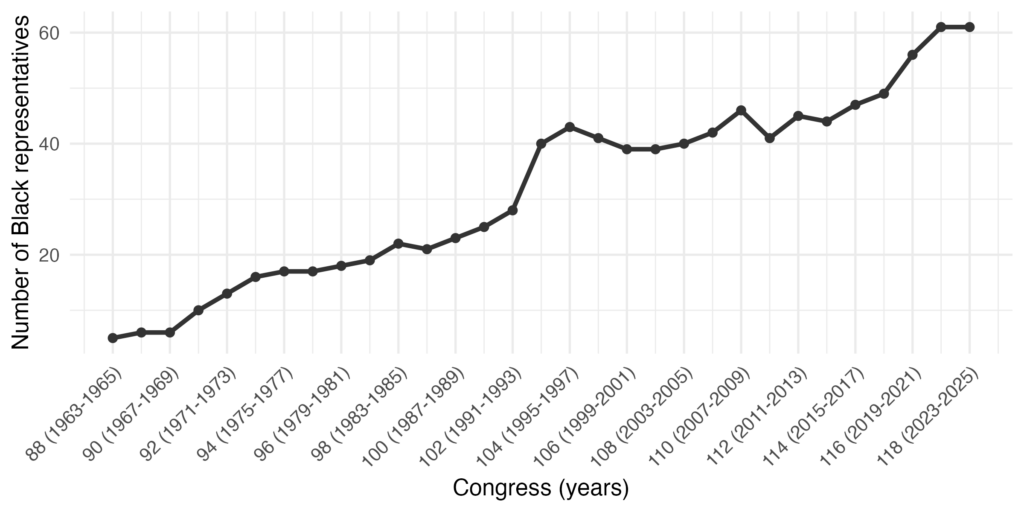
Figure 2 confirms how critical the VRA has been to the growth of Black political representation. For most of the post-1965 era, the overwhelming majority of Black members of Congress were elected from majority-minority districts – with congressional maps designed to increase the chances of electing racial and ethnic minorities. It was only recently, beginning around the 114th Congress (2015–2017), that fewer than half of Black representatives came from such districts. In other words, Black representation has historically relied heavily on the existence and protection of majority-minority districts. Yet, as shown in Figure 1, the total number of Black legislators continues to grow even as their reliance on these districts declines. This recent change, with more Black members overall but fewer from majority-minority districts, highlights a telling shift in the geographic and political bases of Black political representation.
Figure 2: Share of Black U.S. representatives from majority-minority districts in each U.S. Congress

Black congresswomen are taking a different path
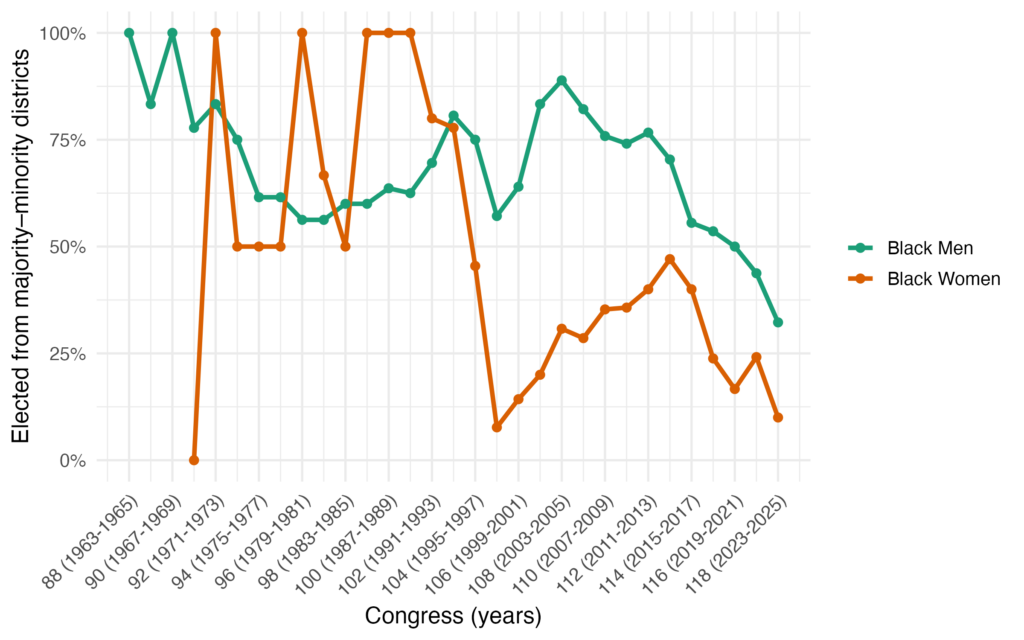
This transformation in Black representation is also gendered. As more Black women have entered Congress in recent years, their paths to elected office often differ from those of Black men. Figure 3 demonstrates that Black women are consistently less likely than Black men to represent majority-minority districts – instead, they often are elected in constituencies where Black voters are not the majority. In fact, since the 104th Congress (1995–1997), the first Congress with double-digit Black women representatives, less than half of Black women have come from majority-minority districts. In contrast, the share of Black men from majority-minority districts remained above 50% until as recently as the 116th Congress (2019–2021).
While the advantages of incumbency could, in theory, explain why some Black members continue to win after their districts become less Black, the evidence suggests that this is not the main reason for the trend. Black women are less likely to be incumbents than Black men. And the overall decline in majority-minority districts appears driven more by new Black members, especially Black women, winning in more racially mixed constituencies than by incumbents holding onto their seats after demographic shifts.
This highlights an important dynamic. Black men’s representation remains closely linked to the Voting Rights Act’s protections for majority-minority districts. Yet for Black women, representation increasingly reflects broader, multiracial constituencies. Therefore, any additional weakening of the VRA would likely disproportionately harm Black men’s political representation, even as Black women continue to make electoral gains in more diverse districts.
Figure 3: Share of Black U.S. representatives from majority-minority districts in each U.S. Congress
The future of Black political representation in Congress
If the conservative majority Supreme Court sides with the Trump administration, the VRA will again be significantly weakened, particularly because Section 5 was gutted by the Supreme Court in 2013. This will undoubtedly have a negative impact on Black political representation in Congress – particularly among Black men, who are more likely than Black women to be elected from majority-minority districts.
Voters in non-majority-minority districts may support Black women because they draw on strategic intersectionality. This concept can also encapsulate a view that voters may prefer women candidates of color because they are focused on the policy concerns of working class communities, their multiple identities allow them to build cross-group coalitions, and their gender “softens” their ethno-racial identity by drawing on feminine roles such as motherhood. Drawing on Christina Bejarano’s research in Latina Advantage, Black women – similarly to their Latina sisters – can effectively draw on strong connections with both ethno-racial groups and women’s groups to increase their electoral resources. They demonstrate their qualifications for office by overcoming the barriers of racism and sexism by being a stronger candidate than their opponents, who often do not face systemic barriers. Black women candidates also have a long and extensive history in their communities as leaders, workers, and organizers.
While our data indicates that Black women candidates for Congress may not be as impacted by the impending Supreme Court decision because they have proven to be successful in winning seats in non-majority-minority districts, there’s little reason to celebrate. Gender disparities among Black members of Congress have implications for Black political representation. Our research shows, for instance, that Black men and women have different legislative priorities and communication styles in Congress.
Simply put, history has taught us that Black political representation in America is not a given. If the Supreme Court strikes down Section 2 of the VRA, the voting strength of Black communities – and, consequently, the political representation of this group – will be significantly diminished. Furthermore, the balance of power in Congress will most likely change as most majority-minority districts vote Democratic.
However, what’s at stake now is not simply a partisan issue. Millions of voters who care about Black political representation – including scholars like us – are watching this case closely. But so too should all Americans who are concerned about the health and well-being of our democracy.
Nadia E. Brown is a professor of government and director of Women’s and Gender Studies at Georgetown University. She is the author of Sisters in the Statehouse: Black Women and Legislative Decision Making (Oxford University Press, 2014) and co-author with Danielle Lemi of Sister Style: The Politics of Appearance for Black Women Political Elites (Oxford University Press, 2021).
Michael G. Strawbridge is an assistant professor of political science at Washington University in St. Louis.