






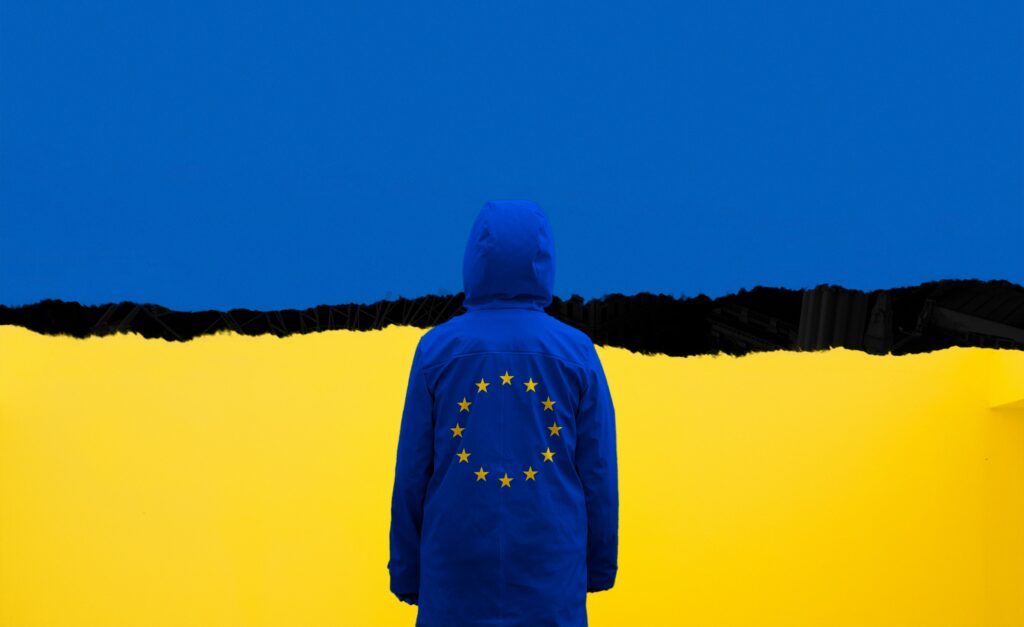
President Donald Trump and Russian President Vladimir Putin’s much-heralded August meeting in Alaska ended without a peace agreement on Ukraine. Days later, on Aug. 18, Ukrainian President Volodymyr Zelenskyy arrived in Washington for his own Oval Office summit – joined by a phalanx of European leaders. Zelenskyy and his allies in Europe made it clear that a mere end to hostilities would just give Russia an opportunity to recover and rearm, as it did after the 2014 invasion of Crimea.
For the past ten months, British Prime Minister Keir Starmer and French President Emmanuel Macron have pushed for a European-led peacekeeping operation to enforce any peace agreement. Starmer has dubbed this proposal a “coalition of the willing.” Although the phrase deliberately evokes the U.S.-led coalition that invaded Iraq in 2003, this time the goal is to deter any further Russian aggression, by deploying a multinational peacekeeping force.
But any serious move to take the lead means rethinking what peacekeeping means. That does not mean abandoning military deterrence, but it does mean taking a wider approach: building a force that emphasizes civilian protection, draws credibility from international participation, and is grounded in the lessons of decades of U.N. experience.
What might a European peacekeeping force look like?
Throughout the spring, Western military chiefs and heads of state engaged in intensive discussions about the shape of the peacekeeping mission, most notably in a meeting in Paris. While NATO and several European nations support the operation in principle, most remain reluctant to commit significant troop deployments. Italy, Poland, and Greece, some of the countries spending the most on defense, initially explicitly ruled out sending troops to Ukraine. On Sept. 4, however, Macron declared that 26 countries have pledged and committed to being part of a “reassurance force,” a concrete step toward making the coalition a reality.
The bloc’s solidarity will likely only strengthen following recent Russian escalations. On Sept. 10, Poland invoked Article 4 after NATO fighter jets shot down Russian drones over Polish air space. The Article 4 invocation, the first since Russia’s invasion of Ukraine began in 2022, triggers a formal NATO discussion about its security. The alliance also activated a multinational air defense force to safeguard its eastern flank, including fighter jets from the Netherlands, Germany, and Italy.
The deployment of a large ground troop presence to Ukraine still appears unlikely. But smaller-scale deployments – perhaps 10,000 to 25,000 troops – could provide a practical operational framework, an IISS report suggests, as long as the mission is backed with American support. This arrangement aligns with a mutual desire to prevent full-scale conflict between Russia and NATO, by positioning European troops to deter any Russian violation of a ceasefire agreement.
However, this European peacekeeping concept diverges significantly from U.N. multidimensional peacekeeping operations, which typically require U.N. Security Council authorization under Chapter VII. Russia’s veto power on the Security Council means that it’s not feasible to deploy a peacekeeping operation authorized in this way. Thus, the envisioned European peacekeeping force would adopt a dual approach – combining older, border-monitoring peacekeeping operations with newer, transformative peacekeeping operations – to stabilize post-war Ukraine.
Understanding the shape of the mission
At the core of any ceasefire agreement lies the credible commitment problem: Adversaries struggle to credibly commit to peace when they believe the other side will grow stronger once the fighting stops. In the context of a Russo-Ukrainian truce, this challenge is especially acute. Russia has repeatedly violated international agreements – and its continued aggression in the region is a concern. This transforms the traditional two-sided commitment problem into a call for targeted deterrence to reinforce the stability of any negotiated settlement. A European force would serve as a credible third-party guarantor by raising the costs if Russia breaches a peace deal.
In this form, the coalition’s goal would be similar to a traditional Chapter VI U.N. peacekeeping mission. These missions focus on monitoring ceasefires, facilitating troop withdrawals, and ensuring adherence to negotiated terms. Such operations have the added benefit of typically requiring fewer personnel than large-scale deployments. UNMOGIP in Kashmir, UNFICYP in Cyprus, and UNIFIL in Lebanon, for instance, all operate with far smaller contingents than robust enforcement missions like MONUSCO in the Democratic Republic of Congo, or UNMISS in South Sudan. Given the hesitation among many European governments, the U.K. proposal for a 64,000-strong force appears overly optimistic. At present, even reaching one-third of that number seems ambitious.
If size and mandate are one challenge, the participation of the United States is another. European leaders, academic blueprints for peacekeeping, and pundits have underscored the critical importance of some form of a U.S. commitment to serve as a “backstop” for the European forces. The Trump administration has shifted from a deliberately vague stance offering only generalized rhetoric about “opening the door to possibilities” to a more concrete public commitment offering support to the mission. Many European countries have signaled that their participation is conditional on U.S. participation since they rely on the United States for intelligence, surveillance, and reconnaissance capabilities. The presence of the U.S. backstop would thus also enhance Europe’s ability to deter Russian violations and manage operational logistics.
The actual composition of the force presents an additional hurdle. Diversity in peacekeeping – whether in terms of gender, ethnicity, or nationality – has long been recognized as a means of bolstering the local population’s views of peacekeeping operations. In Ukraine, however, the challenge is less about earning local trust. Most European countries already enjoy a strong reputation and soft power among Ukrainians. Instead, the strategic value of diversification lies in managing perceptions abroad – particularly in Moscow.
Involving non-NATO countries, for example, could help reduce Russia’s perception of the force as a Western instrument. Notably, the inclusion of China – an unexpected but potentially pivotal partner – could act as a buffer against Russian hostility. China is one of Russia’s few close allies and the eighth-largest contributor to U.N. peacekeeping globally, and China’s participation could lend both credibility and deterrent weight to the mission. In the absence of the physical presence of U.S. troops, such a move could serve as a symbolic and strategic substitute “backstop.” It might also draw the U.S. back into the fold through competitive influence.
Tripwire forces: an outdated concept
The absence of a true U.S. “force” on the ground significantly weakens the credibility of the proposed European peacekeeping force as a “tripwire.” This concept, rooted in Cold War-era NATO doctrine, relies not on overwhelming military presence but on the strategic placement of small contingents of troops whose harm or targeting would trigger a broader military response. The idea is that even a limited force, if attacked, would obligate allied nations – particularly the United States – to escalate militarily in defense.
In a best-case scenario, Trump’s support extends to full logistical capabilities. But without American personnel embedded in the coalition, the political cost of inaction following a provocation is substantially lower, reducing the deterrent effect. Studies have shown that tripwire deployments, on their own, do little to bolster the credibility of deterrent threats when there is no strong public or institutional expectation of retaliation. NATO’s own response to the Russian invasion of Ukraine in 2022 reflected this logic, prioritizing substantial troop and weapons commitments rather than symbolic and menial “tripwire” forces. Still, the presence of European troops – even without U.S. backing – creates a potential tripwire dynamic that may complicate escalation calculations for both Russia and the coalition.
Moving beyond war
Diplomacy alone will not be sufficient to forge sustainable peace in Ukraine. A ceasefire, while a critical first step, is only as strong as the international mechanisms designed to uphold it. Centuries of historical experience and decades of political science research make this clear.
The European-led peacekeeping initiative represents a bold and necessary experiment in a world of uncertain U.S. security cooperation – but it is also one fraught with limitations. Without greater troop commitments, broader international buy-in, and some form of strategic support from the United States, the force risks being under-resourced, politically fragile, and strategically ambiguous.
Ultimately, peace in Ukraine cannot rely on symbolism or half-measures. The research suggests a truly credible, coherent force can deter renewed aggression, protect civilians, and help Ukraine rebuild its own capacity to defend and govern. If Europe can lead – and if the United States can support without dominating – this could mark not only the beginning of peace in Ukraine, but a new model for international crisis response in an increasingly multipolar world.
William G. Nomikos is assistant professor of political science at the University of California, Santa Barbara, and a 2025-2026 Good Authority fellow. He is the author of Local Peace, International Builders: How UN Peacekeeping Builds Peace from the Bottom Up (Cambridge University Press, 2025).
Joshua Zhang is a third year political science student at the University of Chicago. His research focuses include international security, peacekeeping, and foreign policy decision-making, with a broader interest in the intersections of politics and legal systems.