






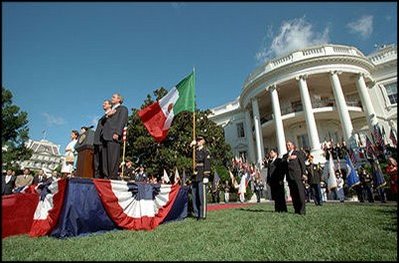
During his first term in office, President George W. Bush invited Mexican President Vicente Fox for a formal state visit, including an address to a joint session of Congress and a trip to Toledo, Ohio. Coming just months after Bush’s formal visit to Mexico in February 2001, the trip sent a clear message that the Bush White House was prioritizing economic and border relationships with Mexico. This included a sustained push for comprehensive immigration legislation – continuing the work of Republican presidents Ronald Reagan and George H.W. Bush.
The trip was successful and positive. It ended on Sept. 7, 2001, and included a state dinner and celebrations of Mexican and American cultures on the White House lawn. Bush’s rhetoric during this trip reflected the overall positive tone towards immigrants that Republican and Democratic politicians had used for the last 40 years. In a speech at the University of Toledo on Sept. 6, Bush remarked:
Oh, I know there’s a lot of talk about Mexican laborers coming to the United States. But I want to remind my fellow citizens of this fact: Family values do not stop at the Rio Bravo. There are mothers and dads in Mexico who love their children just as much as mothers and dads in America do. And if there are a mother or dad who can’t find work, worried about food on the table, they’re going to come and find work in America.
Four days after this visit, the events of September 11, 2001, fundamentally shifted the direction of U.S. foreign policy and undercut Bush’s plans on immigration. It is unclear if the president realized it at the time, but the era of bipartisan support for a comprehensive immigration package was over.
The 1990s backlash
A decade earlier, the end of the Cold War opened space for anti-immigrant interests. Many Americans had grown increasingly pessimistic about the direction of U.S. immigration policy. Party leaders had been generally positive in their immigration rhetoric during the Cold War. But a split within the GOP soon emerged between pro-business and social conservative elected officials. The immigration issue also intensified cracks in the Democratic coalition, where white ethnocentric voters continued to react to the changing demographics of the country and the party since the 1960s.
The end of Reagan’s Cold Warrior leadership on refugee policy unleashed GOP social conservatives in the 1990s. The pro-immigration policy successes of 1965 and 1986 had created a thermostatic backlash among Americans that exploded. By the mid-1990s, far more Americans believed immigration levels should decrease, according to Gallup polling.
Immigration restrictionists gained control of the national conversation after the Republican takeover of Congress in the 1994 midterm elections. California’s successful anti-immigrant Proposition 187 also passed easily in 1994. These shifts in leadership and public opinion led directly to the restrictive 1996 Illegal Immigration Reform and Immigrant Responsibility Act (IIRAIRA), which focused on preventing immigrant access to government resources. This legislation reflected the GOP’s new negative tone on immigration and put the Democratic Party on defense throughout the 1990s. Nonetheless, the courts and pro-immigration members of Congress successfully stopped or diluted these initial anti-immigration efforts. Throughout the decade, pro-immigration interests still found congressional support in both parties, even if the issue was beginning to show promise as a powerful partisan cleavage.
Immigration after 9/11
The 9/11 attacks on the United States accelerated and transformed the underlying immigration dynamics that had begun in the 1990s. Political scientist Anna Sampaio documents the changes in the federal bureaucracy, both large and small, that merged immigration enforcement and the growth in anti-terrorism government activities. The Homeland Security Act of 2002, for example, restructured the federal bureaucracy around fighting the “War on Terror.” These moves included the creation of Immigration and Customs Enforcement (ICE), along with folding other agencies from Justice, Treasury, and Agriculture into the new Department of Homeland Security. Immigrants in America became a target of general anti-terrorism attitudes and policy. And policy elites and the news media began to frame all immigration broadly as a national security threat, increasing both public and policymaker support for stronger immigration laws centered around border threat and security.
After 9/11, Democrats transformed into the party that would protect immigrants’ interests. Democratic leaders continued to be consistently more positive in their immigration rhetoric, while many within the GOP became increasingly negative. Some voters responded to the increased public narrative on the threats immigrants posed – and the growing polarization on the issue of immigration – by rethinking their partisanship. Americans who wanted tougher restrictions on immigrants and the border in the 2000s saw the Republican party as a home for generalized ethnocentric preferences. Voters who wanted a more comprehensive approach to immigration, including pathways to citizenship for undocumented immigrants, responded instead to the pro-immigration rhetoric of the Democrats. At the same time, many voters adapted their immigration views to match the new normal in their party.
Comprehensive policy failures
Within the post-9/11 national security threat context, Bush worked with other pro-immigration Republicans like Senator John McCain (R-Ariz.) and Senator Marco Rubio (R-Fla.) for bipartisan comprehensive immigration reform, including a path to citizenship for undocumented immigrants. But the window had closed. The GOP no longer belonged to pro-immigration reformers.
The end of the Cold War had opened the door to an anti-immigrant wing of the GOP, and 9/11 solidified that group’s control of the party. After a decade of failed comprehensive bipartisan work, Congress made a final attempt in 2013 with the “Gang of Eight” Bill. This legislation included a path to citizenship for undocumented immigrants along with tightened border security, and it passed easily in the Senate with bipartisan support. It had President Barack Obama’s approval. But the bill died after House Republicans declined to bring it up for a vote.
The person behind the demise of that bill in the House, an aide to Senator Jeff Sessions (R-Ala.) named Stephen Miller, features heavily in the next and final installment of this series. By dashing any hopes of an immigration compromise in 2014, Sessions and Miller paved the way for the ultimate ascendency of the anti-immigrant wing of the GOP when Donald Trump announced his candidacy for president in 2015. As he launched his campaign, Trump attacked immigrants from Mexico, in particular. We will explore the effect of this upheaval, more than two decades in the making, in the next article.
Eric Gonzalez Juenke is a 2025-2026 Good Authority fellow.