






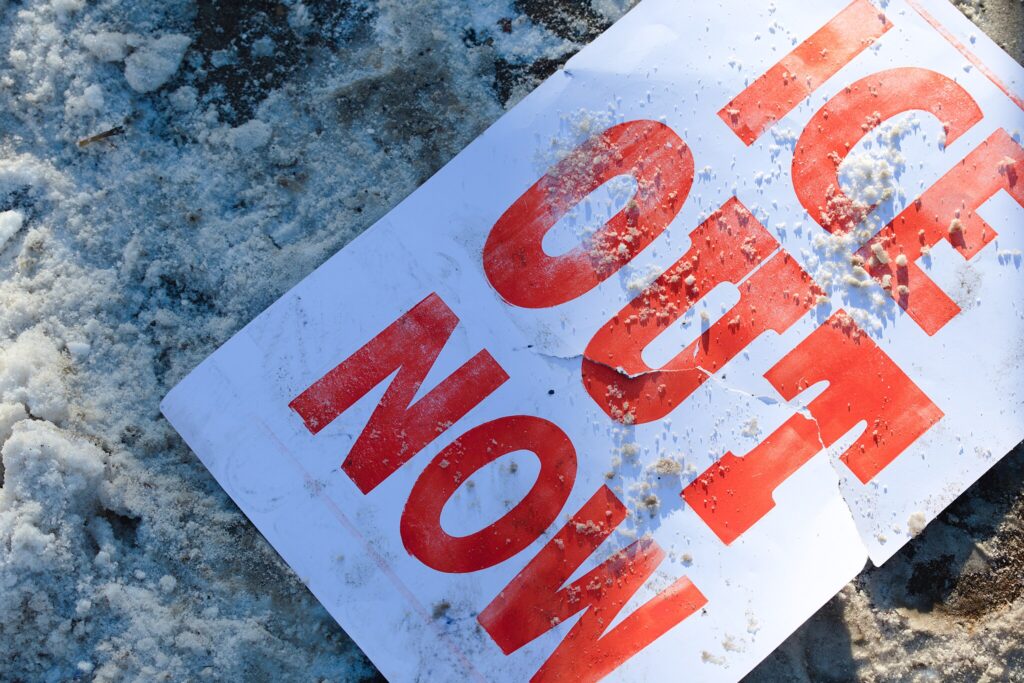
The Trump administration, in keeping with the campaign promise of mass deportation, has dramatically increased the budget and scope of the Immigration and Customs Enforcement agency (ICE), making it the largest domestic law enforcement agency in the country. As part of the new deportation agenda, ICE operations have been carried out in various cities, including the ongoing operation in Minneapolis and St. Paul. Residents in targeted cities like Minneapolis have protested and attempted to disrupt and document ICE activities. In response, the immigration enforcement agents faced with protest are often reacting with repressive tactics, including lethal ones.
Given that ICE agents now routinely face citizens protesting their operations, the scholarship on protest and repression can help us understand why ICE is responding to protest with repression. Repression involves the use or threat of physical sanctions to deter people from engaging in activities or espousing beliefs that the government sees as a challenge to its authority. Yet repression does not consistently deter protesters. As we’ve seen recently in Minneapolis, repression can spark renewed protests and draw new participants. And repression can be unpopular and electorally costly. In fact, in a recent U.S. poll a majority of respondents indicated that they believed the ICE agent’s killing of Renee Good was an inappropriate use of force. A growing number of polls suggest that general support for ICE and Trump’s immigration agenda has decreased.
So why use repression if the benefits don’t clearly outweigh the costs? Political science research suggests that the institutional context – including factors like the presence of skilled and trusted personnel, and whether law enforcement agencies use repressive hardware and adopt an adversarial policing culture – may increase the likelihood of repression.
Is repression driven by protester violence?
In the United States, nonviolent protest activity is broadly protected under the rights of speech and assembly. And many protests take place without a repressive response. For example, more than 100,000 people protested across New York City at the No Kings protest in October 2025. Police refrained from using violence and did not make any arrests. The wave of anti-ICE protests has generated a very different response from authorities, including the extensive use of tear gas, pepper balls, pepper spray, flashbangs, and kinetic impact projectiles.
People may assume that repression is driven by protesters’ use of violent tactics, especially since media coverage of protests tends to amplify protesters’ use of or potential for violence. Indeed, research shows that when protesters employ violent tactics, repression is more likely.
However, this relationship does not always hold. In an analysis of German protests, sociologist Ruud Koopmans noted that 25% of violent protests were not met with repression, while 20% of nonviolent events were. In addition, protest violence is interactive and it often erupts after police respond to nonviolent protest with violence. In other words, when we are looking at scenes of protest violence, it often follows police repression rather than providing the initial spark for it.
Government capacity, trust, and negotiated protest management
My own research shows that repression is more likely when conditions for the negotiated management of protests are absent. Protest management is a complex task. Protests involve crowds in the streets. Protests rarely have clear leaders and, at a given event, protesters often express a multitude of demands and grievances. Government officials tasked with managing protests have to monitor these complex events and make decisions about when and how to intervene. In contexts in which local officials specialize not just in protest management, but also in working with the public in the substantive areas targeted by protesters, repression is less likely. In other words, where government capacity is high, officials are more likely to have the skills to understand the protest and the discipline to avoid rash responses.
In addition to broad administrative capabilities, linkages between government officials and protesters also make repression less likely. For negotiated management to peacefully end a protest, protesters must have channels of communication with government officials and trust that government officials are operating in good faith. Under these conditions, protesters and officials are more likely to engage in dialogue even over contentious issues.
In Minneapolis, ICE agents have been directly responding to the protests against their immigration enforcement actions. Their responses include aggressive repressive tactics, including lethal force. Protest management is not part of the normal purview of immigration enforcement officials – and their training does not appear to cover managing crowds of protesters. In addition, immigration enforcement officials have been carrying out operations masked and without visible identification, which does not create conditions for trust.
Unlike most other law enforcement agencies, which ultimately answer to mayors or governors, ICE is housed in the Department of Homeland Security. As a federal force, ICE officers are not embedded in – and may be in open conflict with – the local government institutions whose officials are connected to the community and have experience managing local issues. These conditions contribute to the use of repression as a central ICE strategy for protest management.
Militarization and the willingness to repress
Political scientist Ryan Welch and his student Martin Stavro found that police militarization increases the likelihood of repression. Militarization, as Stavro and Welch explain, describes the process of domestic policing agencies adopting “military hardware, culture, organization, and operations.” They argue that militarization generates an increased willingness to repress for two primary reasons.
First, when police are trained to conduct military-style operations with military equipment, police culture also shifts into a military framework. Rather than viewing the population as a constituency to serve, police officers view people on the street as potential enemies to be neutralized. Staying on high alert generates an inflated perception of threat, which prompts militarized police to more quickly turn to repression even in response to peaceful protest.
Second, militarized police have the tools to carry out repression – armored cars, flashbangs, grenade launchers. This military-style hardware also signals to officers that their bosses intend for those tools to be used to solve problems. In other words, as Stavro and Welch note, agents on the street view the provision of these tools as greenlighting repression.
ICE officers have military equipment and receive training in military tactics. ICE is reportedly building a new training facility in Fort Benning, Georgia, that will create hyper-realistic buildings for training that one ICE official described as replicating “battlefield conditions.” And messaging from the Trump administration has reinforced the adversarial culture – and the use of violence to respond to dissent. For example, during anti-immigrant operations in Chicago last September, Trump posted a meme comparing the operation in Chicago to the Vietnam War. More recently, Gregory Bovino, commander-at-large of Border Patrol, signaled that the ICE agents involved in the shooting of Alex Pretti would face limited consequences.
Is training the answer?
In response to the fatal shootings by ICE agents, congressional Democrats are demanding that immigration officers receive more training – and some Republicans agree. In the past, ICE has resisted disclosing their training policies, blacking out almost the entire document that was made available through a Freedom of Information Act request. But we know that in the effort to rapidly scale up the agency’s force, the Trump administration has reduced the length of the required training.
To be sure, better training might help deescalate some protest conflicts. But training alone will not change the larger institutional landscape within which ICE operates – or forge meaningful connections to local communities or officials. Nor will it change the culture of militarization within ICE. A unit on deescalation would not shift the broader adversarial culture, especially if it simply sits atop a training program that treats communities like war zones and residents like enemy combatants.
One year into the second Trump administration, ICE agents have become de facto protest managers. But as Americans in Minnesota and elsewhere voice their disapproval of ICE operations, protesters that directly confront these agents should expect to be met with repression.
Stay up to date on all things politics and political science. Bookmark our landing page and sign up for Good Authority’s weekly newsletter by entering your email address in the box below.