






Recent reports from the White House suggest that the Trump administration is planning dramatic cuts to the number of refugees admitted to the United States. The New York Times reported last week that the United States would accept just 7,500 refugees in 2025 – not the full 125,000 refugees slated for resettlement through the U.S. Refugee Admissions Program. This number is down significantly from a September report by Reuters, which suggested the U.S. would cut refugee admissions to around 30,000.
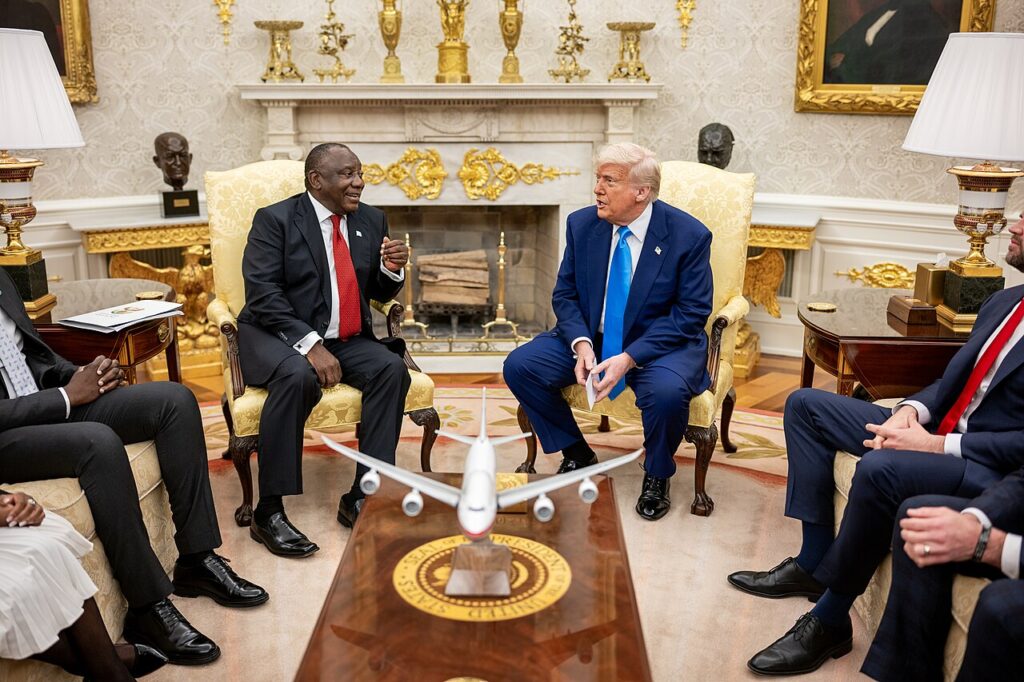
Both reports agree on one point, however: Most of these spots will likely go to white South Africans. President Trump initiated the classification of white South Africans as refugees in a February 2025 executive order. The order alleged an ongoing campaign of discrimination and violence against South Africa’s white minority – based largely on disinformation about the country’s new land act. In May, during a contentious Oval Office meeting between the two heads of state, Trump claimed to South African President Cyril Ramaphosa that there was a campaign of ”white genocide” in South Africa, although there is no evidence to support such claims, and experts have roundly debunked the allegations. The South African government has called both of these allegations “completely false.”
Nonetheless, the first group of Afrikaner refugees arrived in the United States in mid-May 2025. Officials from the Department of Homeland Security and the Department were at Washington Dulles International Airport, in Virginia, to welcome the group. Deputy Secretary of State Christopher Landau, in livestreamed and televised remarks, told the group of 59 refugees, “I want you to know that you are really welcome here.” Since then, at least one other group has arrived, but without the same levels of publicity.
White South Africans are a U.S. refugee priority
The U.S. refugee admission program targets white South Africans, and particularly those descendants of Dutch and French colonists called Afrikaners who make up about 4% of the South African population. To many observers, this initiative is serving an unusual population for a refugee program. White South Africans are, on average, significantly wealthier and safer than their fellow citizens, come from a country without ongoing war or conflict, and have representation through strong democratic institutions.
The new U.S. initiative has also been administered differently than almost any in U.S. history. More than 100,000 refugees fleeing conflict and humanitarian crises in countries like Afghanistan, Chad, Haiti, Myanmar, Somalia, Sudan, and Yemen had received provisional U.S. approval to emigrate, but now remained blocked from entering the United States. The speed with which these latest applicants from South Africa are being processed and resettled is much faster – other applicants have waited years. Established refugee resettlement partner organizations, like the Episcopal Church, have refused to participate in the program, and the U.S. government has turned to a new startup in South Africa as its official partner in the refugee screening and resettlement process. The group called The Amerikaners was founded in 2025 by Sam Busa, a South African of British descent and proponent of the debunked “white genocide” narrative, who had herself applied for refugee status.
This new refugee program has generated a significant amount of controversy in both the U.S. and South Africa. Critics and commentators in both countries have called those participating in the program “opportunists,” “fakes,” “cowards,” “traitors,” and “cogs in the distraction machine.” Conservative white groups in South Africa have been at pains to distance themselves from the program, and many white South Africans have been critical of those who have left. And some of the refugees themselves have generated controversy, with histories of racist social media posts and questionable motives for leaving.
How is the resettlement going?
Some reporting has also suggested that the resettlement process has been difficult for some of the South Africans. When interviewed by a South African news outlet on the differences between life in the two countries, one of the refugees noted, “The biggest challenge is here you work, hey. There’s no kitchen lady you call to sweep the house, or clean the house, or stuff like that. You do the work yourself.” Other refugees have complained on social media about the location or quality of accommodations supplied to them, the difficulties in finding work, the limited possibilities to return to South Africa for holidays or family visits, or the challenges in finding ways to evacuate pets as part of their resettlement process. Some refugees that had been part of the program in summer 2025 have also dropped out, citing the constraints the program introduced in their new life in the U.S.
Alongside these developments, a concerted online campaign by supporters of the program has sought to demonstrate how effectively the program is working, and advocate for its expansion. Reports from South Africa about the number of applicants have been limited, but initial estimates put the totals around 8,000 people. The U.S. Embassy in South Africa said in August that there was a “sizable volume of submissions.” Reporting by Reuters suggests that as of August, less than 100 white South Africans have been resettled under the program thus far, despite Trump administration plans to resettle as many as 30,000 people.
What happens now?
Advocates for the program have called it a “pilot,” acknowledging the difficulties but remaining optimistic. But eight months into the program, one big question is whether there are enough Afrikaners that want to sign up to be refugees, and resettle in the United States. This controversial program is scaling up at the same time that refugee admissions are all but grinding to a halt for groups from other countries. Yet it may prove less impactful than its architects had hoped if those victims of alleged atrocities would prefer to stay home.
What does seem certain is that the ongoing diplomatic tensions between the United States and South Africa, as well as the rest of the continent, over racial issues, trade, minerals, and Israel’s actions in Gaza, are unlikely to ease with the scaling up of the U.S. refugee admissions program for South Africa.

.jpg)