





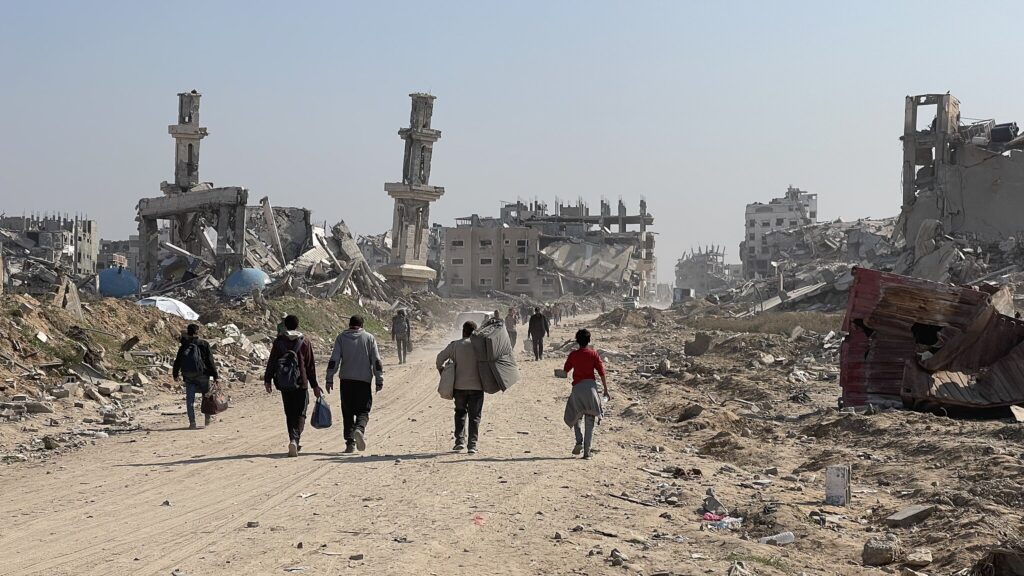
Initial hopes ran high that the ceasefire deal that went into effect last weekend in Gaza may finally end this horrific war. In Donald Trump’s words, it will bring “a Strong, Durable, and Everlasting Peace.” But previous ceasefires, including those brokered by Trump, fell apart. Will this one hold?
Earlier this year, I wrote a Good to Know explainer on ceasefires, detailing the prospects and the pitfalls in the January 2025 ceasefire announcement between Israel and Hamas. Like that earlier ceasefire effort, this one is meant to proceed in phases: first the cessation of hostilities and initial withdrawal of Israel Defense Forces (IDF) soldiers; then resumption of humanitarian aid deliveries; then the release of Israeli hostages; then release of many Palestinian detainees; then further staged withdrawals of the IDF, and the creation of an International Stabilization Force (ISF). Trump’s 20-point plan forms the basis of the deal, calling for the eventual demilitarization and redevelopment of Gaza, governed by a “reformed” Palestinian Authority (PA).
This deal, unlike the previous one, has at least some semblance of a “concept of a plan” for long-term peace and reconstruction in Gaza. The prospects that this deal will last are also improved by the notion of the ISF. Peacekeeping forces are not a silver bullet, by any means, but they significantly increase the chances that a ceasefire will last.
Many details remain unclear
But it is an understatement to say that key details have yet to be worked out. The timing and extent of the Israeli withdrawal remains murky, the extent and form of demilitarization, the formation of transitional technocratic government, under an international transitional body, what PA “reform” means – all of this remains very vague at best. Ambiguities are often necessary to reach a deal. But different views on these details, and what it all means for the prospect of an eventual Palestinian state, may prove irreconcilable. These differences could easily derail peace.
And many of the threats to lasting peace that upended previous attempts remain.
Can each side make a credible commitment to peace?
The biggest of these is the credible commitment problem – what prevents either side from reneging on the deal and restarting the war? Hamas, the militant Palestinian group that has been in control of Gaza since 2006, is much weaker militarily and politically than it was in January. In fact, Hamas appears to have agreed to commit political suicide by disarming and eschewing a role in the future governance of Gaza. Trump has signaled quite clearly that if Hamas does not comply with the deal, Israel would have his “full backing to finish the job.” Given the strong alliance between the United States and Israel, the deployment of U.S. troops to “support and monitor” the ceasefire deal signals a U.S. commitment that provides additional assurance to Israel.
But these U.S. forces will apparently not be inside the Gaza Strip. This means they will not be positioned between Hamas or other Palestinian militant groups and the IDF, as would be needed to provide a credible buffer between the two sides.
The agreement arguably makes the credible commitment problem for Israel worse than in previous ceasefires. Once it has secured the remaining hostages, Benjamin Netanyahu’s government will no longer face domestic protests to end the war. Yet the domestic pressure from the right to annex Gaza (and the West Bank) will remain. The incentives for Netanyahu to restart a war that has helped him remain in power will be strong.
The hard work lies ahead
Can Trump credibly hold Israel to its side of the bargain and prevent it from restarting the war, as it did in March? Perhaps Trump’s transactional approach to alliances means he would sever the relationship and end U.S. support to Israel if he felt Israel’s reneging on the deal was a personal slight to him and his desire to bring peace to the Middle East. But personalist foreign policy is notoriously unpredictable, so that might be a gamble Netanyahu would be willing to take.
The various ambiguities and uncertainties that remain include the immediate challenge of finding the bodies of hostages under the rubble, which will make it very hard to tell if Hamas is acting in good faith, or stalling. This type of uncertainty would give ample cover should Netanyahu decide to restart the war.
The spoiler problem also remains, on both sides. Hardline factions on both sides are not in favor of this deal. It is not hard to imagine a faction within Hamas that disagrees with the need to commit political suicide. Nor is it hard to imagine far-right parties in Israel attempting to scuttle the deal even if Netanyahu himself wants to uphold it. In the extremely precarious first days and weeks of any ceasefire, it is very easy for spoilers to provoke an incident that quickly spirals back to war.
The October 2025 ceasefire is the best chance yet for peace, and it provides a much-needed respite to the people of Gaza. It has brought the remaining living Israeli hostages home, so this is a positive development, even if it is short-lived. But a lot of hard work remains before this ceasefire is strong and durable, let alone everlasting.
It may – unfortunately, but not surprisingly – already be crumbling.
Page Fortna is the Harold Brown Professor of U.S. National and Security Policy and chair of the Political Science Department at Columbia University.