





The headline of this post is taken from the title of a new piece of research by Elizabeth Elder and Neil O’Brian. Their finding is striking: Political conservatives didn’t used to have worse health than political liberals. But now they do. Here’s why.
Elder and O’Brian use a dataset called the National Longitudinal Study of Adolescent to Adult Health. This study has been tracking a large group of people who were adolescents in the 1990s. These people were born between 1976 and 1982. By now, they are middle aged.
The survey has only one political question: where people place themselves on a left-right ideological scale. But the survey has many measures of health outcomes. Elder and O’Brian construct an index based on five health markers, including body mass, blood pressure, cholesterol, blood glucose, and a measure of inflammation, C-reactive protein. A person in good health on all markers would score 0 on the index. A person with a concerning reading on every marker would score 1.
In the 2008-2009 wave of the survey, there was little correlation between ideology and health. The average score on the index was 0.218 for people who said they were “very liberal” and 0.222 for people who said they were “very conservative.” But in the 2016-2018 wave, strong liberals scored about the same (0.225) while strong conservatives scored 0.305 – a statistically significant difference.
This pattern of change is due to two patterns: People who were consistently conservative in both waves became less healthy, and people who “switched” from liberal to conservative between the waves also became less healthy. In other words, the authors write, “less healthy people become more conservative in this era – and already conservative people become less healthy.”
The same pattern shows up in mortality. The vital status of each survey participant is checked against national records on a regular basis. By 2020-2022, people who identified as conservative in any of the earlier waves were more likely to have died than liberals were. The probability of dying was about 1.4 points higher among conservatives than liberals. This was mostly due to deaths from “internal” causes, like cancer and heart disease.
So, why are ideology and health now more strongly related? One explanation is demographic changes among liberals and conservatives. Markers of socioeconomic status, and education in particular, have become more predictive of political attitudes in the United States. And education is also correlated with having health insurance and being healthier in general. But Elder and O’Brian find that demographic differences cannot account for ideological differences. Neither can attributes of the places where conservatives and liberals tend to live.
Another explanation, particularly for mortality in the 2020-2022 period, is COVID-19. Some research has already shown that there were mortality gaps between Republicans and Democrats after the COVID-19 vaccine became available, presumably because Republicans were less likely to be vaccinated. But Elder and O’Brian find that there were ideological gaps in mortality even after deaths attributed to COVID-19 were excluded.This brings us to a third, and more political, explanation: declining trust in medicine. Between 2010 and 2021, Gallup polls show that Republicans became less confident in their doctor’s medical advice, while Democrats’ confidence increased.
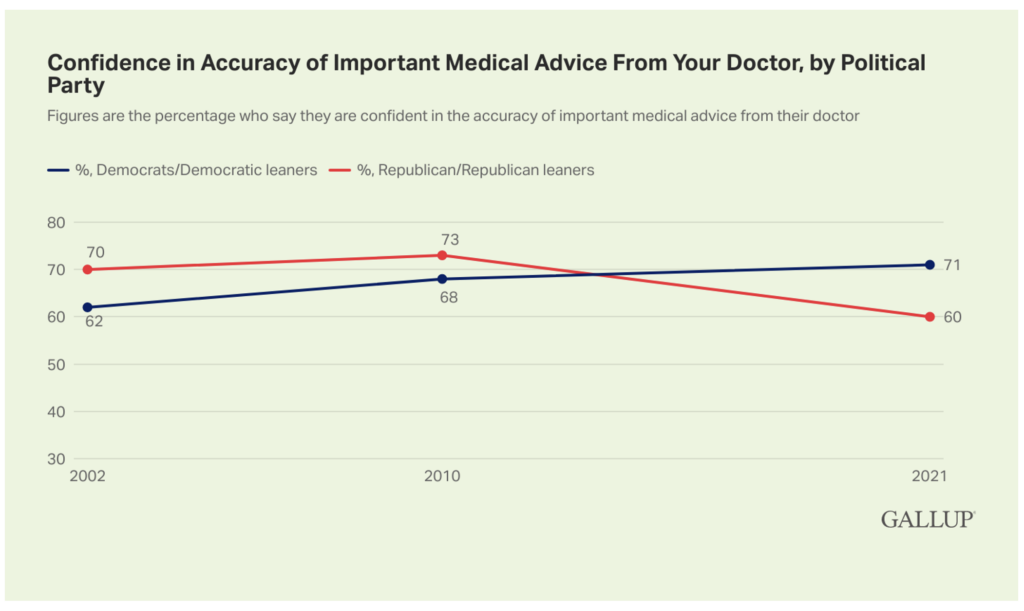
Elder and O’Brian did their own poll in 2024 and found that political ideology or partisanship was correlated with many health attitudes and behaviors. Compared to Democrats and liberals, Republicans and conservatives were less likely to trust their primary care physician and adhere to their advice. Republicans and conservatives also reported less trust in emergency room doctors and were less likely to say that they would go to a doctor if they were experiencing chest pain.
And among respondents who had a chronic health condition – like high blood pressure or type 2 diabetes – Republicans and conservatives expressed less confidence in the medication they take for that condition.
These results show that partisan and ideological differences in health and health attitudes go beyond vaccination. There is a growing skepticism among conservatives and Republicans about other kinds of health professionals, medications, and advice. And this skepticism may be making them sicker and more likely to die.
Stay up to date on all things politics and political science. Bookmark our landing page and sign up for Good Authority’s weekly newsletter by entering your email address in the box below.