





The Supreme Court this week overturned a nearly century-old legal precedent, ruling in Trump v. Slaughter that presidents have a constitutional right to fire government regulators at will. Bundled with the Slaughter decision, however, the Court in Trump v. Cook carved an exception for the nation’s central bankers: Presidents must treat members of the Federal Reserve’s Board of Governors as protected, rather than at-will, employees and clear a substantial bar to demonstrate “cause” if they seek to remove a Fed governor.
The majority opinion only partially insulates America’s central bank from White House interference. The institution remains exposed to ongoing and future presidential threats and demands, complicating the Fed’s ability to meet its congressional mandates of stable prices and maximum employment.
A safe but temporary harbor for the Fed
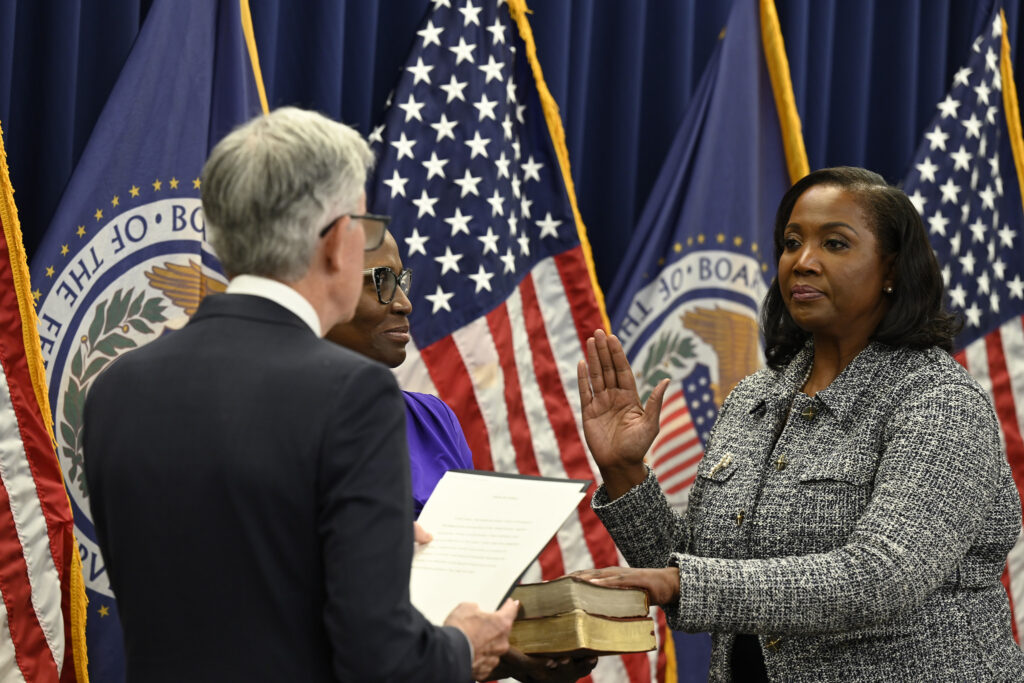
The narrowest Court majority upheld lower federal court decisions that blocked President Trump from cashiering Governor Lisa Cook. The Court opined that firing a governor with no more than a social media post, with neither evidence nor chance for rebuttal, failed to afford Cook the due process she deserves. This week’s decision allows Cook to stay at the Fed. But the opinion doesn’t preclude the president from trying again to remove her, which Donald Trump immediately vowed to do.
The justices, however, offered no guidance about the legal standard to remove a Fed governor. The majority said only that the president’s social media post was too low and flimsy, and the threshold set by Cook’s legal defense was too high and rigid (not least because it excluded “private, pre-office conduct”). Rejecting both sides’ positions, the Court concluded that “we need not fully demarcate the contours of ‘cause’ today.”
That means this question could come back to the Court, likely requiring the justices to grapple with past judicial decisions on the nature of “cause” and the role of U.S. federal courts in adjudicating such questions. The Federal Reserve’s judicial protection now hangs by that tenuous thread.
Why exempt the Fed?
It’s hard to find a constitutional rationale for carving out an exception to protect Fed governors, given the Court’s simultaneous decision in Trump v. Slaughter that grants presidents free rein to fire agency leaders. Dissenting in Slaughter, Justice Sonia Sotomayor called it an “ad hoc historical exemption.” Dissenting in Cook, Justice Thomas asked if it’s unconstitutional to limit the president’s removal power, what’s the legal basis for protecting Fed governors?
Blame avoidance weighs heavily in the Court’s decision.
Granted, the three liberal justices’ votes were never in doubt. After all, they simultaneously dissented in Slaughter. To attract Justice Brett Kavanaugh’s critical fifth vote, Chief Justice John Roberts focused on the American history of central banking, alongside potential economic and political fallout should the Court fail to raise the threshold for removing governors.
Roberts argued that limits on presidential removal of Fed governors are constitutional in light of America’s long-standing (even pre-revolutionary) commitment to protecting central banks from political interference.To justify his Fed carveout, Roberts draws a through-line from the design and organization of the First and Second Banks of the United States to that of the modern Fed. That’s a convenient, but questionable, reading of history. The First and Second Banks were federal-chartered profit-seeking corporations that lacked monetary policy responsibilities. Today’s Federal Reserve is an evolved hybrid system empowered to set interest rates and oversee the banking system.
What’s more, our own research and others’ analysis analyses throws cold water on the claim that lawmakers in 1913 expressly sought to create an “independent” central bank. Instead, legislators chose core organizational features to meet political demands of competing factions. For example, lawmakers combined a dozen quasi-public reserve banks mostly far from Wall Street and Washington with a president-appointed, Senate-confirmed governing board in Washington. Those sorts of compromises were the price of enactment more so than deliberate choices to follow in the tradition of the early (failed) attempts at central banking. An homage to Alexander Hamilton it was not!
Justice Kavanaugh went even farther in his concurrence: Political influence could undermine the efficacy of monetary policy, ignite a political crisis, and spark tumult in economies here and abroad. Even jurists-for-life don’t want their legacy linked to a market meltdown.
Court forensics reinforce this view. Veteran SCOTUS watchers noted an unusual sequence at the courthouse that day. The Court released bundled copies of the Slaughter and Cook rulings to the public about 30 minutes before the chief justice announced the Cook opinion from the bench. In other words, early release of Cook curbed any market speculation that the justices would fail to protect Fed independence from the Slaughter opinion.
The new Fed chair gains some breathing room
The Court ruling is a boon for the Fed’s new chairman, Kevin Warsh. Making it harder for presidents to remove Fed governors dampens one obvious threat to Warsh’s leadership. He can better deflect Trump’s frequent demands for lower interest rates, focusing instead on his own key objectives for the Fed. As Warsh put it at a gathering of central bankers in Europe this week, “We’ve been an independent central bank for a very long time, we’re going to be an independent central bank at this moment and you’re going to see no changes on that.”
Most importantly, the Cook opinion is a vital reminder that the Fed’s policymaking autonomy depends on securing and maintaining political support from players outside the Fed. That includes members of Congress – e.g., Senator Thom Tillis (R-N.C.) – and market participants, alongside federal judges and justices. Broad political support beyond the Oval Office emboldens the Fed and thus Warsh. To be sure, the Fed builds its own street cred when it meets its dual mandate from Congress: stable prices and maximum employment. Going forward, it needs to keep that fifth Supreme Court justice on board.
Here’s why the Fed remains vulnerable
The Slaughter carveout protects Cook from removal for the foreseeable future. But like all presidents, Trump has other ways to pressure the Board for more dovish monetary policy. And, as we’ve seen repeatedly in his second term, Trump is willing to pull on every string he can find. What’s more, Cook might not even be the last word on Lisa Cook – or other Fed officials. The opinion raises several questions the justices leave unanswered.
First, can the president fire the leaders of the dozen Federal Reserve district banks who rotate on and off the Fed’s rate-setting committee? A 2019 analysis by Trump’s Office of Legal Counsel argued that reserve bank presidents are “inferior officers,” removable without cause by the Federal Reserve Board that appoints them. Does the Cook carveout for the Fed also protect officers like reserve bank heads from being removed? The justices didn’t say either way.
Second, Justice Clarence Thomas in his Cook dissent underscored the significant executive powers exercised by the Fed as bank supervisor and regulator. So too did Justice Amy Coney Barrett in her dissent: “Do all the Federal Reserve’s existing regulatory powers have the requisite connection to monetary policy? If not, are they grandfathered in?” Chief Justice Roberts footnoted their critiques, suggesting that the Fed’s regulatory powers were a necessary ingredient for the Fed’s monetary policy-making. That’s certainly the view of recent Fed chairs including former Chair Ben Bernanke, who explicitly made the case to Congress that overseeing banks improves the Fed’s ability to make sound monetary policy. But dissenters’ doubts beg the question: Might a future Court decide that the Fed’s regulatory powers undermine its exemption from Slaughter?
Governors of the Federal Reserve Board might be safe from at-will firing for now, but the battle for monetary control is far from over.
Sarah Binder is a Good Authority editor, a professor of political science at George Washington University, and senior fellow at the Brookings Institution. She studies American political institutions, especially Congress.
Mark Spindel is founder and chief investment officer at Potomac River Capital, a Washington-based investment firm.
Sarah Binder and Mark Spindel are co-authors of the award-winning The Myth of Independence: How Congress Governs the Federal Reserve (Princeton University Press, 2017).
Stay up to date on all things politics and political science. Bookmark our landing page and sign up for Good Authority’s weekly newsletter by entering your email address in the box below.