






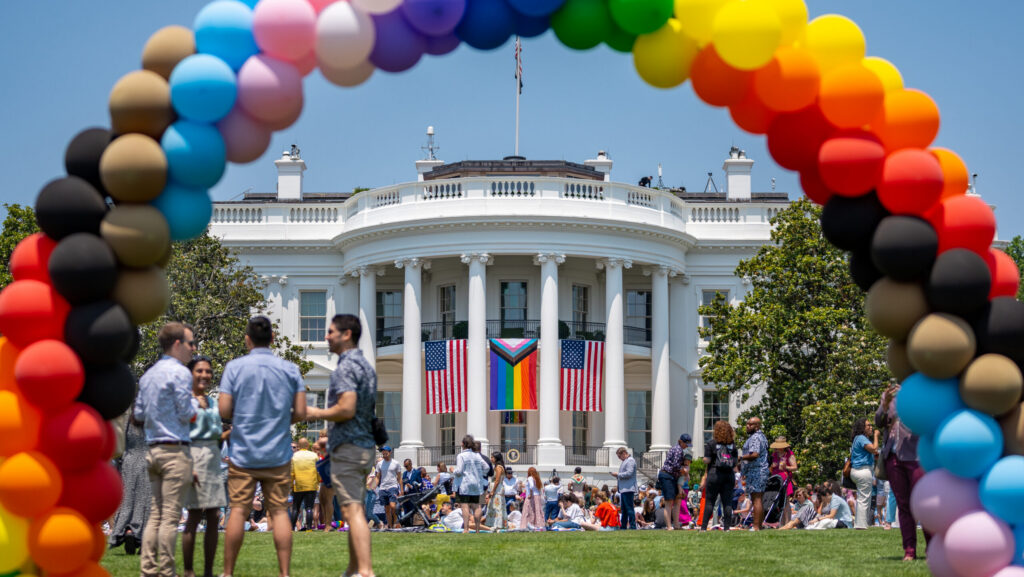
.jpg#/media/File:P20230610CF-0046_(53008576621).jpg)
As the United States gears up to celebrate the 250th anniversary of our founding, debates over Pride Month reveal a larger struggle over national identity. Some Republican governors, for instance, sought to rebrand June as “Nuclear Family Month,” “Strong Families Month,” or “Fidelity Month.” To be sure, this is not simply about GOP disagreements about LGBTQ rights or celebrations for Pride Month, which is celebrated each June in honor of the Stonewall Uprising that took place in 1969. Many now see a broader challenge over who is a legitimate member of the American political community – and whose stories become part of the nation’s historical narrative.
Drawing on Eddie Glaude’s argument in America, U.S.A.: How Race Shadows the Nation’s Anniversaries, I extend his claim that democracy depends on ordinary people – including LGBTQ Americans – claiming ownership of the nation’s future. Connecting Pride and America 250 celebrations offers an opportunity to ask whose contributions, struggles, and visions of freedom are included in the story of American democracy.
Why anniversaries matter
Anniversaries are steeped in the memory-making process. Yet these moments can also become revisionist opportunities for Americans to see the nation that they desire, rather than the one before us, and its true history. Glaude explains that “American anniversaries are often moments to turn a blind eye to the evils of the past and the present.” Thus, the narrative of what and who counts as an American is rebranded at every meaningful anniversary.
Anniversaries become a moment of national storytelling. However, every commemoration requires choices about whose stories are elevated and whose are marginalized. This 250th anniversary follows years of political battles over school curricula, historic monuments, diversity, equity, and inclusion policies, and public memory. Pride Month is also part of this broader struggle over democratic memory.
Pride Month has always been about democratic inclusion
Pride is a claim for visibility, dignity, and full political membership. Its origins are rooted in the 1969 uprising at the Stonewall Inn in New York City. At the time, gathering openly as LGBTQ was often criminalized, many employers refused to hire openly queer people. And bars that served LGBTQ patrons risked losing their liquor licenses. When police raided the Stonewall Inn on June 28, 1969, patrons and community members resisted, sparking six days of protest that helped launch the modern gay rights movement. One year later, thousands marched from the Stonewall Inn to Central Park in the first Pride parade, chanting, “Say it loud, gay is proud.”
Pride Month continues to be a form of political activism. These activities are rooted in the collective struggle of LGBTQ people to secure equal rights, dignity, respect, and acceptance. At its core, Pride affirms the right to exist authentically, free from social, cultural, and legal systems that seek to marginalize or erase queer identities. At the same time, Pride is a celebration, one centered on visibility, equality, community, and human dignity.
The politics of rebranding Pride Month
In 2026, conservative alternatives to Pride are attempting to actively frame cis-hetero patriarchal celebrations as the moral response to queer celebrations. These alternative celebrations seek to center a social order that advantages cisgender, heterosexual men while disadvantaging women, LGBTQ+ people, transgender and nonbinary individuals, and those who do not conform to the dominant gender or sexual norms that some Americans see as “traditional.” The question is not simply whether Pride should be celebrated, but rather, which families, identities, and communities are recognized as authentically American.
Pride is particularly meaningful in today’s political context, where queer rights are under attack. Scholars have shown the impact of movement building for LGBTQ politics in response to Trump policies that sought a retrenchment of queer inclusion and participation in American political life. However, it is important to note the diversity among queer communities necessitates an intersectional analysis: Pride may have different meanings for some LGBTQ people.
For example, discussions about LGBTQ rights are not experienced the same way by everyone. Race, class, and disability shape whose experiences are recognized and whose are overlooked, meaning that some LGBTQ identities have historically received greater acceptance and protection than others. Conversations about LGBTQ equality often assume that all queer people face the same challenges. This approach, however, overlooks the diverse ways queer people experience discrimination and exclusion. Ignoring these differences has also allowed some conservative political groups to appropriate or redirect LGBTQ political agendas toward their own priorities.
What Pride can teach us about America at 250
Democracy is not static. The meaning of “We the People” is constantly changing, contested, and renegotiated. Democratic renewal requires ordinary people to participate in defining the nation’s future. It cannot depend solely on elected officials or elite leaders.
Pride Month reflects ordinary Americans demanding inclusion in the national narrative. The ongoing political friction surrounding Pride Month – an observance born from the grassroots insistence of everyday citizens for visibility – epitomizes the persistent spirit of negotiation defining two-and-a-half centuries of the American democratic experiment.
Stay up to date on all things politics and political science. Bookmark our landing page and sign up for Good Authority’s weekly newsletter by entering your email address in the box below.