






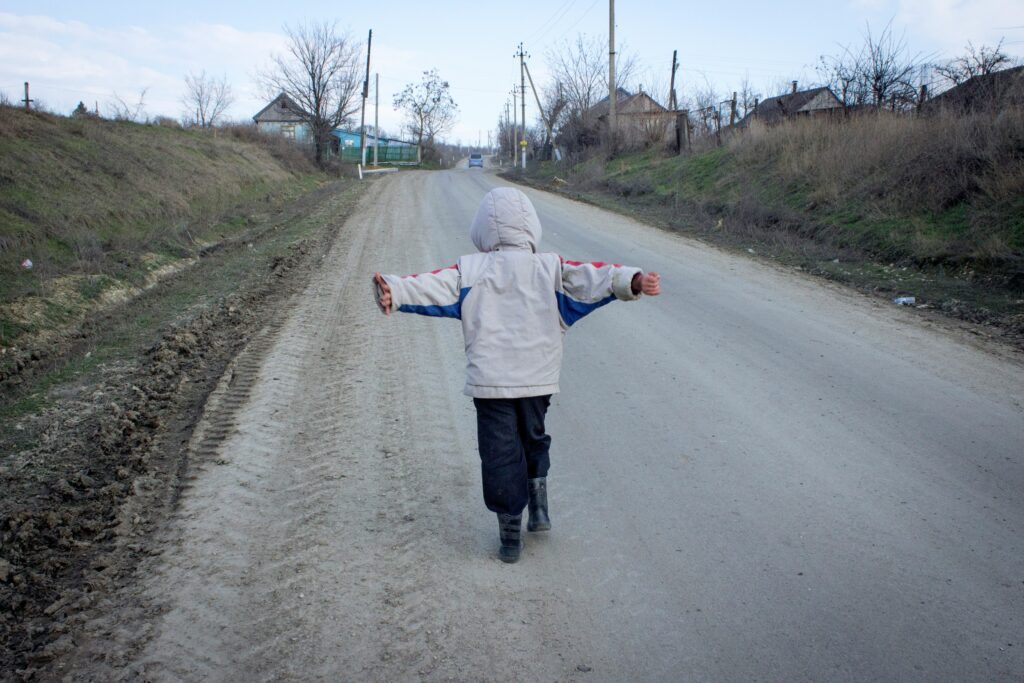
Birth rates in Ukraine have plummeted since Russia’s February 2022 full-scale invasion. But the uncertainties of war are just part of the bigger demographic picture across Eastern Europe. What’s behind these population-related shifts, and what are the political implications? Here’s what you need to know.
Fertility rates have been declining for decades
Demographic challenges aren’t just a concern in Ukraine. Total fertility rates – the average number of children a woman is expected to have over her lifetime – have declined sharply across Europe since the 1960s, reaching about 1.5 by the year 2000. That’s well below the replacement-level of 2.1, a fertility rate that would keep population levels steady.
Falling birth rates create a range of potential economic problems, including labor force shortages and stress on pensions and health care systems. Some analysts also point out that anti-immigration policies are adding to a “population crisis” in Europe. Demographic challenges are especially profound in Eastern Europe, where economic pressures – and now, war – drive people to leave their home countries and seek opportunities elsewhere. Other demographic research explains how fertility rates are often tied to economic, social, and political uncertainty.
The political consequences of these demographic changes are arguably just as important as the economic and social impacts. In fact, governments across Eastern Europe (and elsewhere) have devoted considerable resources to encourage women to have more children. But Russia’s war against Ukraine continues to have a major demographic impact across the region – and not just in the two countries actively at war.
How Eastern European governments respond to declining fertility
Governments in this region have a long history of using coercive pro-natalist policies to increase birth rates. In the 1920s, the Soviet Union promised radical changes that would liberate women from their traditional familial role. But by the 1930s, the Soviet government glorified motherhood and outlawed abortion, effectively abandoning this pro-feminist outlook. At one point during the Soviet era, men and women without children actually paid an additional 6% income tax to the government. To help his country recover from World War II population losses, Soviet leader Joseph Stalin introduced a “Mother Heroine” award for women with 10 children or more – a monetary award that Russian President Vladimir Putin revived in 2022.
Romanian dictator Nicolae Ceaușescu launched the most notorious pro-natalist policy during the Soviet era. He banned abortion and contraception, in an effort to boost the population. But the dire economic situation in the 1980s resulted in overflowing orphanages, where thousands of children received substandard care.
New pro-family policies across the region
In recent years, Eastern European countries began to implement “friendlier policies” to boost birth rates. Hungary’s Prime Minister Viktor Orbán, for example, allocated 5% of GDP on programs like free IVF (for women under 40 who are not in a same-sex relationship), favorable loans, and lifetime income tax exceptions for women who have more than three children. In 2016, Poland’s conservative Law and Justice party introduced a policy that gives mothers a monthly tax-exempt payment of 500 złoty (over $100), for their second and subsequent children. The Baltic states – Estonia, Latvia, and Lithuania – have implemented milder pro-natalist policies, including generous parental leave.
Research suggests that these policies have generally not seen long-term success, as far as increasing birth rates. But there are important social and political implications. For example, after Estonia tripled the length of paternal leave in 2020, both mothers and fathers shifted toward more egalitarian attitudes, endorsing shared domestic roles and women’s participation in political life.
How has the Russia-Ukraine conflict affected fertility rates?
In Eastern Europe, the data suggest that fertility declines during conflict. For example, scholars have found that the uncertainty created by internal displacement and economic hardship in Eastern Ukraine – during the war in Donbas since 2014 but before Russia’s full-scale invasion in 2022 – left many Ukrainian women more hesitant to have children.
After February 2022, when Russian troops invaded Ukraine, the demographic situation became even more serious, as shown in Figure 1. The U.N. Population Division estimated that Ukraine’s total fertility rate fell sharply from 1.148 in 2021 to 0.897 in 2022. Fertility rates in Russia dropped only slightly after the invasion of Ukraine – from 1.47 to 1.416. However, even a small decrease in total fertility can reflect a large drop in births, especially if the population of women who can have children is also shrinking (e.g., due to aging or emigration). In 2024, Russia recorded its lowest annual births since 1999.
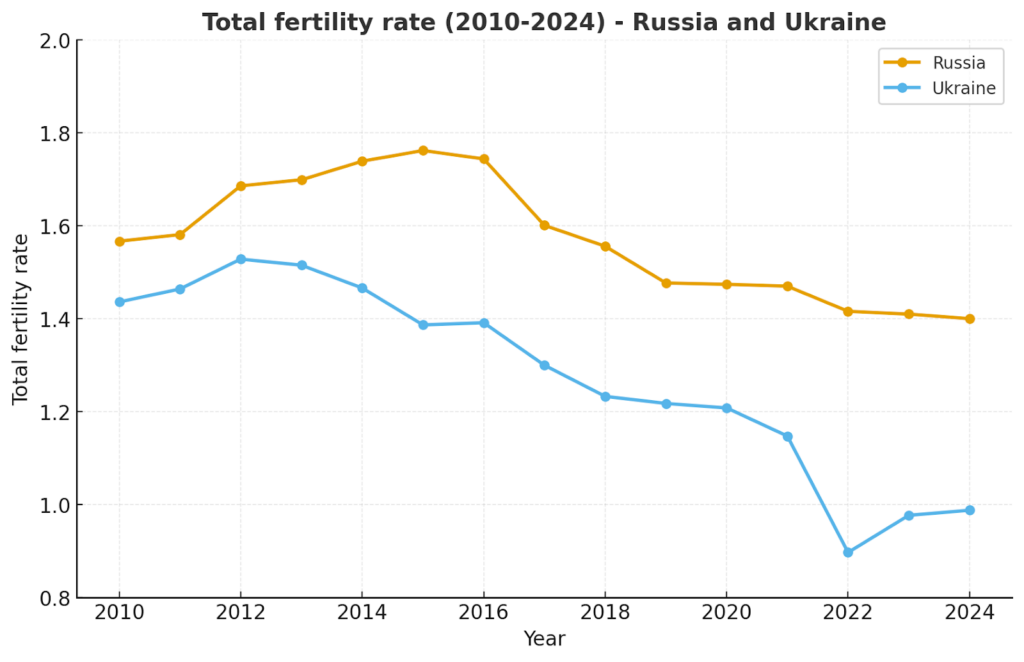
The fertility rate data – along with military casualties on both sides and the civilian toll in Ukraine – point to a troubling demographic outlook for both countries. The situation is arguably even more severe in Ukraine, where civilian losses, large-scale out-migration, and a smaller population base compound the impact of a lower number of births.
The war-related uncertainty affects neighboring countries
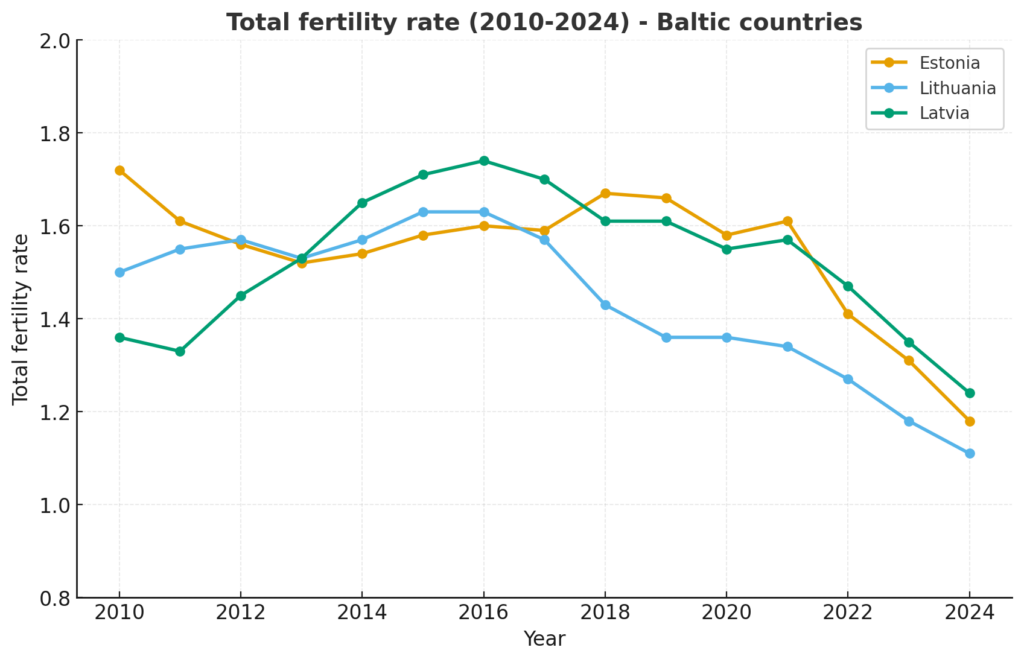
The stress of the Russia-Ukraine war also has spillover effects, particularly in the Baltic countries, where total fertility rates have declined considerably since 2022 (see Figure 2). Estonia’s statistics are striking – total fertility declined from 1.61 to 1.41, a decrease of 12.4%. According to the 2024 Estonian Women’s Health Survey, nearly one-third of women of childbearing age who expressed uncertainty or unwillingness to have children reported that the war contributed to their hesitation.
In Estonia, Russia’s war against Ukraine has revived painful memories of Soviet occupation, which partially explains why the Baltic nation of 1.4 million people has expressed such great solidarity with Ukraine. In the first 10 months of Russia’s full-scale war in Ukraine, Estonia accepted more refugees per capita than any other E.U. country. Estonia also provided more aid to Ukraine (as a fraction of GDP) than any nation – including important Ukrainian allies like the United States and United Kingdom.
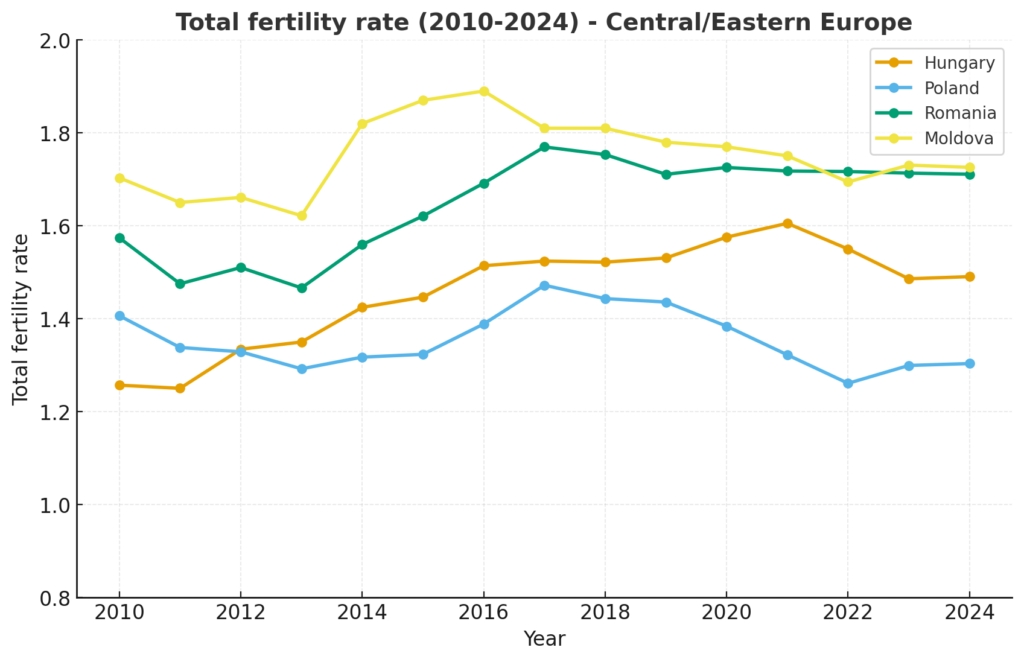
Elsewhere in Eastern Europe, fertility rates have shifted little over the past three years (see Figure 3). In Moldova, the decline from 2021 to 2022 was only marginally steeper than the existing downward trend. Poland saw a decrease consistent with its prior trajectory, while fertility rates in Romania registered almost no change. Hungary may be the exception: Fertility rates had been rising since 2011 – likely aided by Orbán’s pro-natalist policies – but began to turn downward after Russian troops invaded Ukraine, though not dramatically.
Demographic shifts have long-lasting political consequences
What are some potential political consequences of falling birth rates in Eastern Europe?
If fertility decline correlates with political ideology, it could set the stage for major structural shifts – though these may not become evident for decades. For example, survey data show that birth rates across the industrialized world are falling more steeply among liberals than conservatives. Assuming that children tend to have similar political beliefs – which is often though not always true – then the balance of political ideologies in a society may well shift.
In the shorter term, an aging population means added strains on pension and health care systems. Policymakers may have to implement unpopular measures, which typically involve political consequences. Pension age hikes in Russia and France, for example, have triggered protests and strikes. A growing number of countries are likely to face unpopular budget choices, as more workers approach retirement age. These pressures could push governments to encourage more immigration to offset their depleting labor forces – a policy shift likely to create a host of political and social consequences.
With Russia’s aggression showing few signs of abating, Ukraine and its neighbors face an added national security risk: The pool of military-age citizens continues to shrink. Ukraine has already struggled with the dilemma that drafting younger citizens to send to the front lines ultimately risks exacerbating long-term demographic trends. How this dynamic will evolve is unclear, as the outcome hinges on both the length and outcome of the war. But the possibility that conflict could drive lasting structural changes in the political landscape – even in nearby countries untouched by fighting – deserves careful attention.
Isabelle DeSisto is a 2025-2026 Good Authority fellow.