






Many today bemoan the resurgence of nationalism and warn about its threats to democracy and peace. And they are right to worry. From Viktor Orbán in Hungary, Narendra Modi in India, to Italy’s Giorgia Meloni, leaders have increasingly embraced a reactionary form of nationalism in recent years, vowing to make their respective countries great again – even at another’s expense. Speaking at the U.N. General Assembly last week, U.S. President Donald Trump declared, “If you don’t stop people that you’ve never seen before, that you have nothing in common with, your country is going to fail.” He warned European leaders that unchecked immigration would destroy their countries, echoing his stance on mass deportations in the United States.
But what precisely is nationalism? And is it always a bad thing? Despite its widespread usage, the term “nationalism” remains slippery and not easy to define. People often conflate nationalism with related concepts like patriotism – love of one’s country – or chauvinism, the notion that one’s country is superior to others. Nationalism is also often pitted against ideas like globalism and cosmopolitanism. It’s no surprise, then, that some people see nationalism as inherently exclusionary and adversarial. Yet, as political scientists Harris Mylonas and Maya Tudor write, “nationalism… has not always been a force for destroying democracies, waging wars, or marginalizing minorities.” Indeed, when people feel connected to their nation, they contribute more to civic and national life, sometimes at great personal cost.
What is nationalism, exactly?
At its core, nationalism is the belief that a people who share a common identity should govern themselves, whether as a democracy or an autocracy. Political elites capitalize on this belief to legitimize their rule and policies, including how to define citizenship and police territorial borders, that make the nation and the state congruent. Nationalism, in this sense, is an ideology. The broader public, meanwhile, practice nationalism in their everyday lives by performing national identities (e.g., using a national language and following cultural norms) or participating in nationalistic rituals, like wearing their country’s flag at an international sporting event. Nationalism resists simple definitions precisely because it takes so many forms in political life.
That said, all forms of nationalism draw a line between citizens and outsiders, though in varying ways. Some forms of nationalism draw on existing internal hierarchies, based on religion, race, ethnicity, class, or caste. They define the rules of national belonging based on inherited qualities, like white Christianity in the United States or Han Chinese ethnicity in China. Other forms of nationalism instead build on collective values and experiences. Canadian nationalism, for instance, is often grounded in multiculturalism and civic ideals rather than ancestry, though this narrative sits uneasily alongside the ongoing marginalization of indigenous peoples.
So nationalism is not inherently bad. Some forms of nationalism can be more conducive to democracy and peace than others. Some scholars have considered whether a specific expression of nationalism is inclusive or exclusive in content. Where national stories are inclusive and help ease social divisions, democracy can take root (as it once did in India). Yet where they deepen those divisions and entrench hierarchies, autocracy is more likely to prevail (as it did in Malaysia). Others have explored whether the form of nationalism fosters strong or weak connections to the state. Stories that strongly identify with the state (as in South Korea) can engender a greater sense of civic duty. But narratives that weakly identify with the state (as in Taiwan) may dampen that civic connection.
What should nationalism look like in a democracy?
In my work, I focus on whether nationalism that the state promotes is open or closed to dissent and debate. This question is especially relevant in established democracies where dissent is institutionalized through representative channels – at the ballot box, or on the streets. In this view, nationalism in a democracy is less about achieving a single, or even dominant, inclusive narrative. Instead, the challenge is whether competing narratives can coexist within a framework of mutual belonging. How political elites, civil society groups, and citizens negotiate and manage the boundaries of these narratives is crucial to a well-functioning democracy.
In the table below, I provide a typology of nationalism based on the inclusiveness of content and openness to contestation. After independence in 1947, India developed an open and inclusive nationalism that acknowledged its vast ethnic, linguistic, and religious diversity. Singapore, which became fully independent in 1965, has championed a multicultural identity, while maintaining strict control over contestation in favor of government-imposed unity. North Korea exemplifies a form of nationalism that is both exclusive – rooted in rigid ideology and ethnocentrism – and closed to dissent. South Korea has similarly anchored its nationalism in an exclusive, ethnocentric narrative. But since democratization in 1987, South Korea has increasingly opened space for debate over what it means to be Korean.
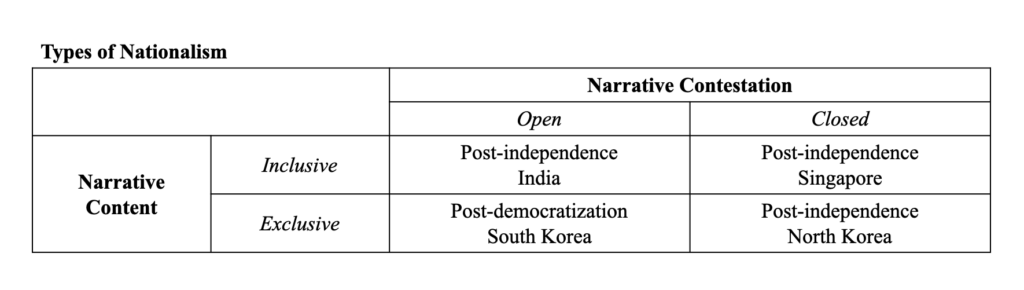
This typology helps clear up some common assumptions about nationalism and democracy. First, not all democracies embrace inclusive national narratives. And not all autocracies rely on exclusive national narratives. The difference between newly independent India and Singapore was not the breadth of inclusion in each country’s national vision, but how they handled disagreement. Second, open contestation does not guarantee good-faith arguments, and bad-faith narratives can winnow the space afforded to pluralism in a democracy. In recent years, India’s ruling elites have increasingly co-opted Hindu-centric national narratives, using them to marginalize dissent and suppress the voices of religious and ethnic minorities. This suggests the need for healthy narrative boundaries, beyond which exclusive narratives can begin to undermine democracy.
Democracy needs more than a good story
Today, some argue that democracies are growing unstable because they lack a compelling, cohesive national story. In the United States, former Obama speechwriter Ben Rhodes warned, “Americans are now bound together by the presence of a federal government and laws, but not by a shared sense of what it means to be American. This is a recipe for sustained political instability and social disruption, if not outright conflict.” He thus called for crafting “a story that can consistently win sufficient victories at the ballot box.”
But this framing misses the point. There is no “right” story that is waiting to be found. What matters is how competing stories are held together – through parties, movements, and people – in ways that strengthen a shared sense of belonging. This means actively resisting exclusionary narratives that stifle open and principled debates as much as co-creating narratives that are unifying and promote democracy.
Related Good Authority posts
- Isabelle Desisto, “Russia’s ‘Victory Frenzy’ is another weapon against Ukraine.” From May 8, 2025, exploring how Russia uses Victory Day to weaponize celebrations and commemorations of the end of World War II, in an attempt to justify its current war in Ukraine.
- Stacie Goddard, “Russia’s Ukraine ‘peace’ plan may be doomed from the start.” From Sept. 2, 2025, discussing how the rise of nationalism and the notion of territorial homelands means countries at war are increasingly unwilling to concede.
- Eric Gonzalez Juenke, “The unanticipated consequences of racialized immigration policy.” From July 29, 2025, the first part of a series of posts exploring U.S. immigration policies.
- Eric Gonzalez Juenke and Alexander Kustov, “Good Chat: How democracies can make immigration more popular.” From June 26, 2025; insights from Alexander Kustov’s new book, In Our Interest: How Democracies Can Make Immigration Popular.
Further reading and resources
- Bart Bonikowski, “Nationalism in Settled Times,” Annual Review of Sociology, Vol. 42 (2016), pp. 427-449.
- Aram Hur, Narratives of Civic Duty: How National Stories Shape Democracy in Asia (Cornell University Press, 2022).
- Eun A Jo, “Storytelling Elites and the Remaking of Nationhood in Democratic South Korea and Taiwan,” Comparative Political Studies, August 23, 2025.
- Jiyoung Ko, Popular Nationalism and War (Oxford University Press, 2023).
- Harris Mylonas and Maya Tudor, “Nationalism: What We Know and What We Still Need to Know,” Annual Review of Political Science, Vol. 24 (2021), pp. 109-132.
- Kathleen E. Powers, Nationalism in International Politics (Princeton University Press, 2022).
- Maya Tudor and Dan Slater, “Nationalism, Authoritarianism, and Democracy: Historical Lessons from South and Southeast Asia” Perspectives on Politics, May 2020, pp. 706-722.
Eun A Jo is a 2025-2026 Good Authority fellow.
Stay up to date on all things politics and political science. Bookmark our landing page and sign up for Good Authority’s weekly newsletter by entering your email address in the box below.