





On Sept. 28, Moldovans voted in the 2025 parliamentary elections. For months, observers warned that a multi-vectored influence operation could tilt the outcome to a parliament aligned with Russia’s interests. Despite unfavorable polls and Russian-funded efforts to sway the vote, the pro-European Party of Action and Solidarity (PAS) – in power since July 2021 – secured another parliamentary majority.
Moldovans and outside observers celebrated the results as a decisive victory for Europe and for democracy. As we’ve written in past explainers on Good Authority, Russia has exerted considerable pressure to block Moldova’s efforts to join the European Union. To be sure, a parliamentary majority will allow PAS to continue pushing their European integration agenda without the need to make the kind of tough compromises a coalition government would likely require. PAS nevertheless experienced a net loss in seats. The party secured 55 of the 101 parliamentary seats in the recent election, compared to the 61 seats it currently holds.
Were voters paying attention to Russia’s efforts to tilt the election? We conducted an original online survey ahead of the election to study the factors informing Moldovans’ voting behavior. Beyond the traditional cleavages that have been shown to shape vote choice in Moldova – like language, age, and region – our results suggest that support for pro-Russian parties was driven in part by social media use and religious appeals.
Russia uses diverse tactics to influence Moldovan politics
Sandwiched between Romania and Ukraine, Moldova has long been a site of contestation between European- versus Russian-oriented political forces. Moldova became an E.U. candidate in 2022. But nostalgia for the Soviet Union remains fairly high, especially among older people and Russian speakers. Although the population is majority Romanian-speaking, there is a large Russian-speaking minority. Many Moldovans in this group are embedded in a Russian-language media landscape.
As we detailed in a previous piece, Russia has tried to influence Moldovan politics in various ways. Pro-Russia groups, for instance, recruited and paid local “activists” to discredit the ruling PAS party and its founder, President Maia Sandu. Russia has also maintained a troop presence in the Moldovan territory of Transnistria, a separatist region across the Dniester River.
Targeting social media – and a religious appeal
Russia’s disinformation efforts via social media gained particular attention both during the recent parliamentary elections and in last year’s presidential election. Sandu won that contest, in large part thanks to overwhelming support in the diaspora. Journalists from the Moldovan investigative outlet Ziarul de Gardă and the BBC went undercover to show how Kremlin-backed groups paid Moldovan citizens to spread anti-PAS messaging on platforms like TikTok and Telegram.
Russian influence campaigns also targeted religious ties to Russia. Last year, several hundred religious figures (mostly Orthodox priests) went on all-expenses-paid “pilgrimages” to Moscow, where they met with Kremlin-linked politicians. Moldovan Orthodox parishes have increasingly turned to Telegram – a popular encrypted messaging app – to post content criticizing the E.U. and promoting “traditional values” that include opposition to LGBT rights.
Evidence suggests that people linked to the Kremlin supplied content for this campaign. This kind of messaging caters to a broad audience in Moldova. An estimated 95% of the population identifies as Orthodox and most belong to a denomination that is subordinate to the Russian patriarchate.
Our survey predicted the election results quite well
We fielded an online survey in Moldova in the week ahead of the Sept. 28 election, with the goal of analyzing which factors influence voting behavior. We also wanted to see how far pro-Russian strategies to sway the election actually resonated with voters. The surveys were offered in Romanian and Russian. We collected a total of 739 responses.
Public opinion polls have a notoriously poor track record when it comes to predicting the results of elections in Moldova, in part due to large numbers of undecided voters and uncertainty about how many people actually turn out to vote, both at home and abroad. Our survey fared surprisingly well this time. After re-weighting our data to better reflect the demographic and regional distribution of the population, we predicted that approximately 44% of decided voters inside Moldova would support PAS. The actual result was 43%. Our predictions for more pro-Russian groups – “Blocul Patriotic” (Patriotic Electoral Bloc) and “Alternativa” (Alternative) – were also fairly close to the actual results (see Figure 1 below). We slightly overestimated the share that would go to minor parties, but not by much.
We excluded the diaspora from this figure. These voters are a major political force in Moldova and their overwhelmingly pro-European vote was decisive in both the 2024 presidential elections and in the recent parliamentary elections. But it is difficult to survey this group accurately and estimate voter turnout. This time, voter turnout was higher than in past parliamentary elections: About 278,000 Moldovans voted abroad, with 79% supporting PAS.

Many Moldovans rely on TikTok and other social media for information
TikTok has become extremely popular in recent years, especially among young Moldovans, though many older people also use it. Large group chats on Telegram, another widely used messaging platform, are a major source of local and international news. In neighboring Ukraine, for instance, Telegram is one of the primary channels for real-time war updates and safety information. VKontakte (VK for short), a popular Russian social media platform, is less popular overall in Moldova, but remains common among older Russian speakers. Figure 2 shows the frequency with which Moldovans use these three social media platforms.

Social media use and religion are highly predictive of pro-Russian vote
Our analysis of the survey data shows that social media use on all three platforms correlated closely with pro-Russian vote choice, especially among older Moldovans. We also find that Telegram and TikTok usage predicted pro-Russian vote choice among religious voters. This offers some suggestive evidence that the appeals by religious figures on social media were persuasive among the Moldovan electorate.
Figure 3 shows the predicted likelihood of voting for BP and Alternativa – the two main pro-Russian groups on the ballot – as a function of social media usage for young versus older respondents. Political science research suggests that older people are typically more susceptible to social media manipulation than younger people. Our survey data confirm that respondents under 40 – irrespective of their social media exposure – were unlikely to support pro-Russian parties. But for Moldovan voters over 40, frequent social media usage was associated with a significant pro-Russian electoral boost. These effects were substantial among VK users, but also applied to the more widely used Telegram and TikTok platforms.
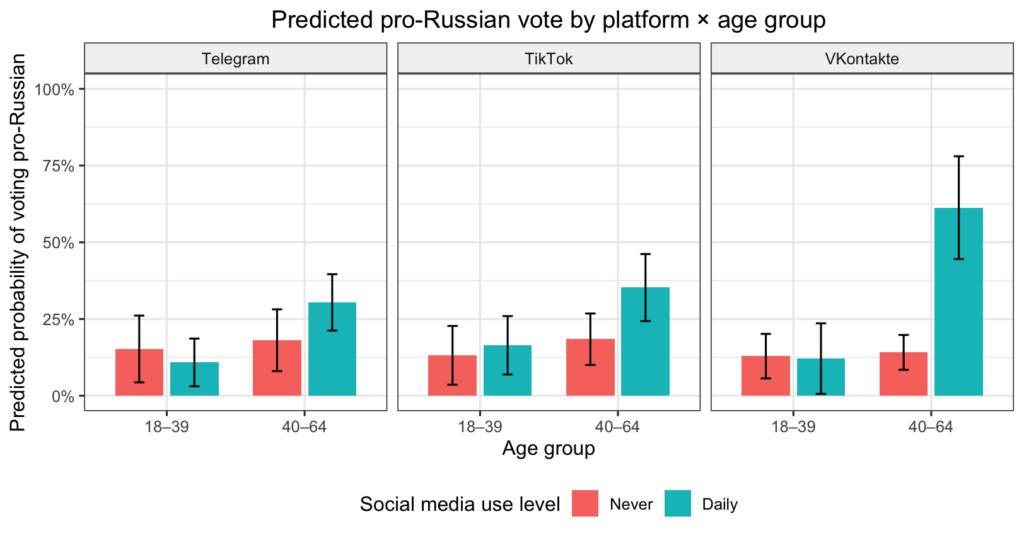
Figure 4 focuses on the interplay between two of the main mechanisms of Russian influence in Moldova: social media and Orthodox priests – many of whom appear to have been recruited by Kremlin-linked political groups. In this case, the interaction between social media and religious influence was more platform-specific. Journalistic evidence indicates that pro-Russian priests received instructions to use Telegram channels to influence voters. The left panel in the figure below details how frequent Telegram use led to greater support for pro-Russian parties – but only among those who attended church frequently (at least once a month). Conversely, Moldova’s pro-Russian parties only benefited from higher church attendance among respondents who reported using Telegram more frequently.
By contrast, the right panel in the figure below suggests that VKontakte usage mattered more for voting among Moldovans who rarely or never attend church. The middle panel reveals fairly similar pro-Russian effects of TikTok use for both frequent and infrequent churchgoers. In other words, higher social media usage contributed to the electoral support of pro-Russian parties across all three platforms. And the figure is compatible with the anecdotal evidence of Telegram as the platform of choice for pro-Russian Orthodox priests.

Moldova’s challenges reflect a broader regional trend
The patterns we observed in the Moldovan elections mirror broader regional trends in Eastern Europe. Both TikTok and the Orthodox church played a pivotal role in the 2024 Romanian parliamentary and presidential elections, for instance. And Kremlin-friendly parties and candidates did unexpectedly well. Ultimately, the first round of the presidential elections was annulled and centrist Nicușor Dan won the presidency, but the threat from disinformation remains acute. In Poland’s recent presidential election, TikTok accounts promoted far-right and nationalist content, reaching millions of voters. Given its increasing popularity, this platform has the potential to shape electoral politics in Eastern Europe and beyond – and not necessarily in a positive direction.
Isabelle DeSisto is a PhD candidate in politics at Princeton University, and a 2025-2026 Good Authority fellow.
Grigore Pop-Eleches is professor of politics and international affairs at Princeton University.