





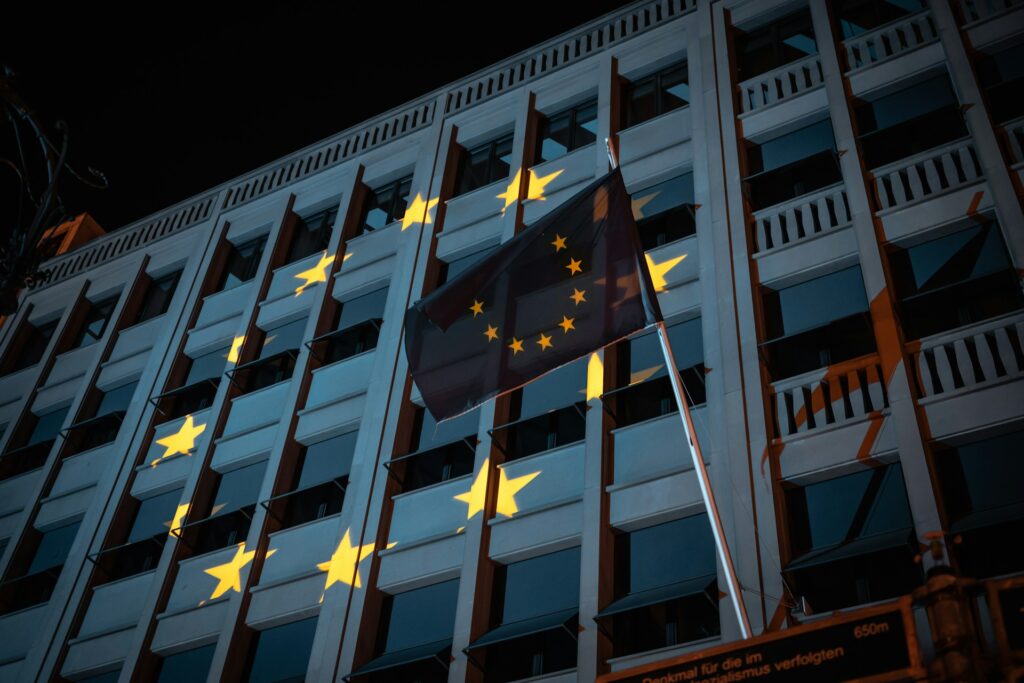
Optimism about membership is running high across the E.U.’s candidate countries. Among several others, leaders in Albania, Georgia, and Moldova have recently voiced hopes of joining the E.U. by 2030. Montenegro’s Prime Minister Milojko Spajić even took a further step – he pledged to secure membership by 2028.
These ambitions stand against the E.U.’s own track record. Ten countries joined the E.U. in May 2004. But the average accession process since then has stretched beyond a decade. Nonetheless, E.U. institutions and member states both in Eastern and Western Europe have encouraged candidates to be hopeful. In her 2025 State of the Union speech, European Commission President Ursula von der Leyen insisted that the future of the Western Balkans, Moldova, and Ukraine “is in our Union” and urged, “Let us make the next reunification of Europe happen.”
Yet the gap between aspiration and reality remains wide. Given the E.U.’s strict membership conditions, the uneven record of previous enlargement rounds, and the caution expressed by European leaders, candidate countries’ self-imposed deadlines seem far from guaranteed.
How the enlargement process works
After the Cold War ended, the E.U. introduced its membership conditionality, also known as the Copenhagen Criteria. This framework requires prospective members to commit to democracy, the rule of law, and a market economy, and also adopt the Acquis Communautaire, the 35-chapter framework of E.U. law consisting of tens of thousands of pages. The purpose is to reward genuine progress and filter out countries unwilling or unable to meet E.U. standards.
The accession process is complex. Joining the E.U. demands the consent of the European Parliament, unanimous approval by the E.U. Council, and ratification by each member state. In practice, every member holds a potential veto.
Scholars often view membership conditionality as the E.U.’s most powerful tool of influence, especially in Central and Eastern Europe (CEE). At first, expectations were high. Citizens across the region hoped that E.U. membership would help address persistent governance problems. After several countries in this region joined the E.U. in May 2004, early studies of post-accession performance confirmed this expectation.
In a 2014 paper, I found that the E.U. and its CEE members had already fallen short of their promises, particularly in the fight against corruption. By the early 2020s, academic studies largely agreed that membership conditionality had failed to reliably distinguish between compliant and non-compliant countries. Recent scholarship has shifted toward examining what comes after accession: democratic backsliding, its effects on policymaking within the E.U., and the growing influence of anti-E.U. politicians in member states.
E.U. candidates have made uneven progress
Currently, nine countries are officially candidates for E.U. membership: Albania, Bosnia and Herzegovina, Georgia, Moldova, Montenegro, North Macedonia, Serbia, Turkey, and Ukraine. Kosovo, whose independence is not recognized by five E.U. members, is currently treated as a potential candidate.
Among these, only Albania, Montenegro, Serbia, and Turkey have formally opened negotiation chapters. And only Albania and Montenegro are engaging in active talks. Albania will soon have 28 chapters opened, though none have been closed. Montenegro remains the most advanced, with 33 chapters opened, but only 7 provisionally closed. Even these two “front-runners” face serious hurdles on the path to accession.
Elsewhere, progress has stalled considerably. The accession processes of Georgia and Turkey are effectively frozen, with little hope of improvement. Serbia risks following a similar trajectory as political tensions with the E.U. weigh heavily on its candidacy. Moldova and Ukraine are still in the screening phase, with no actual negotiations underway. North Macedonia, meanwhile, completed the screening process two years ago but is still waiting for substantive talks to begin.
Russia’s full-scale invasion of Ukraine revived the geopolitical case for E.U. enlargement. A number of scholars suggest this explains why the E.U. was quick to move Ukraine, Georgia, and Moldova onto the candidate track – and why optimism has risen in several other candidates. Yet, while the E.U. may have political reasons to grant candidate status, E.U. leaders have repeatedly made clear that accession itself will remain merit based, with no shortcuts. This is a view that experts also share. Obstacles such as democratic backsliding, ongoing corruption, and disputes with neighbors continue to undermine progress in most, if not all, E.U. candidates.
Lessons from past enlargement rounds
There are also several considerations on the E.U.’s side. First, the uneven success record of past enlargements weighs heavily on current debates. Disruptions caused by Hungary under Viktor Orbán, Poland under the Law and Justice (PiS) party, and Slovakia under Robert Fico have left E.U. officials and member states wary. These experiences suggest the European Union will approach future enlargement decisions with greater scrutiny.
The rise of Euroskepticism and far-right populism poses another obstacle. Enlargement requires unanimity – even a single government can block progress. In Hungary, Prime Minister Orbán has reiterated his opposition to Ukraine’s membership. Orbán even staged a non-binding referendum, claiming that 95 percent of participants opposed membership. Low turnout (under 30 percent) and opposition boycotts shed doubt on the legitimacy of the referendum. Still, the case clearly demonstrated the disruptive potential of any one E.U. member.
Experts also emphasize the need for the E.U. to make some policy changes before admitting new members. One issue concerns the E.U. cohesion funds, which channel large amounts of aid to less-developed member states. With the accession of new countries, current CEE recipients would see their funding share decline sharply as resources shifted toward the newcomers. Representation also poses a challenge. Seats in the European Parliament are distributed by population size. The accession of Turkey, with more than 85 million people, and Ukraine (over 40 million), would dramatically alter the balance. Under current rules, Turkey would immediately become the most represented member state in the European Parliament.
To enlarge or not to enlarge? That’s a big question.
For the E.U. itself, the decision to enlarge or not is a double-edged sword. On the one hand, European leaders have wisely avoided setting rigid deadlines, which would pressure them to admit new members that might not have met the full conditions for membership. The E.U., scholars point out, made that mistake already with Bulgaria and Romania. On the other hand, experts argue that being too vague about membership prospects risks disillusionment in candidate countries. For this reason, they argue, the E.U. should offer “a clear and structured path to membership.”
The war in Ukraine has given the issue of E.U. enlargement new urgency – but urgency does not erase complexity. Candidate countries may have ambitious deadlines, but the European Union is bound by strict conditions, national considerations, and institutional challenges.
At the same time, the E.U. leadership seeks to avoid premature promises while keeping candidate countries invested in doing the work necessary for accession. Failure to strike this delicate balance could either repeat the mistakes of rushed enlargements or risk losing potential members to disillusionment and authoritarian drift. As von der Leyen and experts argue, these countries’ future lies in the E.U. But accession is unlikely to be completed within the timeframes that leaders of these candidate countries are hoping for.
Mert Kartal is a 2025-2026 Good Authority fellow.