






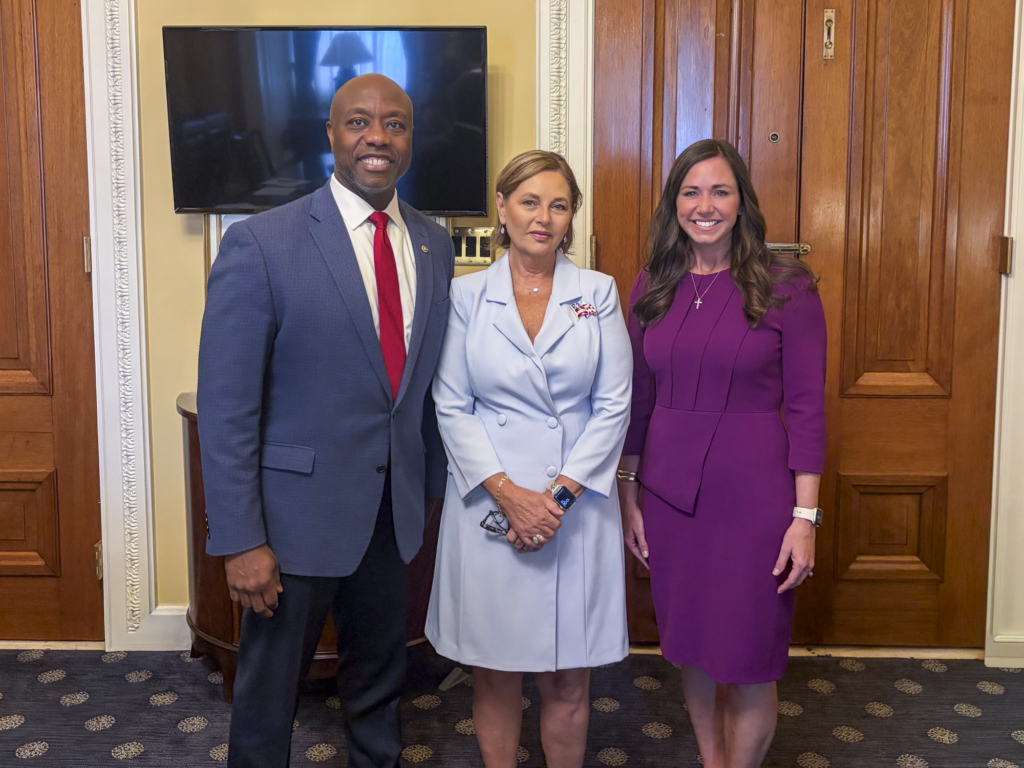
Darline Graham Nordone was sworn in as the newest United States senator earlier this week. In doing so, she became the first woman to represent South Carolina in the chamber in the state’s 250-year history. Graham Nordone will complete the six months remaining in the Senate term of her late brother, Sen. Lindsey Graham (R-S.C.), who died unexpectedly on July 12.
This Senate appointment illustrates an enduring, gendered pathway to political office: family succession.
Graham Nordone’s appointment provides an opportunity to revisit an old political science question: How do women gain access to institutions that were not originally built with them in mind?
Family ties have long been a doorway to politics for women
Women often entered elective office through routes different from their male counterparts. Around the world, women have frequently reached executive positions or legislative office after the retirement, death, or assassination of a male relative. Widows, daughters, sisters, and wives have inherited political organizations, donor networks, name recognition, and voter goodwill.
Men often inherit family political capital as a continuation of dynastic politics – think of the Kennedy, Bush, Udall, Daley, and Cuomo families, for instance. Women have historically been more likely to receive opportunities through temporary appointments following a male relative’s departure from office. As political scientist Diane Kinkaid memorably noted decades ago,”statistically at least, for women aspiring to serve in Congress, the best husband has been a dead husband, most preferably one serving in Congress at the time of his demise.”
America’s newest senator fits within this category. To be sure, a sister succeeding her brother is comparatively unusual. Most congressional succession appointments involving women have seen widows or daughters step into office, not sisters.
Representation can expand through unexpected routes
South Carolina now has its first female senator because Governor Henry McMaster appointed a woman to preserve continuity after a male senator’s death. From a descriptive representation perspective, meaning that the legislator mirrors an important characteristic of the constituency, this is very significant. Women remain underrepresented in the U.S. Senate. And Republican women remain particularly underrepresented in the GOP conference. In the current Congress, just 27% of U.S. senators – 16 Democrats and 11 Republicans – are women.
However, descriptive representation alone tells us relatively little about how Graham Nordone will represent South Carolina voters over the next few months. Unlike many first-time officeholders, she arrives after years working in South Carolina state government and public administration rather than electoral politics. True, her stated goal is to honor her brother’s legacy rather than chart a dramatically different ideological course. But as political scientist Diane Kinkaid demonstrated, many congressional widows have defied this conventional expectation, using their initial appointments to launch their own independent and successful electoral careers.
Gender should not disappear from the story
Media accounts have largely framed Graham Nordone’s appointment as a story about grief, continuity, and Republican succession. These are appropriate frames, but gender also belongs in this conversation.
Women’s political representation has never expanded through a single pathway. Some women political leaders emerge through their engagement with local office, social movements, or careers in law, business, or the military. Others arrive through appointments or because they come from political families. Each route reflects the institutional opportunities available at a particular historical moment.
Senator Darline Graham Nordone’s appointment is a reminder that family remains an important political institution. A family in politics can recruit candidates, transmit political capital, and sometimes open doors that formal party organizations leave closed for women.
Stay up to date on all things politics and political science. Bookmark our landing page and sign up for Good Authority’s weekly newsletter by entering your email address in the box below.