





Last month’s New York Democratic primaries produced a wave of victories for candidates who ran as critics of Israel. The results appear to mirror a broader shift among Democratic voters, who increasingly believe the U.S. has been too supportive of Israel. This trend has been building since the Israel-Hamas war began in 2023.
These developments have some Democratic strategists asking whether the party’s shift on Israel will cost it support among Jewish voters in November 2026.
The Cooperative Election Study (CES) is well suited to answer that question. In election years, our sample includes more than 1,000 Jewish respondents; in the smaller off-year surveys, several hundred.
A drop in Jewish identification with the Democratic Party
The first plot shows how Jewish Americans have identified politically since 2008. Democratic support has eroded recently.

In 2008, 65% of Jewish Americans identified with the Democratic Party. That share climbed to a peak of 68% in 2019 and held at or above 60% through 2024. In 2025, it dropped to 55% – an 8-point decline in a single year. By comparison, identification with the Democratic Party among all Americans dropped from 48% in 2008 to 40% in 2025. But that trend has been gradual during the entire period rather than concentrated more recently. The decline among all Americans was just 2 percentage points from 2024 to 2025.
The share identifying with the Republican Party has moved in the opposite direction. Roughly one in four Jewish Americans identified as Republicans from 2008 through 2020. In 2025, nearly one in three did. During the same period, there has been barely any movement in Republican identification among the American population.
Is 2025 a one-year anomaly or the leading edge of a longer trend? That’s not yet clear. Because partisanship is one of the strongest predictors of vote choice in American politics, the answer will shape a lot of what happens next.
Will this translate into less support for Democratic candidates?
As of last November, the answer was no. The 2025 CES asked Americans which party they planned to support in the 2026 midterm elections. Among Jewish voters who named a likely vote, Democrats were on track to win about two-thirds – in line with the party’s share in past midterms like 2010, 2014, and 2022, and a bit below the 2018 high.
The more important question is whether Jewish voters who recently supported Democrats are pulling away. The cleanest baseline is the 2020 presidential race, which preceded the Hamas attack in 2023 and the war that followed. In the 2025 CES, 90% of Jewish Americans who supported Joe Biden in 2020 said they intended to vote Democratic in their 2026 House race. Just 3% planned to vote Republican; the rest were not yet sure. This is slightly higher than the retention rate for all Biden voters in 2020, 87% of whom plan to vote Democratic in 2026.
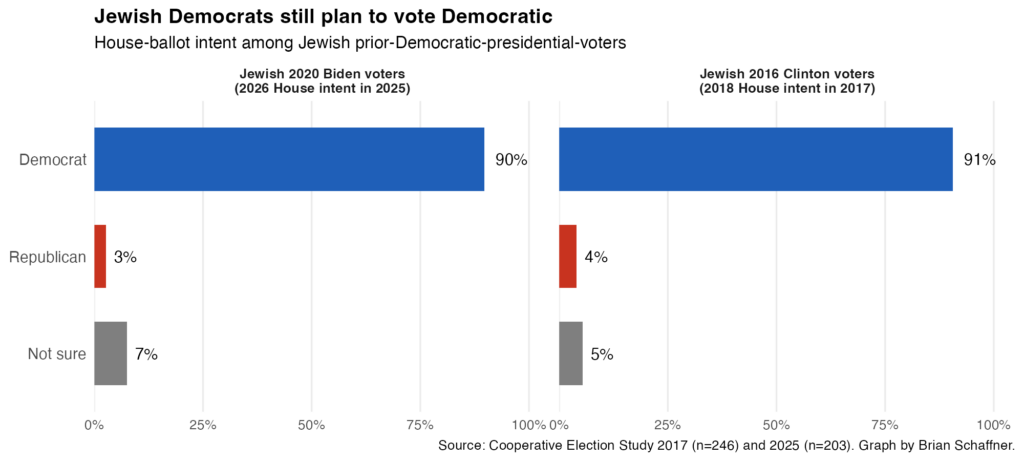
The same exercise applied to the 2017 CES – the last comparable pre-midterm year – produces nearly identical numbers. The CES data revealed that 91% of Jewish Clinton voters said they planned to vote Democratic in their 2018 House race.
Of course, that intention could shift if Democrats nominate more candidates who take positions on Israel that conflict with the sympathies of many Jewish Democrats. The Senate campaign of Abdul El-Sayed, for example, is a high-profile case to watch in Michigan’s Aug. 4 primary. It is one thing to tell a pollster you will vote for the party in November, and another to do so when the candidate on the ballot is one whose rhetoric on Israel you actively oppose.
What the two findings mean together
The two signals do not point in the same direction. Jewish American identification with the Democratic Party has dropped to its lowest level in nearly two decades. Jewish Democratic voters’ stated vote intention has remained much the same. Both of those things can be true at once, and the needle on either gauge can move again between now and November.
The 2025 data capture a moment before most general-election candidates have been chosen – and prior to the next inflection points in the Israel-Gaza war. What the data do capture is an erosion of identification with the Democratic Party, along with a strong indication that many Jewish voters still plan to vote for Democratic candidates in fall 2026.
