





On July 7-8, the heads of all 32 members of the North Atlantic Treaty Organization (NATO) will convene in Ankara, Turkey. These high-level NATO summits used to be rare. During the Cold War, NATO held only eight heads of state and government summits. But since Russia’s invasion of Ukraine in 2022, NATO heads of state have convened seven times.
Officially, there is not much new on NATO’s agenda. Indeed, NATO Secretary General Mark Rutte, who will be chairing the meeting, described the summit as one of “delivery and implementation,” rather than creation and innovation. NATO’s website identifies several key issues: Europe’s increased investment in defense, the state of the defense industry, and the war in Ukraine.
But while the topics may not be new, ongoing frictions, especially between President Trump and his European counterparts, threaten consensus at the summit. Here are three things to watch.
1. Why location, location, location is important
At this summit, even the choice of location is fraught. Turkey’s position within NATO has always been complicated. When the founding members voted to let Turkey join the alliance in 1952, there were concerns about overstretch and conflict escalation. NATO members worried that Turkey’s ongoing conflict with Greece over the status of divided Cyprus might damage the alliance. At the same time, NATO countries saw Turkey as strategically vital to protecting the alliance’s southern flank against Soviet aggression. Turkey’s accession added a major military partner with close access to the Middle East, the Black Sea, and the eastern Mediterranean.
Similar tensions are visible still today. In 2026, NATO describes Russia as the most significant and direct threat to allied security. Thanks to the war in Ukraine, the Black Sea has once again become a central theater of European security, with Ukraine utilizing asymmetric naval drones and long-range strike capabilities to challenge Russia’s naval dominance in the region.
European countries have a particular interest in strategic ties with Turkey. The possibility of reduced U.S. involvement in Europe is forcing these NATO members to rethink European defense capacity. While the European defense industry remains anemic, Turkey has been developing the scale and expertise needed to mass-produce defense technology like drones and guided missiles.
These ties mean new tradeoffs, critics point out. Will the decision of Ankara as the host city reinforce the autocracy of President Recep Tayyip Erdoğan, and thus weaken NATO’s commitment to liberal democracy as a cornerstone of the security alliance? Although Turkey is an important partner in the great power competition, Erdoğan has proven willing to “hedge” when he sees fit. For example, he purchased a Russian S-400 surface-to-air missile defense system in 2019, even when NATO members threatened to cut the country off from the F-35 fighter jet program. And Erdoğan’s willingness to use Turkey’s defense industry in support of Europe’s security needs comes with plenty of strings – namely, demands for the European Union to resume negotiations on Turkey’s accession to the 27-member economic and political union.
2. Are NATO members friends or frenemies?
The summit is also likely to become yet another test of the NATO partnership. Trump continues to be a strong critic of NATO, charging that European members free-ride on U.S. defense. Recent data, however, suggest the Europeans have quite a bit to show for their efforts. Not only have European allies reached their previous target of spending 2% of their respective GDP on defense, they have made substantial progress toward the 2025 NATO commitment to spend 5% of GDP on defense by 2035. Much of this buildup has been accomplished through arms purchases from the United States. The E.U. has also made sure the fiscal structures are in place to fund the buildup, largely through the Readiness 2030 framework adopted last year.
All indicators, in fact, seemed to point towards a European victory lap – and smoother relations with the Trump White House. But then came the Iran war. Spain’s Prime Minister Pedro Sánchez condemned the war and refused to let U.S. forces operate from jointly operated bases or use Spanish airspace. French President Emmanuel Macron excoriated Trump for his changing war aims, saying, “When we’re serious, we don’t say the opposite of what we said the day before.” The British government only allowed the U.S. to use its bases after some hesitation.
U.S. Secretary of State Marco Rubio called this week’s summit “probably the most important meeting in NATO’s history” because there are “some things here that need to be cleared up and fixed.” Last month, Secretary of War Pete Hegseth announced a review of U.S. forces in Europe and a drawdown in assets, including fighter jets, reconnaissance drones, and warships. A recent story in the Wall Street Journal suggests that Hegseth wanted to go further, and announce additional cuts to forces ahead of the summit, but Rubio pushed back.
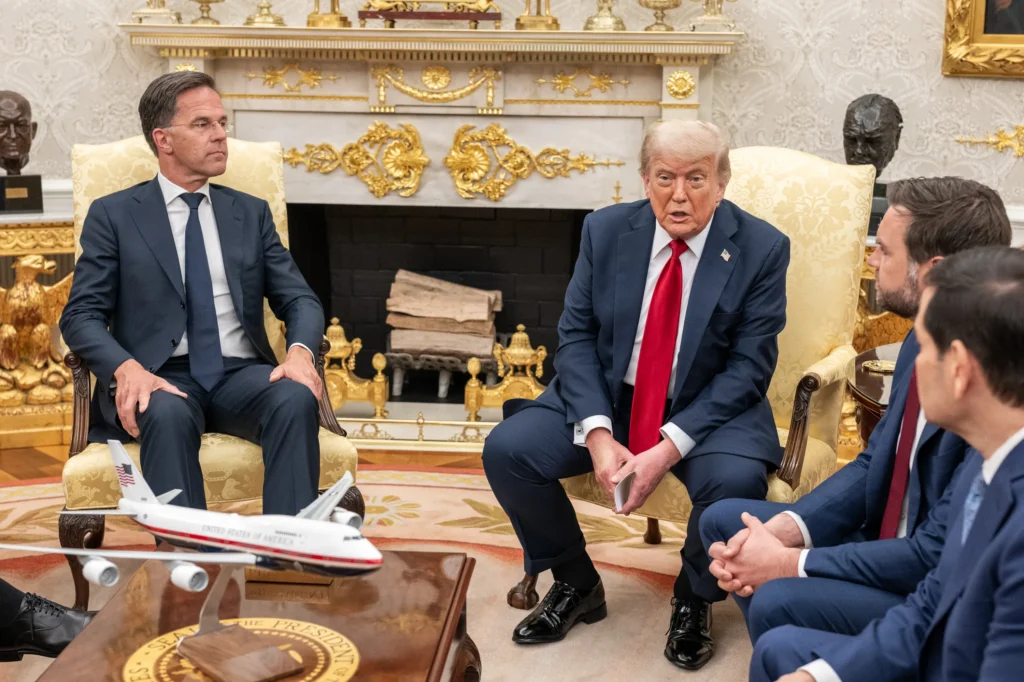
In advance of the summit, Rutte met with Trump last month to smooth ruffled feathers, but whether this will have any effect is unclear. And U.S. allies have their own significant complaints about U.S. foreign policy, especially with Trump’s ongoing threats to claim Greenland.
3. Russia is still waging a war against Ukraine
After four years of a war on Europe’s doorstep, NATO faces some challenging discussions about the conflict in Ukraine. While the U.S. has been distracted by its war this year with Iran, Ukraine has continued to fight to push back against Russia. Ukraine continues drone attacks against Russia, including striking Moscow itself. But Russia has also increased attacks against Ukrainian civilians, including a recent strike against Kyiv.
Ukraine’s President Volodymyr Zelenskyy will be at the NATO summit, and reports suggest that he and Trump will meet privately. Ukraine has made significant investments in its own defense industry, but still relies on the U.S. for more advanced systems, particularly to meet air defense needs. It’s uncertain whether the U.S. will be willing to allow Ukraine to build its own Patriot missiles, for instance. And, in a worst-case scenario, ongoing tensions between Trump and Zelenskyy could undermine any conversations, and provoke Trump to completely draw down the U.S. commitment to support Ukraine.
Taken together, the location, the transatlantic sniping, and the war in Ukraine point to the same underlying story: NATO’s unity is in serious danger. The NATO leadership may bill Ankara as a summit of “delivery,” but delivering consensus could prove the hardest task of all.