







In the April 12 parliamentary elections, Hungarians voted out Viktor Orbán and his Fidesz party. According to preliminary results after 99% of votes have been counted, the main opposition party, Tisza, led by Péter Magyar, won over 68% of seats based on a 52.4% share of the party vote. Fidesz, with just 39.2% of the vote, lost almost 60% of its parliamentary seats.
What prompted this decisive end to 16 years of Orbán’s rule? His remarkable electoral resilience had long been buttressed by a carefully calibrated electoral manipulation system that managed to deliver comfortable majorities even when the popularity of Fidesz had suffered. Orbán’s resounding loss in the 2026 elections will undoubtedly attract a lot of attention from scholars and pundits in the weeks ahead. My March 28-April 11 survey of 2,400 respondents in Hungary offers some interesting clues to what just unfolded. The results from this online survey conducted on Pollfish, with all results weighted based on demographics and region, hopefully will help structure some of these coming conversations.
The issues that drove this year’s voting
While much of the global press focus has been on Orbán’s contentious foreign policy entanglements, Figure 1 below shows that public dissatisfaction with the Orbán government was particularly pronounced in domestic issues, including key electoral priorities like the economy, corruption, health care, and education. Nevertheless, these survey results suggest that after 16 years the Hungarian public had grown almost as tired of Orbán’s foreign policy antics, particularly his friendly ties to Russia and combative relationship with the European Union. Furthermore, responses to another survey question indicate that voters cared slightly more about domestic issues (including the economy and corruption) than about foreign policy issues.
Figure 1

In previous elections, Orbán had skillfully used his control over the media and the state apparatus to mask his governing failures – and focus public attention on the infighting and unpopularity of the opposition. But the unexpected rise of Tisza shortly before the 2024 European parliament elections changed the dynamics of Hungarian party competition. Most of this rise is due to Péter Magyar, a young, dynamic, former Fidesz politician. Magyar’s charisma and tireless campaign style quickly made him the focal point of the anti-Orbán opposition. Magyar’s former allegiance to Fidesz made him somewhat controversial – and Orbán’s media machine tried its best to discredit him. Nonetheless, as Figure 2 shows, even in Hungary’s highly polarized context Magyar was considerably more popular than Orbán on the eve of the April 12 elections.
Foreign endorsements failed to help Orbán
As public opinion polls over the past year increasingly showed that Orbán was in trouble, his numerous international allies became increasingly vocal defenders. Orbán was endorsed by an impressive who’s who in radical right politics, including Italian Prime Minister Giorgia Meloni, Argentina’s President Javier Milei, Israeli Prime Minister Benjamin Netanyahu, Poland’s President Karol Nawrocki, and Russia’s President Vladimir Putin. But the most publicized foreign support came from the Trump administration, including a last-minute visit by Vice President JD Vance, and increasingly vocal endorsements from Trump himself.
Figure 2
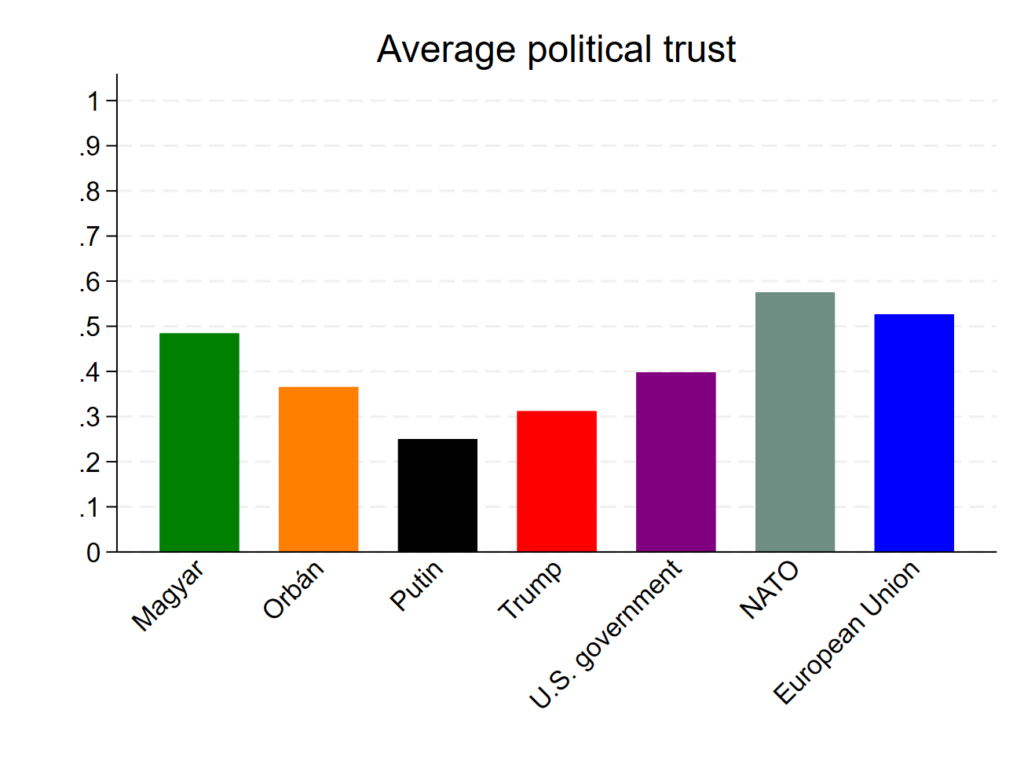
Of course, a definitive verdict on the impact of these endorsements will require more detailed analysis. Yet the patterns in Figure 2 suggest that two of Orbán’s highest-profile international backers – Putin and Trump – were noticeably less popular with the Hungarian public than even Orbán himself. This means that rather than boosting Fidesz’ flagging support, their endorsement may have further undermined the party’s electoral chances. The survey responses also suggest that Orbán’s embrace of the Trump administration and his repeated criticism of Euro-Atlantic institutions – and particularly the European Union – were ultimately counter-productive. The survey results indicate that Hungarian voters held NATO and the E.U. in higher regard, compared to their trust in the U.S. government. (However, it is worth noting that survey respondents expressed greater trust towards the U.S. government, compared to how they viewed President Trump, which suggests that at least some Hungarians are willing to distinguish between the two.)
Arguably the most high-profile U.S. intervention in the final stages of the campaign was Vance’s visit to Budapest, which included a joint public appearance with Orbán on April 7 and a call-in from the U.S. president. As the evolution of Hungarian voting preferences in Figure 3 shows, there is little evidence that Vance’s visit helped Fidesz electorally. Many factors can shape last-minute electoral choices, so such trends warrant cautious interpretation. But the results in Figure 3 suggest that the gap between Fidesz and Magyar’s Tisza party actually increased after Vance’s visit, a pattern that reinforces the reactions to the visit in election betting markets.
Figure 3

Tisza’s decisive victory now gives Magyar’s party a two-thirds parliamentary super-majority – and the power to roll back many of Orbán’s institutional changes. This seems likely to have fundamental implications for Hungarian democracy. But what does the fall of Orbán mean for the broader global right-wing populist tide? For defenders of democracy around the world, the collapse of the Orbán regime highlights the limitations of the “Hungarian model,” which much of the far right had hailed as a model for conservative revolution. Indeed, Orbán’s political tactics have inspired would-be backsliders for more than a decade. Further, the results of the Hungarian elections also suggest that the foreign electoral lobbying efforts of the “nationalist international” spearheaded by the Trump administration are ineffective – and possibly counter-productive.
What does this election say about populism?
But there are also important reasons to be cautious about what just happened in Hungary. First, much of the longer-term impact of these elections – both domestically and internationally – will depend on the ability of the new Magyar government to deliver tangible results while wrestling with the difficult legacy of Orbán’s corruption and economic mismanagement. As Poland’s experience after the 2023 electoral turnover suggests, the new government will face important challenges in dealing with Fidesz loyalists, who are entrenched in most key Hungarian institutions, including the judiciary and the mass media.
Second, while this week’s turnover should drastically improve Hungary’s relations with the E.U., it’s not clear a more pro-E.U. Hungary will boost E.U. governance. Other countries governed by nationalist-populists, such as Slovakia, led by Prime Minister Robert Fico, may step in to block important E.U. foreign policy initiatives – including greater support for Ukraine. And strained relations between the U.S. and NATO allies seem likely to continue, regardless of the new Hungarian government’s support for E.U. foreign policy.
Third, those involved in fighting against populism and would-be authoritarians of all stripes would do well to remember that much of Tisza’s remarkable success was driven as much by domestic bread-and-butter issues like economic mismanagement and corruption as by the promise to end Hungary’s pariah status in Europe.
On a final note, the opposition’s electoral message did not differ significantly from the failed campaigns over the 2014-2022 period. Thus, Tisza’s victory highlights the importance of opposition unity and of finding a candidate with Magyar’s personal appeal – and the right combination of savvy online media strategy and tireless commitment to grassroots in-person campaigning.
Grigore Pop-Eleches is professor of politics and international affairs at Princeton University.