






Exiting international organizations (IOs) seems to be a frequent strategy in current international relations. Recent high-profile events underscore this impression: The United Kingdom withdrew from the European Union in 2020, and the United States announced withdrawals from IOs like the World Health Organization (WHO) and the United Nations Educational, Scientific and Cultural Organization (UNESCO) during both Trump administrations. Countries have also been forced to leave IOs in the last few years: African regional organizations suspended Mali, Burkina Faso and Niger after coups in those countries. And Russia was suspended from the Council of Europe and the United Nations World Tourism Organization (WTouro) after invading Ukraine in 2022.
So, what are IO exits? How does a government go about the logistics of leaving an international organization? And what are the effects of IO exits for world politics?
First things first – what is an IO, exactly?
Commentators use the term “IO exit” to mean a lot of things. But there are many kinds of international institutions and several kinds of exit. The differences matter, particularly when we want to establish a common set of events to compare.
When political scientists speak of IOs, they usually mean formal intergovernmental organizations. Researchers have catalogued 534 such IOs – including UNESCO, WHO, and the African Union (AU) – in the Correlates of War Intergovernmental Organization (COW IGO) dataset. These entities have (1) three or more member states, (2) a founding treaty, and (3) an independent secretariat. These criteria mean that IO membership departure can have stringent rules, requiring a vote, formal announcement, and/or a waiting period. The legally binding nature of IO treaties means these organizations have less-fluid membership criteria than other international institutions. These formal IOs have historical importance in defining the world order and deserve focused attention related to membership exit. We use this definition and dataset in our delineation of “IO exit.”
This term therefore does not include departure from other kinds of international institutions like informal organizations (e.g., the G-7) where “membership” might change from one global summit to the next; treaties (e.g., the New Strategic Arms Reduction Treaty [START]) which have no permanent headquarters; institutions without independent secretariats like the United Nations Human Rights Council (UNHRC); executive agreements like the Paris Climate Agreement; and bilateral investment treaties (BITs). Each of these forms of governance are important, but create different nuances related to exit.
So, what is an IO exit?
IO exit occurs when a country leaves a formal intergovernmental organization, removing its rights and responsibilities related to membership. This includes voting, meeting attendance, leadership roles, and decision-making about financial allocations and programs. Some organizations also debate whether nationals of the exiting country can remain employed in the organization. The details and nuances of exit differ between IOs (just as the rules of joining also vary).
Strictly speaking, IO exit is the discrete event of leaving an IO (the date the formal exit becomes effective), but it is useful to think of IO exit as a process and consider the time before and after that date. This can include implicit/explicit threats, the announcement of exit, a waiting period, actual exit implementation (effective date), and possibly the return to full membership. Some countries might return after months or years, while others never return. Minimum conditions for reentry are often specified (either by the leaving or remaining member states).
IO exit comes in two main types: voluntary withdrawal and forced suspension.
What is an IO withdrawal?
An IO withdrawal occurs when a member state removes itself from all contractual obligations to an IO and legally terminates its membership. IO withdrawal is mostly a member state’s unilateral act, requiring no consent from other members (though technicalities exist under international law).
Withdrawal rules vary across IOs and are often – but not always – outlined in the IO treaty. In general, a country withdraws by providing notice to the IO secretariat, waiting an IO-specified timespan, and receiving acknowledgement from the IO. When the IO treaty does not specify withdrawal rules, countries can leave based on three legal pathways in the 1969 Vienna Convention on the Law of Treaties (VCLT). First, a member state can withdraw when an IO covenant explicitly outlines withdrawal terms (VCLT Article 54). Second, a country may withdraw when all parties agree (VCLT Articles 54, 65). Third, a member state can withdraw due to a “fundamental change in circumstances” that “constituted an essential basis of the consent of the parties to be bound by the treaty” (VCLT Article 62).
While some legal scholars argue that the VCLT does not always legally permit IO withdrawal, as a matter of practice we are not aware of cases where an IO has refused to let a member withdraw, even if the IO treaty did not address that possibility.
What is an IO suspension?
IO suspension occurs when a stipulated portion of an IO’s member states (temporarily) removes one country’s membership for violating an IO rule. This can include removing its ability to vote, attend meetings, or otherwise participate in IO decisions. Many – but not all – IOs have charter clauses stipulating the conditions under which suspension can occur; IOs can (and do) still suspend members even when procedures have not been specified in the IO charter.
Suspensions often include guidelines for what needs to happen before a country can regain membership, and an expected timeline for changes to be implemented. At times, IOs readmit countries even when they haven’t fully embraced these changes.
Expulsion is closely related to suspension but technically means permanent ejection. In practice, however, IOs and countries alike have used the term “expulsion” interchangeably with “suspension.” In fact, “expulsions” have only been permanent a handful of times, so the few true expulsion cases are grouped with suspensions for analytic purposes.
How often does IO exit occur?
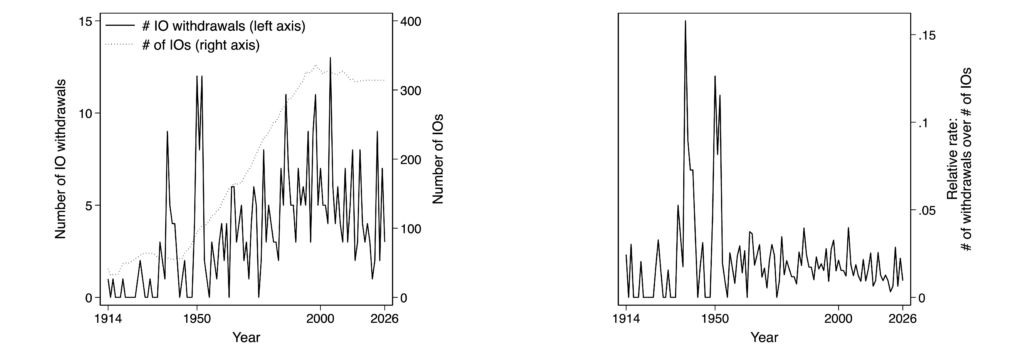
The IO Exit Dataset provides a comprehensive reference for comparative analysis across all 534 IOs and 198 countries. The dataset sources details on exits from news reports, IO websites, inquiries to IO staff, IO archives, and academic publications. It documents 488 IO exits between 1914 and 2022. These data show that IO exit is infrequent and intermittent. Over the long haul, exits have been relatively consistent. This is important: In contrast to some perceptions, IO withdrawal has not been escalating over the last 10-15 years. This is true for absolute numbers, and even more so in relative terms, given the increasing number of IOs and IO members. Figure 1 documents these two patterns, and expands on the IO Exit Dataset by updating it to 2026. Furthermore, moving out of any individual IO is a rare event; members tend to participate for many decades.
Of the total set of IO exits until 2022, 387 IO exits were withdrawals. These withdrawals occurred across a wide range of countries (127 – 64% of those in existence) and 90 organizations (17% of IOs). IO withdrawals took place in 2% of all country-years since 1914, with the first U.S. departure (from the International Council for the Exploration of the Seas) in 1919.
The dataset also tallies 101 IO suspensions between 1939 and 2022. Almost 70% of these suspensions resulted from political backsliding – like coups, serious election irregularities, and large reductions in democracy and human rights. In the post-Cold War era, IOs increasingly paid attention to democracy and human rights conditions to tie member states’ hands to liberal political reforms. Suspensions were on the rise from the late 1990s until a high point in 2013 – reflecting the international community’s increased focus on promoting democracy and human rights – but were on the decrease from 2013 to 2022.
Why do countries exit IOs? And are current narratives accurate?
Our research shows that countries often attempt to use exit as a strategy to negotiate policy and institutional change at the international or domestic level. While countries join IOs for the benefits (including centralization and information, and to signal credible commitments), IO membership also comes with costs: financial contributions, decreased flexibility, restrictions on sovereignty, and concerns that other member states will free-ride on the collective action, for example. The rules governing IOs (at the outset) represent an equilibrium that balances the costs and benefits of a diverse set of member states.
But IOs that start out as a desirable tradeoff may become less appealing to some members, particularly when preferences diverge, power shifts, and IOs themselves evolve. Dissatisfied members can voice their discontent and use flexibility mechanisms internally. But if voicing dissent does not generate desired institutional changes, members sometimes use the process of IO exit to invoke change. Threatening, announcing, and enacting exit can accelerate a tipping point by presenting remaining member states with the reality of a future without the exiting country, which could reduce the institutional benefits. Exit is costly for the country that leaves because it loses the benefits of membership, and the IO itself may be diminished, too.
As evidence that IO exit is often a negotiation strategy, our research shows that two-thirds of IO withdrawals are motivated by the desire to negotiate change – and most suspension statements include specific criteria to regain admission. In addition, many exit threats do not end in an actual exit and many exits are temporary rather than terminal. Half of all withdrawing countries and almost 80% of suspended countries return to the same IOs. Sometimes, exits prompt changes within IOs and member states, though we emphasize that deep, fundamental changes are rarely triggered by exit alone.
The idea that an IO exit is a costly strategy to push for institutional change runs counter to two important narratives in international relations. First, IO exits aren’t occurring widely because of a backlash against increasing globalization. Our research, in fact, shows that countries are not more likely to withdraw as they become more deeply interconnected in the global economy. And more authoritative IOs are not more likely to experience exits. Second, IO exits aren’t primarily a result of nationalism/populism. Instead, these political patterns are just one kind of dissatisfaction that can (but often does not) prompt exit. Countries with a populist leader may be more vocal in their complaints about IOs, but aren’t actually leaving at a higher rate.
What drives IO exits?
Since IO exit is a strategy to negotiate institutional change, factors related to bargaining and institutional constraints can predict an IO exit. In the case of withdrawals, member states are significantly more likely to leave when their government’s preferences have diverged from the IO average, or when they are declining in power. We also found that countries are significantly less likely to get suspended from IOs when they have alliance relationships with regional powers, greater natural resources (i.e., oil), and greater economic power. In other words, powerful countries are more able to insulate themselves from IO pressures, avoiding punishment for violations that might trigger a suspension for a less-powerful member. Suspension (for political backsliding) is also more likely from IOs with greater democratic density.
How are exits more complicated than accession?
Even when a country is dissatisfied and its government has exhausted “voice” options, friction points at the domestic and international level can inhibit or delay exit. These hurdles can keep the country inside the IO: Thus, an IO exit is not simply the reverse of accession. These hurdles include sunk costs (a country might be reluctant to exit or force exit because it has invested substantial resources in membership); bureaucratic challenges (vague rules can complicate action, while specific rules on voting thresholds, waiting periods, or other hurdles can create administrative burdens); and status quo bias (the inertia of membership may override dissatisfaction, while loss aversion explains why countries sometimes stay in losing ventures longer than might seem rational). Loyalty to the global institution also can act as a brake on the decision to exit.
What are the actual costs of IO exit?
IO exit is costly for countries that leave. Other organizations and governments often interpret an IO exit – both withdrawal and suspension – as that country back-tracking on international commitments. Exit generates costs related to perceptions of the country’s political risk, investor confidence, and patterns of future cooperation. Factors such as the possibility of a non-permanent seat on the U.N. Security Council, or whether other countries are looking to sign treaties with that country matter. These considerations mean that IOs or member states cannot use exits capriciously or evenly.
What should we make of the current era of IO exits?
On Jan. 7, 2026, President Trump announced that the U.S would withdraw from 66 international institutions. Historically, the U.S. has withdrawn from a total of 18 international organizations – and never more than two in any one year. Six of Trump’s announced withdrawals are from formal intergovernmental organizations as defined above. Assuming all six threats manifest in actual exits, this marks an unprecedented shift from historical patterns of multilateralism.
That said, these announced exits fit past patterns in several ways. First, the Trump administration views many IOs as “ineffective or harmful.” But the U.S. has also moved away from other countries, leaving the U.S. government limited alternative strategies to negotiate change internally. Second, previous withdrawal spikes have also occurred during times of geopolitical upheaval.
Trump’s announced exits stand to be costly (just as previous exits have been) for American markets, as well as U.S. soft power and leadership on the world stage. International cooperation will not cease just because the U.S. has exited these organizations. China will likely step into the void left by the U.S. and seek to increase its international influence at the expense of values and policies promoted by the U.S. for decades.
Moreover, research shows that the withdrawal of founding institutional members can speed the collapse of an organization, and lead to contagion as other members leave. The removal of U.S. economic and political resources will threaten crucial areas like poverty alleviation, security, and environmental protection across the world.
That said, the U.S. is not pulling out of IOs that have the most power – like the United Nations, NATO, and World Bank. The U.S. wields considerable power in these IOs. The à la carte retractions from smaller agencies suggests a domestic political story: Trump seeks to curry favor with voters who want to see the administration “doing something” about “woke” policies and “government waste.” The administration is banking on some payback at the ballot box.
While membership changes can fundamentally alter the network of global governance, how remaining member states react to the U.S. exits will be critical for IO vitality and survival. IO bureaucrats will also play an important role in responding to U.S. dissatisfaction and carving resilient pathways for future forms of international cooperation.
Related Good Authority posts
- Richard Clark and Allison Carnegie, “How populists are reshaping global institutions,” from April 9, 2026, explaining institutions have adapted to new threats.
- Ananya Balakrishnan, Maria C. Garcia, and Stacie Goddard, “As New START expires, what’s next?” from Feb. 19, 2026, explaining how this bilateral arms control treaty expired, raising big questions about future options to curtail nuclear arsenals.
- Eric Voeten, “The world isn’t moving away from the U.S. The U.S. is moving away from the world,” from Feb. 17, 2026, with data on the shift in U.N. voting patterns.
- Sabrina B. Arias and Lotem Bassan-Nygate, “When Trump withdraws from global agreements, will the public follow?” from Feb. 3, 2026, explaining that Trump’s actions can change minds, but there are limits.
- Christopher Clary and Brian Greenhill, “Trump plans to pull the U.S. out of dozens of organizations,” from Jan. 13, 2026, discussing the impact of this move – and how Americans see international organizations.
- Carolyn E. Holmes, “The G20 line-up for this weekend is shrinking,” from Nov. 21, 2025, explaining why the U.S. boycotted this global summit, and the impact.
- Stephen C. Nelson, “What the U.S. would lose if it left the IMF,” from May 19, 2025, discussing why global finance isn’t popular with the MAGA crowd, but how the International Monetary Fund also supports U.S.-friendly governments.
- Julia Gray, “The coming age of zombie internationalism,” from March 10, 2025, which argues that treaties and institutions remain, but countries act as if they don’t.
- Christopher Clary and Catherine Z. Worsnop, “Trump’s push to exit the WHO could impact global disease control,” from Feb. 4, 2025, which explains what you need to know about the potential U.S. withdrawal and its consequences.
- Emmanuel Balogun, “ECOWAS announced a timeline for its three departing members,” from Dec. 23, 2024, discussing why Mali, Burkina Faso, and Niger plan to exit the African bloc – and what happens now.
- Timothy Meyer and Todd N. Tucker, “There are two ways to kick Russia out of the world trade system,” from March 11, 2024, which explains the route that is more likely to work and asks whether WTO members would change the rules.
- Zoha Siddiqui and Kelebogile Zvobgo, “The Council of Europe expelled Russia. That hurts people, not Putin,” from April 12, 2022, which discusses what the Council of Europe is and why expulsion matters.
- Emmanuel Balogun and Aarie Glas, “Don’t expect regional organizations to rein in coups,” from July 13, 2021, which explains why ASEAN and ECOWAS stumbled after recent coups in Mali and Myanmar.
- Julia Gray, “Are we witnessing the collapse of the global order?” from May 18, 2018, which argues that international organizations have faced crises many times before.
Further reading and resources
- Inken von Borzyskowski and Felicity Vabulas, Exit from International Organizations: Costly Negotiation for Institutional Change (Cambridge University Press, 2025).
- Inken von Borzyskowski and Felicity Vabulas, Why do Countries Walk Away from International Organizations (Policy Brief for United Nations University Center for Policy Research, 2026).
- Inken von Borzyskowski and Felicity Vabulas, “Public support for withdrawal from international organizations: Experimental evidence from the US” (Review of International Organizations, 2024).
- Inken von Borzyskowski and Felicity Vabulas, “When do member state withdrawals lead to the death of international organizations?” (European Journal of International Relations, September 2024).
- Inken von Borzyskowski and Felicity Vabulas, “When do withdrawal threats achieve reform in international organizations?” (Global Policy, 2023).
- Inken von Borzyskowski and Felicity Vabulas, “Credible commitments? Explaining IGO suspensions to sanction political backsliding” (International Studies Quarterly, 2019).
- Inken von Borzyskowski and Felicity Vabulas, “Hello, goodbye: When do states withdraw from international organizations?” (Review of International Organizations, April 2019).
- Allison Carnegie and Richard Clark, Global Governance Under Fire: How International Organizations Resist the Populist Wave (Princeton University Press, 2026).
- Christina Davis, Discriminatory Clubs: The Geopolitics of International Organizations (Princeton University Press, 2023).
- Catherine De Vries, Sarah Hobolt, and Stefanie Walter, “Politicizing international cooperation: The mass public, political entrepreneurs, and political opportunity structures” (International Organization, February 2021).
- Hylke Dijkstra, Laura von Allwörden, Leonard Schütte, and Giuseppe Zaccaria, The survival of international organizations: Institutional responses to existential challenges (Oxford University Press, 2025).
- Averell Schmidt, “Damaged relations: How treaty withdrawal impacts international cooperation” (American Journal of Political Science, August 2023).
- Stefanie Walter, “EU‐27 public opinion on Brexit” (Journal of Common Market Studies, September 2021).
Inken von Borzyskowski is professor of international relations at Oxford University. She is the co-author, with Felicity Vabulas, of Exit from International Organizations: Costly Negotiation for Institutional Change (Cambridge University Press, 2025).
Felicity Vabulas is Blanche E. Seaver Associate Professor of International Studies at Pepperdine University.